Singapore boffins weave a GUI into fabric, and it's machine washable too
For those who find taking a phone out of their pocket just so last century
Researchers in Singapore have developed an electronic fabric they claim can be woven into garments to create a new form of graphical user interface (GUI), for people who find retrieving a device from their pocket too much effort.
The development could lead - at some point - to a "future in which clothing functions as a pervasive, multimodal human–computer interface," according to the study published in peer-reviewed science journal Nature this week.
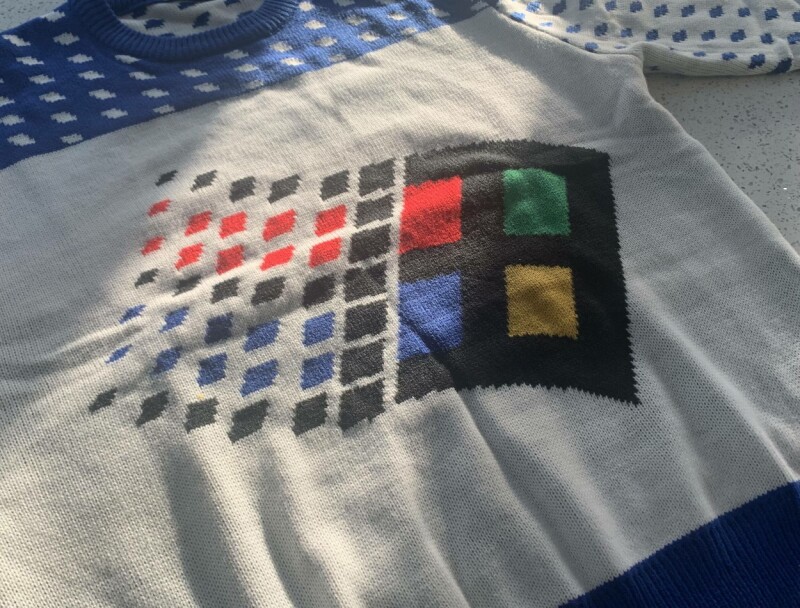
The paper shows someone interacting with computing devices using the sleeve of a wool sweater (no jokes about the Windows ugly sweater please, this is serious). The researchers, led by Singapore National University research engineer Fu Heng, claim this is a big leap forward.
REG AD
“This fiber-centric approach shifts wearable electronics from flexible panels toward truly textile-native architectures, laying the groundwork for fabrics that visualize, sense, communicate and compute as naturally as the garments they inhabit,” the paper says.
REG AD
The researchers claim to have developed a scalable process to make millimeter-thick fibers. Using lasers to strip the insulation from specific spots on the thin copper wires, they attached light-emitting chips to the exposed sections, creating electrical connections to the chips. Thousands of chips were connected to the wires with extreme precision using this process.
The fibers were then fed into a transparent plastic tube, and made pressure-sensitive by adding two strips of a compressible, conductive polymer into a second longitudinal channel in the tube.
The paper says they could make fibers 10 meters long using this method, and that they are thin and flexible enough to be woven into or attached to fabrics. The researchers were also able to add "peripherals" such as a microphone, a speaker, a temperature sensor and a light sensor.
The researchers reckon they could build into the sleeve of a sweater an interactive interface with audio-video playback, wireless data exchange, computing, and dynamic graphics. The fabric can survive 50 gentle machine washes and 1,000 bending cycles without losing its functionality, we're told.
In an accompanying article, Shanshan Yao, assistant professor at the Department of Mechanical Engineering, Stony Brook University, said the main advance lay in building functionality directly into fiber, which were then assembled into a fabric.
“If the fibers prove to be compatible with standard industrial weaving, knitting and embroidery processes, the findings would pave the way to producing multifunctional electronic textiles in almost any shape or size,” she said.

"The work is also a big step towards replacing rigid displays with fully integrated wearable interfaces, moving everyday computing away from flat screens to fabrics that comfortably conform to the human body. The interactive features of the GUI that have been demonstrated so far are relatively simple, comparable to those of early-generation smartphones and tablets," she said.
However, the current prototype relies on separate microcontroller circuits connected to the fibers through cables, and external battery packs to supply power, she pointed out.
REG AD
"Future research should focus on integrating the control electronics more seamlessly to improve wearability, and on integrating flexible, energy-harvesting threads that can generate power from body heat or movement," she added. ®
KioskNews shows a cleaned-up reading view extracted from the publisher’s page — the original always lives on their site, not ours.