iPhone Duo Owners: Your Apps Will Look Better Soon

For some lucky Apple superfans, today is the day they get to unbox their iPhone Duo. (Others may have to wait until January.) But after formally transferring all their software, they’ll discover a troubling truth: Some of their favorite apps look bad, with awkwardly unused space.
Yet the message from CNET phone reviewers over the decades is reassuring. If precedent is anything to go by, updates will be coming to adjust apps to the iPhone Duo’s novel screen ratios, from the squat and wide front screen to the 4:3 inner display. Don’t worry — your apps will get better (and some are already tuned to the device’s dimensions).
That may be little comfort for Duo owners looking forlornly at Android foldables, which have had the better part of a decade on the market for app makers to adjust to the new formats. Despite having a similar passport-sized format to Apple’s foldable, most apps are sized correctly for the Samsung Galaxy Z Fold 8.
But that wasn’t the case with the first Samsung Galaxy Fold, which launched in early 2019, as CNET Editor at Large Andy Lanxon recalls.
“I had exactly the same experience when I used the first Samsung Galaxy Fold on the day it came out, with many apps appearing to be oddly squashed into that larger inner display,” Lanxon said. “Over time, both Android and foldable makers like Samsung and Google developed better software to accommodate foldables, and I’m confident that Apple won’t take long to patch up any shortcomings in this area.”
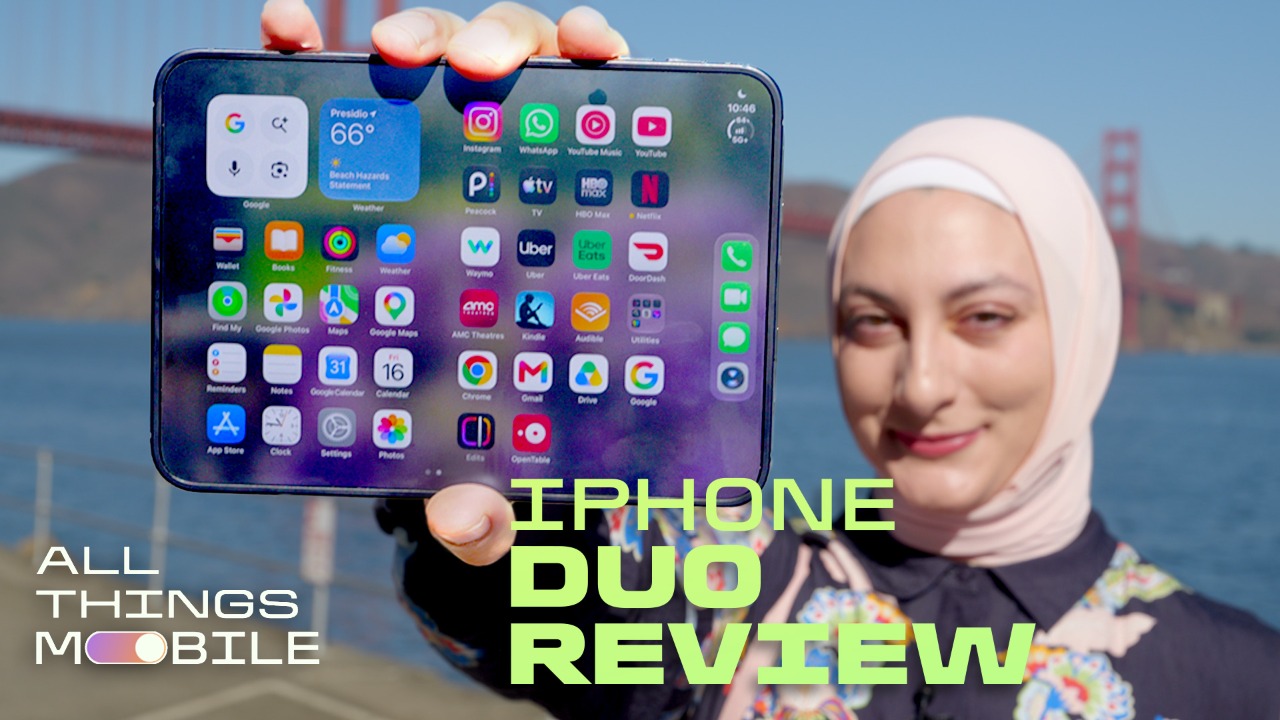
Indeed, it’s easy to forget that as the world’s first mainstream foldable, the original Galaxy Fold launched with plenty of display, hinge and other hardware problems that were ironed out over the years. Apple’s first foldable benefits from that refinement, launching with a minimal crease, a smooth and seemingly durable hinge, internal software suited to a folding screen (with FOMO-inspiring animations), IP68 dust- and water-resistance and other qualities that ease use.
The Duo also benefits from being a single design, as opposed to the various screen sizes and formats across all the Android foldables. The Google Pixel 11 Pro Fold and Galaxy Z Fold 8 Ultra, for instance, both have 6.5-inch outer screens and 8-inch inner screens, but the former is slightly wider yet shorter than the latter.
Read more: New iPhone Duo? Here are 4 Features You Should Check Out Now

But it’s the Duo’s specific design that might also accelerate app adjustment, Lanxon notes: The outer display has the same aspect ratio as the larger inner display, something Apple highlighted during its Sept. 9 presentation launching the device. So developers only need to design one app size for the Duo that will work perfectly well on both displays.
Compare that to Samsung’s Galaxy Z Fold 8 Ultra, which pairs a tall and narrow 21:9 cover screen with an almost square 10:9 inner screen.
That’s somewhat reassuring, but what iPhone Duo owners likely want to know is: When will my apps get updated? To predict that, we look to the past — both the development of other foldables and the radical changes in Apple’s own iPhone line.

The iPhone X, revealed on stage in October 2017, shifted to an all-glass front panel and the notorious notch at the top, requiring apps to adjust.
Apple / Screenshot by Sarah TewRemembering when apps had to adapt to new screens
Given how long smartphones have had all-glass front panels, it’s understandable that it takes time to adapt apps to foldable displays. But it’s easy to forget that app makers had to go through the same process before when phones finally ditched physical buttons below screens for the all-glass front to begin with.
“I remember when the iPhone X came out, and apps that hadn’t been optimized had black bars above and below,” said CNET Editor at Large Scott Stein, who reviewed the device back in 2017. “It meant all apps didn’t initially make the most of the new phone’s size.”
The Duo will have the same growing pains until more apps get optimized, Stein added — it takes time, and it’s part of what it means to be a hardware early adopter.

The original Samsung Galaxy Fold, launched in Feb. 2019.
Sarah Tew/CNETIt’s important to remember how complex it is to make software for a foldable, as explained by Jessica Dolcourt, CNET Group and CNET Labs vice president of content operations and commerce. When you open and close a foldable device, you’re asking your app to perform acrobatics, instantly leaping between internal and external displays while simultaneously expanding or contracting the view window and rearranging all the pixels.
Dolcourt spent over a decade reviewing phones for CNET, including the original Samsung Galaxy Fold in 2019, where she got her first taste of apps rendering badly.
“Native apps could be slow to load, but brought the vision of a foldable future to life. Third-party apps — which were most of them — struggled to catch up quickly and smoothly to the demands of a folding screen,” Dolcourt said. “At the outset, some were barely usable.”
Nowadays, most apps are designed for Android foldables, in part thanks to years of Google software updates specifically addressing flexible displays. The Duo will have to play catch-up.
But as Lanxon pointed out, Apple has deep relationships with developers of its apps, which sometimes launch on iOS first before heading to the Google Play Store. Apple will surely be working closely with its software partners to ensure they’re using the Duo’s proportions to the best advantage, Lanxon said.
When your apps, like Instagram, will be updated to fit the Duo’s screens is hard to gauge (especially given it took 15 years to get an iPad-native Instagram app), but developers have many more advantages than they did when adapting to the first Android foldables’ displays. Over time — and hopefully soon — the Duo will be even better to use as apps catch up with it.

Managing Editor, Mobile
David Lumb is a managing editor for the mobile team, covering mobile and gaming spaces. Before CNET, he covered tech, gaming, and culture for TechRadar, Engadget, Popular Mechanics, NBC Asian America, Increment, Fast Company and others. As a true Californian, he lives for coffee, beaches and burritos. See full bio
KioskNews shows a cleaned-up reading view extracted from the publisher’s page — the original always lives on their site, not ours.