For Akali Dal, ‘reunion’ with BJP is less about politics, more about survival
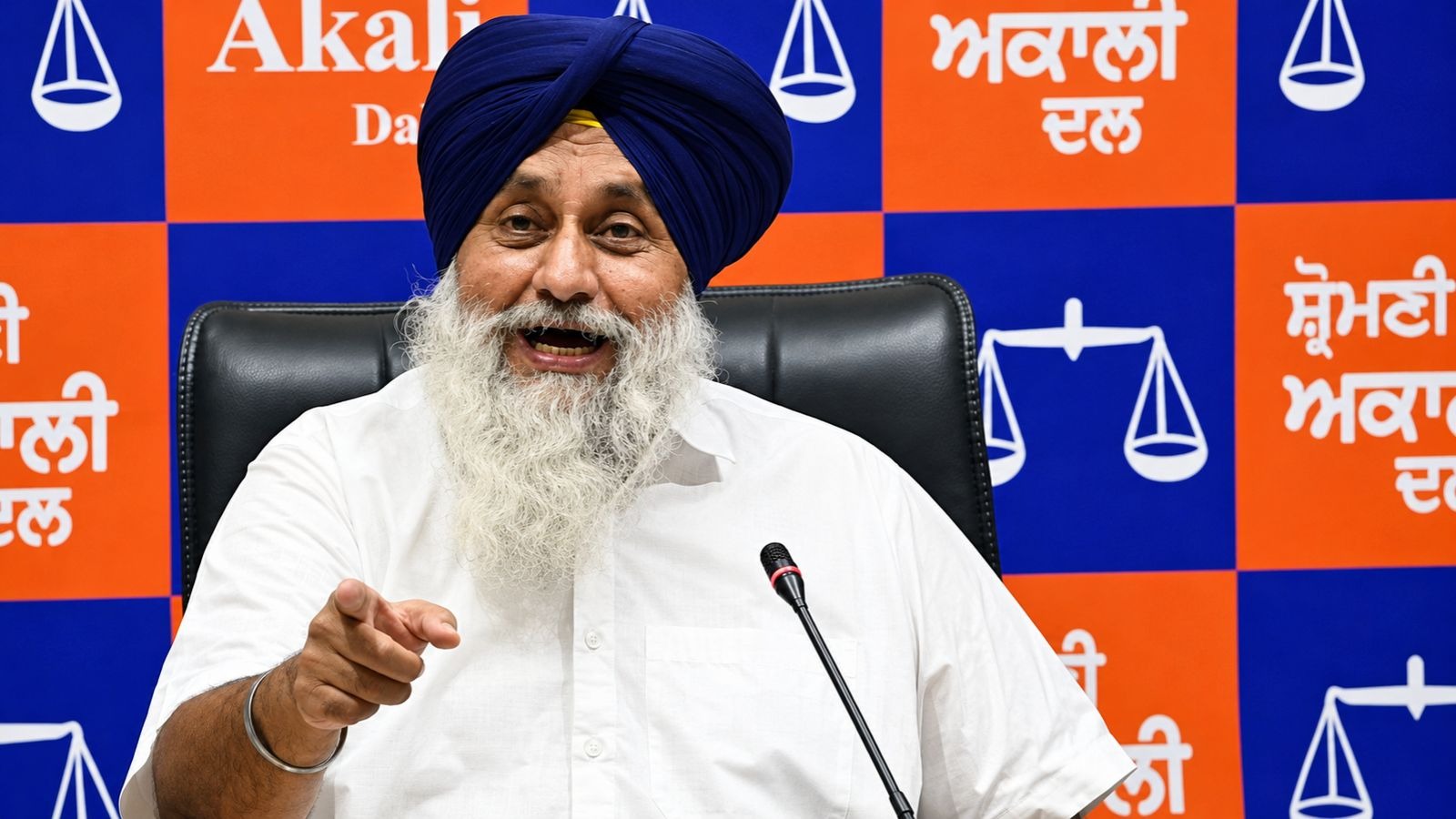
For the Shiromani Akali Dal (SAD), the question of a reunion with the BJP is no longer merely about political realignment. Ahead of the 2027 Punjab Assembly elections, it could be about survival.
The Akali leadership insists that any alliance decision rests with party president Sukhbir Singh Badal. Yet, over the past three months, senior party leaders have repeatedly spoken favourably about a tie-up, even as Union Home Minister Amit Shah has twice referred to forming an NDA government in Punjab in 2027. BJP national president Nitin Nabin too had said earlier this year that the party was not against the possibility of alliances.
The signals and the remarks make for a curious study as they have largely come from the BJP’s national leadership and the SAD, rather than the BJP’s Punjab unit. The latter continues to say it is preparing to contest all 117 seats.
The speculation began after Sukhbir’s August 7 meeting with Prime Minister Narendra Modi. Soon after, the SAD supported the Women’s Reservation Bill and the Centre’s proposed 50 per cent increase in Assembly seats — a significant shift given the party’s earlier opposition to the reservation measure.
On August 20, Bathinda MP Harsimrat Kaur Badal spoke of the possibility of an alliance. “Though I am not supposed to say this…You will come to know. May such alliances happen, as earlier your development works used to happen from Delhi. May once again such a foundation of development and progress be laid in Punjab, so that Punjab benefits from it,” Harsimrat said while addressing a gathering in memory of Sant Harchand Singh Longowal in Sangrur.
Her brother and party leader Bikram Singh Majithia, the following day, said people wanted the SAD and BJP to reunite. Veteran leader Sikander Singh Maluka also described such an alliance as the “voice of the masses”.
Harsimrat later clarified that her remarks had been misinterpreted. But the speculation had acquired a momentum of its own.
Why the SAD has more to lose by staying alone
The electoral arithmetic explains the renewed interest.
The SAD-BJP alliance together polled 37.08 per cent in the 2019 Lok Sabha elections and won four seats. After their split, the BJP’s vote share rose from 9.63 per cent in 2019 to 18.56 per cent in 2024, while the SAD’s fell sharply from 27.45 per cent to 13.42 per cent.
Even separately, their combined 31.98 per cent vote share in 2024 was higher than that of the Congress (26.30 per cent) and AAP (26.02 per cent). Yet the BJP won no Lok Sabha seat and the SAD just one.
The Assembly numbers are equally telling. In 2017, when they were allies, the SAD won 15 seats and the BJP three. In 2022, after the split, the SAD was reduced to three seats and the BJP won two.
For the SAD, the decline has been particularly severe. It now has just one MLA and one Lok Sabha MP. Of its three MLAs elected in 2022, one jumped ship to AAP and another moved to Akali Dal Waris Punjab De. In the 2024 Lok Sabha election, SAD candidates lost their security deposits in 10 of the 13 constituencies they contested.
The party is also facing competition from breakaway Akali formations, including SAD (Punar Surjit) led by former Akal Takht Jathedar Giani Harpreet Singh and Akali Dal Waris Punjab De of Khadoor Sahib MP Amritpal Singh, besides independent leaders associated with the latter. For a party attempting to reclaim its traditional political space, every additional division matters.
The BJP, too, has reasons to look back
The alliance, however, would not be a one-sided rescue operation. The BJP’s vote share has grown substantially in Punjab since the split, but its organisational strength has not translated into Assembly or Lok Sabha seats on the scale of its vote. In 2024, it polled 18.56 per cent but won none of Punjab’s 13 Lok Sabha seats.
The old alliance offered the BJP a tested rural network and a partner with a deep organisational presence in Sikh and agrarian constituencies. For the SAD, the BJP brought urban votes and access to a wider national alliance.
That old complementarity is precisely what makes a reunion electorally tempting — even if politically complicated.
But the baggage remains
Any rapprochement would come with considerable costs for the SAD. Its opponents, particularly AAP and Congress, are already portraying the party as eager to return to the BJP fold.
Chief Minister Bhagwant Mann repeatedly invokes the farmers’ agitation against the Centre’s farm laws, including the deaths of more than 750 farmers during the year-long protest, while also attacking the SAD over the sacrilege and drugs issues.
The SAD would therefore have to explain to its traditional support base why a party it once broke with over the farm laws is again an acceptable partner. That is perhaps why Sukhbir has avoided explicitly confirming any talks. On November 2, responding to Shah’s reference to an NDA government, Sukhbir said he was “not an astrologer” and asked people to wait a few days. He has, however, repeatedly said the SAD is open to alliances with parties other than the Congress and AAP, provided they accept its ideology.
The BJP’s Punjab leadership remains publicly non-committal. Its state president Kewal Singh Dhillon recently reiterated that the party was preparing for all 117 seats, even saying: “In Punjab, NDA means BJP only.”
But Shah’s repeated references to an NDA government have kept the door ajar.
For the SAD, the calculation is increasingly stark: contesting alone may preserve its political independence, but another election with a fragmented Akali vote could further erode the party’s already diminished base. A BJP alliance would carry political baggage. Yet, with 2027 approaching, the larger question for the SAD may be whether it can afford not to take that risk.
KioskNews shows a cleaned-up reading view extracted from the publisher’s page — the original always lives on their site, not ours.