Harrowing Israeli documentary pipped by Danish war drama at Venice Film Festival awards
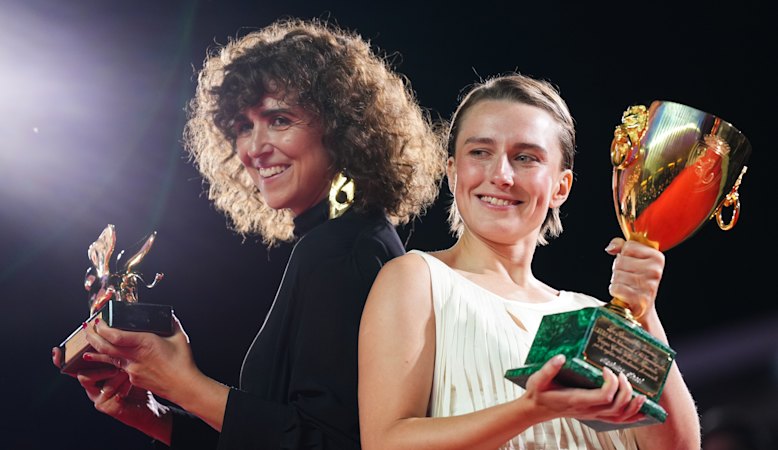
There was widespread surprise when NAZA, an Israeli documentary that had a record-breaking 25-minute standing ovation at the 83rd Venice Film Festival, won the special jury prize at the awards ceremony on Saturday.
That early award meant Israeli filmmakers Yuval Abraham and Rachel Szor’s harrowing documentary, which features testimony from 24 Israeli military insiders whose insights into the war in Gaza include what they say is the systemic killing of Palestinian civilians, could not win the Golden Lion later in the ceremony.
Three days earlier, NAZA had left many viewers winded and speechless. For this viewer, it made everything else at the festival pale into unimportance.
Shot on the rooftops of Tel Aviv at night in extreme secrecy over three years by two of the filmmakers behind the Oscar-winning No Other Land, the documentary is named after the acronym used for non-combatants killed when the Israeli army targets suspected Hamas operatives.
Wreathed in shadows, soldiers tell how the blanket hacking of phones means they know where everyone is and what they’re saying. Linked numbers create suspects who may be taken out with family groups or as entire streets of houses, the exact number of expected dead already noted.
One soldier remembers pushing the button while listening to a baby crying in the target house; another remembers wondering, on a school trip to Auschwitz, how the Germans could have done such terrible things. “I still think the Nazis were evil,” he says, pondering what that now made him.
“It’s honestly not very easy to stand here, thinking of all the people, the Israeli politicians, the journalists back home who are attacking this film, denying it without even seeing it,” Abraham said after winning the award. “It is really, really especially important to us that Israelis watch this film.”
If NAZA had not been in the mix, the Golden Lion winner, Danish director May el-Toukhy’s A Woman Unknown, would have been beyond dispute. Set in Denmark immediately after World War II, it begins as a live-in nanny, played by Mathilde Arcel, prepares to marry her older employer. But a secret past relationship with a German soldier threatens to upend her reputation.
Austere, tight with tension and rich with social history, A Woman Unknown was considered a safe bet for a jury led by actor-director Maggie Gyllenhaal, whose own films The Lost Daughter and The Bride revolve around disruptive women.
El-Toukhy, who was the only woman to have solely directed a film in the main competition this year, became just the eighth woman to win the festival’s top prize.
“To me personally, Woman Unknown is about the female body as a battleground,” she said. “At the same time the film tells the tale of women who are unseen, invisible and voiceless.”
Arcel was a popular winner of the Volpi Cup for best actress. “This is my first lead role in a movie and my first time at a film festival,” she said. “I’m extremely honoured.”
John Malkovich won best actor for his performance in Martin McDonagh’s dark CIA comedy Wild Horse Nine. “I am humbled to be chosen for this award which has been given to so many wonderful actors,” he said in a video message, explaining that he was shooting in Montreal.
Korean slow cinema doyen Lee Chang-dong’s Possible Love, on the relationship between a working-class woman whose husband has lost his job and a rich film-maker documenting dismissed workers’ lives, won the Silver Lion, the festival’s second-biggest honour.
Thoughtful and punctuated by small but sharp plot twists, Lee’s unpacking of Korea’s high-voltage economic miracle – and its winners and losers – was a critical favourite.
“We are living in an era where the meaning of labour is fading and human connections are increasingly becoming severed,” Lee said through a translator. “I made this film to ask what cinema can and should do in times like these. I take this award as a sign that you want me to keep asking these questions.”
Stephane Brize’s A Good Little Soldier, an angry French film about a human resources manager (Alba Rohrwacher) trying to paper over systematic bullying within a company, won best screenplay.
The Silver Lion for directing went to Russian-born Ilya Khrzhanovsky for DAU, an epic three-hour-plus film which has been described as loose biopic of the Soviet Nobel Prize-winning physicist Lev Landau. Taking more than 20 years to make, it took two years to film with actors living around the clock as their characters in a purpose-built complex that included laboratories, kitchens and a newspaper office.
The prize for the best new young actor went to the unknown Malou Khebizi from French director Cedric Khan’s A Place to Heal, about a juvenile care hostel for troubled young people.
With AP

KioskNews shows a cleaned-up reading view extracted from the publisher’s page — the original always lives on their site, not ours.