Israel/Today: Israel’s elections, Netanyahu’s shadow - Sponsored Content
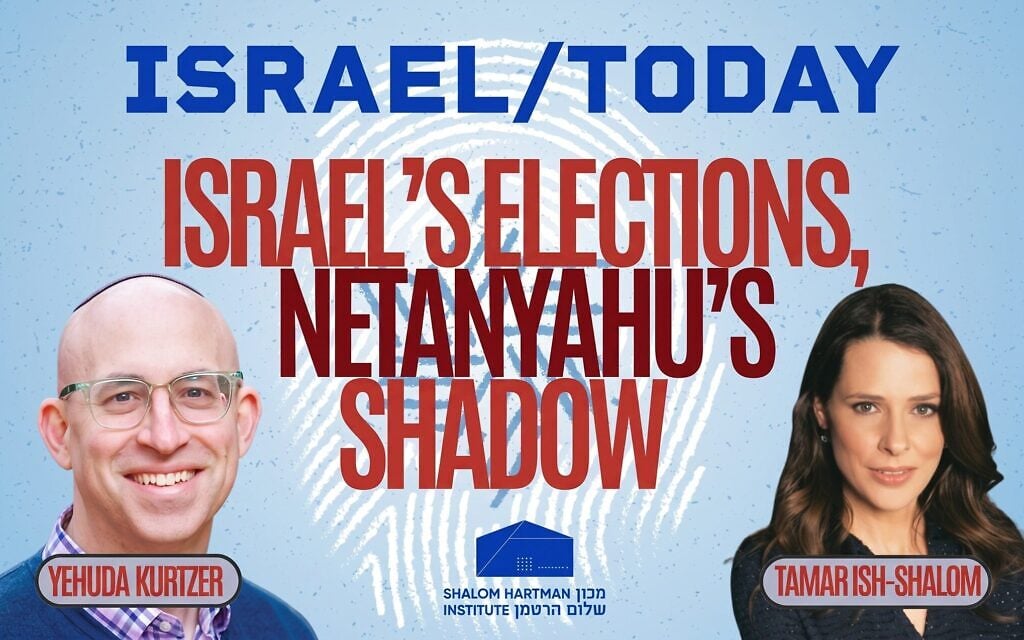
With Israel’s elections just weeks away, what vision for the country’s future will ultimately prevail?
In this episode, the third installment of our Israel/Today mini-series, Yehuda Kurtzer speaks with Israeli journalist Tamar Ish-Shalom. They examine Benjamin Netanyahu’s enduring political strength despite mounting public criticism, Israel’s international isolation, and unresolved questions of accountability following October 7. Together, they explore the forces shaping voter behavior, the growing influence of fear and conspiracy thinking, and the competing visions for Israeli society three years after October 7.
We want your questions and comments for our upcoming listener mailbag episode.
Send voice memos and emails to [email protected].
You can now sponsor an episode of Identity/Crisis. Click HERE to learn more.
A full transcript of this episode is available below.
Listen to this episode wherever you get your podcasts.


Here’s more from the Shalom Hartman Institute this week:
Vote in the Signal Listener’s Choice Awards for our podcast mini-series Thoughts and Prayers by October 15!
Register to learn with Tal Becker and Abigail Pogrebin on October 27 in New York City.
Israel/Today: Israel’s Elections, Netanyahu’s Shadow Transcript
Note: This is a lightly edited transcript of a conversation, please excuse any errors.
Yehuda: Hi, everyone. Welcome to Identity/Crisis, a show from the Shalom Hartman Institute, creating better conversations about the essential issues facing Jewish life. I’m Yehuda Kurtzer. We’re recording on Wednesday, October 7th, 2026.
I want to tell you about something that we’re preparing here on Identity Crisis, a listener mailbag episode, and we really want your questions and comments. These could be questions about past episodes of the nearly three hundred that we’ve done in this catalog, and the issues themselves that we’ve raised, things that you wished I had asked my guests or responded to, ideas you want covered on the show, and any behind-the-scenes questions about what it’s like to make this podcast. You can send your mail or voice memos to our inbox, [email protected]. The deadline to submit questions is October 16th, and I hope to hear from you.
I hope you listened to the first two episodes in our series on Israel Today, two weeks ago with Dahlia Scheindlin, last week with Yossi Klein Halevi, in preparation for the anniversary of October 7th. Today’s our third episode in that series, and as we’re recording on October 7th, it feels impossible not to start there as well.
Of all the shocking things that have happened since October 7th, I think I want to include on the list that we’re now on the precipice, a full three years later, of the first elections in Israel since that fateful day.
October 7th was the worst intelligence failure in Israeli history. It also represented the articulation of the absolute folly of Prime Minister Netanyahu’s signature policy approach towards the containment of the Palestinian cause, which involved him for years dividing Palestinian leadership against itself by upholding Hamas governance in Gaza.
Netanyahu, since October 7th, has successively defeated all efforts to engage in a serious government accountability investigation about the lead-up to that day. He has alienated the entire international community and largely forfeited US support for Israel and continues to preside over corruption and lawlessness in many parts of the country.
And while Israeli governments can collapse instantly with a vote of no-confidence, this government, having completely failed in its core function, which is held together by the duct tape of extremism, nevertheless, that government has endured for three full years and now heads into an election that it very well might win.
It reminds me a little bit of 2004 in the United States, where the mismanagement of the Iraq War just three years after 9/11 had torpedoed support for President Bush, but he won the election anyway.
I find the Netanyahu possible case more shocking. I was talking with colleagues about this recently, and I’ve heard more and more people, Israelis, say with some resign and reluctance that they would be willing to accept some version of a “national unity government,” I put that in quotes, that would involve both Bibi’s Likud party and the other, let’s call them non-racist and non-ultra-Orthodox, and unfortunately non-Arab parties.
It would decidedly be a right-of-center government, but ostensibly it could make some progress on curbing West Bank violence, on army conscription for the ultra-Orthodox, on some common sense religion and state issues, and maybe more. It would be perhaps better than the present. It would change nothing on the status quo with the Palestinians, and I would say it offers very little inspiration for any future on that front.
When I was talking about this with my colleagues, I observed that this is one of the places where they in Israel and I in America live on different planets. They might be able to continue to accommodate a Netanyahu reality in some form or another, but I honestly don’t think that most American Jews could, and that includes a lot of right-of-center American Jews.
I just think a lot of Jews here feel that they—we—have been carrying water for Israel amidst its growing international isolation by insisting that there’s a difference between the state and its government and the people and its government, and in the hope that that leadership will be replaced very soon with a version more compatible with our hopes for Israel. But another Netanyahu-led government would be a lot to take.
And maybe Israelis do care about how their political future is seen by us here, and maybe they don’t. Usually, I experience it as a desire by Israelis for American Jews to really understand them, but a disinterest when they do and just really don’t like what we see.
And maybe Israelis will leave. That seems pretty likely to me. Some put the numbers, if there’s a Netanyahu victory, as between 50— to 100,000 Israelis planning to leave Israel. Maybe that’ll happen. Maybe it’s just a threat. It’s really painful to consider that so many people would feel that they have no plausible future in Israel, that they would decide that the country is too Orthodox, too authoritarian, too morally isolated, too unsafe, too right-wing to be a part of it. It would mean a total reversal of the optimistic project of what Zionism ultimately tried to do for the Jewish people, another notch in the belt of Bibi’s accomplishments.
As you can hear, I’m not shy in expressing my feelings about all of this. Sometimes I try to be circumspect about some matters of Israeli policy, even when I disagree with them. There are a lot of times I’m willing to acknowledge that there’s intelligence and experience I simply don’t have access to in order to turn my feelings into hot takes. I try to be careful, and I try to be nonpartisan.
But I am unapologetically dumbfounded about the Israeli electorate right now, and what seems to me to be a pretty unambiguous choice between two possible futures. There’s the uncertain future that keeps Bibi and all of his failures in power, and an equally uncertain future that tries for new possibilities, albeit ones that are unstained by the blood and scandal of the past several years.
And I’m really selfishly worried for those of us who are trying to hold a flag for Israel from far away, even as we advocate for its improvement, for it to be accountable for its mission, and I wonder whether that will be possible for us here in the diaspora should Bibi once again pull off his superpower trick of political survival under virtually any circumstance.
I’m delighted to be joined today to talk this through by an especially acute observer and commentator on Israeli politics to unpack these elections and what they represent even before they actually take place in a couple of weeks.
My guest today is a new friend Tamar Ish-Shalom, one of Israel’s most prominent journalists and news anchors. For more than a decade, she anchored the primetime edition of Channel 10 News, and later Channel 13, in which she became a leading voice in Israeli media, then went on to anchor the Saturday edition of Channel 13 News, which was more of an in-depth news magazine.
Tamar has been serving for the last few years as a senior fellow at the JPPI, the Jewish People Policy Institute, where she created and hosted the podcast Jewish Crossroads, profound conversations with American Jews about identity, community, and Israel diaspora post-October 7th. Tamar now lives in the States for a couple of years, and for perhaps longer, TBD.
And what I appreciate is that she’s now joining me in watching this from afar as both an insider and outsider, an invested stakeholder. I think she has been learning, and I’m gonna talk about that a lot, by living among American Jews, but also among Israeli Jews in America, and all of the ways in which “dvarim she-roi’m misham lo ro’im mikan,” “that which we see from afar, we can’t see from here.”
So thanks for coming on the show, Tamar. Thanks for being here, and maybe we’ll start there, and we’ll get into the meaty political issues in a moment. Like, what does it feel like to be an Israeli, not just a voter in these elections, and you’re gonna go back and vote, of course, and not just an expert on these whole phenomena, but watching this story unfold from seven thousand miles away, and w- what would feel totally different, and I’m sure you know what would feel different to be watching this unfold if you were still living in Tel Aviv?
Tamar: Yeah. Well, I’m from Bikat Ono. Never lived in T—maybe two years when I was a student, although I’m part of the Israeli media. And yes, I’m used, on election evening, to be in the newsroom, in the studio and broadcasting the news. And seeing these elections unfold from afar is an interesting experience.
I think we’re following the news very, very closely. If there’s one thing that I think is much more vivid when I look at these elections from here and not from back home, that maybe I wouldn’t be so alarmed by if I was still in Israel, is how marginal the discussion in Israel is in these elections about where Israel stands in the world and the deterioration of support in Israel, in Europe, and in the United States, but mainly in the United States, the collapse.
And it’s not that the media is not covering it. It does, and you can see conversation about it on X, but it isn’t resonating. It’s not breaking through into the campaigns and into the heated discussions. And there are good reasons. There’s so many subjects, you know, in this pile towards the elections that Israelis are facing.
But when you see it from here and you understand how crucial it is for the security of Israel, for the military ability of Israel, and I think in the long run, and maybe not so long run, for the mere existence of the state of Israel, the support of the United States, and it starts with the public.
And when you see the numbers, and I think one of the most shocking numbers was, I think it was a Pew poll in 2026 that talked about 57% of young Republicans, and that’s not university students, okay? Right. It’s 18 to 49, and I’m happy to be still considered a young person, but that’s most of the working force of America and the Republican Party. They see Israel in an unfavorable way. And politicians tend to listen to their constituencies.
So I think it, it’s so crucial for the next administration, whether it’s Democratic or Republican, it’s gonna affect each and every one of us Israelis in Israel, and I don’t think that’s in focus. And I understand why, but it disturbs me, ’cause it should.
Yehuda: Let’s unpack it a little bit. I mean, maybe it’s denial. I think maybe it’s a little bit of it. My primary working theory is that Israelis have been so caught up with the perception that everybody in the world misunderstands their plight, and therefore is morally backwards. So anyone who—
Tamar: Doesn’t agree with us, basically.
Yehuda: Everyone who doesn’t agree with us is not just wrong, but immoral, and therefore, I don’t have to be afflicted by the fact that now they don’t agree with us because they’re obviously on the wrong side of history. But that’s a very unstrategic way to think about what it means to build allies.
What else fills out the story for why you think Israelis seem so incredibly oblivious or disinterested in the fact of Israel’s declining standing, uh, in the West?
Tamar: It starts with very basic stuff, okay? That aren’t complicated, and that is that we have a lot to unpack in these elections, okay? It seems maybe from the outside it’s all about October 7th.
It isn’t. It’s about October 7th and the responsibility. Of course it is. But it’s about, uh, whether Ultra-Orthodox will be enlisted to the army, and it’s about the whole relationship between Ultra-Orthodox and the state, and it is about the judicial system and its independence. These are the first elections since October 7th, but they are the first one as well since the judicial overhaul, and it’s connected.
So there’s so many things in these elections that are crucial, and then when you have this other aspect that is far away, it’s geographically far away, and I think that historically, like in Israel, foreign news is foreign news. You know, it comes at the end of the news broadcast, not at the beginning of it.
So I don’t think we comprehend how much we depend, but if we face the more hard question that you’re asking here, I think that many times as Israelis, we say, “Okay, we know what’s happening, but it has to do with anti-Semitism, anti-Zionism, double standards, hypocrisy.”
And it’s all true, Yehuda. I, I believe in all, and we can talk an hour about that, about how raged sometimes I feel when I read The New York Times. As an Israeli journalist that grew up, like, looking up to this, you know, media outlet and others—the New York Times, as, you know, a symbol.
Yehuda: In particular, yeah.
Tamar: But at the same time, that’s part of the answer. But we have agency, and I think what sometimes we forget is our agency. Zionism was always about agency. Yes, the world is complicated, but you know, Herzl went and, and tried to, to meet with the Pope, and with a, with a Caesar, with a Caesar, and everything because he believed that we need the world. So sometimes we forget about our agency and about our responsibility.
What brought us to this place? It was all of the things above that I mentioned, but it had to do with the way that Israel, this government, conducted its ways during the past three years
Yehuda: You know, it’s so interesting, and we could go deep on this. I don’t think we’ll do it today. But I remember when Netanyahu came and lectured Obama in the Oval Office, and then went behind his back to speak in Congress against Obama’s signature foreign policy piece, which Netanyahu and many Israelis interpreted as, you know, this constant word existential threat, and they saw as a great betrayal.
And as a result, it was like, “We’re gonna throw out the playbook of how we engage with the American government, with the American presidency.” And nobody was willing, in Israel at the time, to look at that and be like, “Can we think about 10 years ahead?” ‘Cause the state of affairs then in the Democratic Party about Israel was vastly better than the story that you have today, and Netanyahu really laid the seeds then for, “We don’t care about your internal politics or even how we’re seen in our internal politics ’cause ultimately we’re gonna win this issue, and ultimately we only care about itself.”
I could not understand the shortsighted nature of what that meant, and I still feel it echoing today. It just feels so unbelievably shortsighted.
Tamar: I, I will just mention that when you say no one—I think no one in his camp. But it was heavily criticized in Israel, in the Israeli discourse, in the Israeli media, and obviously in the opposition, but, you know, he had the call.
I think that what he saw in those days, and he was sure that he understands America, right? Who knows America like, like Netanyahu? Until last few years when we’re seeing the huge shifts in American society, that was the assumption, that Netanyahu understands American politics best and the American society.
And his approach was that the Democrats, we lost them. He saw the future. And with the Republicans, it’s gonna be okay, so we need to put, you know, all the eggs in the basket. I think what he didn’t see and didn’t understand until recently, and you saw that when he went to a few podcasts of right-wingers in, in the past year or two. And it seemed, at least, as a viewer, that he was surprised by how, you know, how they pushed back. He didn’t understand that there are shifts that are going to affect the Republican Party as well, and the right wing as well, and that you can’t do that.
Yehuda: Yeah. I mean, in general also, you can’t continue to lead a country with the same exact set of policies over a 10 to 15-year period while the whole globe is changing ideologically and politically. Then you’re subject to the fact that if everyone else changes and you’ve stayed the same, the circumstances are gonna change.
So maybe you could help me understand, and I’m not trying to be naive about this, I actually just wanna learn about it, what is driving the continued loyalty of, let’s say, 30 to 40% of Israelis maybe higher, to Netanyahu? I use that number because it’s not just who votes for him, but who votes for parties that are gonna result in coalitions in which he’s going to lead.
You know, you mentioned the judicial reform. It kind of felt like if there had been an election in September of 2023, that 60% of Israelis opposed the judicial reform, Bibi might have been swept out of power then. It certainly felt, you know, right after October 7th, like, what an unbelievable failure of intelligence.
There’s so many places along the way of the last couple of years where it seemed untenable that Bibi would continue in his leadership, and yet we find ourself at a place today where, according to the latest polls, you know, even if the opposition wins, it’s gonna have a hard time building a coalition. What is that magnetic attachment that so many in the Israeli electorate seem to continue to have with Bibi?
Tamar: First of all, I think we should acknowledge that Israeli society, prior and after October 7th, is deeply, deeply politically divided.
Yehuda: Tribalism.
Tamar: And there is this sense of shivtyut, tribalism, and it’s very hard for people to even think about electing someone from the other tribe, okay? So there’s tribalism and, and it’s on both sides. And I think that he has a very, very strong base, okay? I think that since the beginning of the judicial overhaul, unless, you know, when Channel 14, which is aligned with him, I didn’t see a poll that he wins, that he has 61 mandates. So he’s losing. But the other side needs to win in order to form a coalition because if not, we have another round of elections, and he’s still prime minister.
But if we dive more deeply, first of all, um, Netanyahu is a very, very gifted politician. I really think he’s one of the most gifted politicians in the West. He does it by a lot of fear, fear-mongering, yes, by polarization, yes. But he wins campaigns. And for, if it… And, and you see the same line. If it was 1996, it was, “Peres will divide Jerusalem,” right? “He will give the Holy City to the Arabs.” And if it was in 2015, it was, “It’s either us or them,” right? Polarizing. It’s either us or the left.
And if it’s now, you can sum up it in four words in Hebrew. As always, in English, it’s, it’s longer. I think it’s six. It’s “Eisenkot yelech im ha’aravim.” “Eisenkot will go with the Arabs.” He will cooperate with Arab parties. And I think that he’s very good in detecting fault lines in Israeli society.
I think one interesting thing to mention is Arthur Finkelstein, a long-lasting political advisor to Netanyahu, that in the ’90s had a thumb rule that I think was quite accurate about Israeli society, at least in the past, and that is, “If you want to know if someone is with us or not, you need to ask him one question: “What are you, Jewish or Israeli? If he says Jewish—high chances that he’s with us, he’s right wing. If he says Israeli, left wing.”
But he and Netanyahu weren’t, like, political scientists in the university observing Israeli society. They worked on that fault line. And since they’re—
Yehuda: They, they cultivated it, in other words.
Tamar: Yeah, they cultivated it, they deepened it, and there are Israelis who are very fearful from cooperation with Arab parties today, and they believe that still he is the person who is most capable of handling the security issues of Israel. And, and we should say that, okay? They believe that when we face so many fronts with Hezbollah, and with Hamas, and with Syria, and with Iran, he’s the most experienced and he’s most capable.
And every—I, I see that you’re smiling, but, you know, every victory, and they see, like, Iran, the strike on Iran and Khamenei as a victory, and the beeper w- um, operation with Hezbollah as a victory, they credit him. If there’s a problem, if there’s a failure, if there’s October 7th, they don’t see it as his responsibility, ultimately, or everyone failed. And if it wasn’t Netanyahu, it would be even worse. Yes, you know, we know October 7th was bad, but it would have been worse if not for Netanyahu.
Yehuda: Human psychology is amazing, right? It’s extraordinary. And I’ve learned over the years to not mock the electorate for why they have those deep biases, and it’s—you really can’t mock an electorate, especially when it is operating out of such genuine existential fear and trauma. It’s just, again, from 7,000 miles away, it’s like, “Whoa.” Why do you assume it would be worse? Why can’t you create the possibility that there’s some alternative that would be better?
I think the piece that’s particularly unusual about what’s going on in Israel is that when you were able to tell the story very clearly of the right versus the left in Israel, Israel’s a right-wing country. Actually has been for a long time. More than I think we think.
Tamar: Prior to October 7th.
Yehuda: Prior to October 7th.
Tamar: I, I think that really the fault line was after 2001, 2002, the Second Intifada.
Yehuda: Yes, for sure. And it was even, the seeds were there even beforehand, right, around the assassination of Rabin and even before that.
I oftentimes speak to American audiences of, like, you can’t impose your categories of how you think about right versus left. You have to start from the assumption that it’s a politically different country, and figure out whether you wanna be in relationship with that. What’s interesting about the current state is that, quote-unquote, “The opposition to Bibi is not left wing.” That’s what’s kind of hard to understand. Like, Bennett is right wing. Eisenkot is right wing.
Tamar: Is center. Center. Yeah. But, but his, but, but the whole team is, like, center right.
Yehuda: Yeah. And but the whole index is, the whole thing has moved to the right.
Tamar: And Lieberman, of course, is, is right wing.
Yehuda: Right. So even center in Israel is more right wing than it is in America. So that’s been what’s interesting, is that the counter right-wing voices have not been able to marshal the credibility to say to the electorate, “We basically share your values, but this guy sucks. Like, replace that with this.”
And where do you think that failure comes from among the other right-wing voices in Israel, that, A, Bibi has been so successful in making them into left-wingers, which they’re not, and B, that they haven’t been able to say, “We will continue to abide by the worldview that you hold, but we can actually govern, lead, and win wars just as effectively, if not more so?
Tamar Ish-Shalom: Well, first of all, I think that in many times in Israeli politics, Netanyahu sets the rules, okay? So, and he’s good at it. As I said, he’s a gifted politician. So if he says, “This is the right and all the others are left,” so all the others are lefties. And yes, Bennett is right, but the feeling of people who are supportive of this coalition, and they are right to think that he didn’t keep his promise.
He promised not to go with the Arab parties, and he did. So they will never vote for him, these people. So first you have, like, Netanyahu setting the rules and the picture, and then you have people who won’t vote for Bennett, and I think others might say, and I’m not an expert, okay, so you’re trying to understand exactly what comes behind voting for Netanyahu this time.
But I think that part of it is they’ll say, “Okay, yes, you’re right-wing. You’re very, very welcome to join our coalition of the right wing, and we would be happy to have maybe Lieberman and Bennett as part of our government, maybe instead of Ben-Gvir. You know, not the extreme right within this coalition.
But we do not want you to be, to rely on the Arab parties, which you need to.” And after they finished, you know, talking about the Arab parties in the past few months, it’s moved on to the Democrats and Yair Golan, and to try and disqualify, you know, the historical Avodah and Meretz parties. Okay?
Yehuda: Guilt by association. Yeah.
Tamar: So they would say, “Yes, you are legitimate, but you can’t lead. Netanyahu can lead, and you can be part of our camp.” That’s a natural. You were a, a natural part in the, in the past, Lieberman and Bennett
Yehuda: Are you at all more optimistic than I portrayed about the possibility of that national unity government, it should have come to pass, led by Bibi? He’s never gonna let anybody alternate with him, but are you at all optimistic that it actually could do things that would change the status quo in Israel on any particular front?
Tamar: I’m not sure it would change the status quo in Israel. To change the status quo—
Yehuda: Or even make progress—
Tamar: You would, you would need Netanyahu on a whole bunch of things. to, you know, really break his alliance, long-lasting alliance with the ultra-Orthodox parties. And I’m not sure he—
Yehuda: You’re, you’re skeptical even on the military conscription front.
Tamar: —he would do that. And certainly not on, you know, Middle East politics.
Yehuda: No.
Tamar: I do think that when you said that you hear Israelis that are more open to the idea, they are comparing that to the current government, which is the most extreme right-wing government in the history of Israel, with Smotrich and with Ben-Gvir.
So I think, you know, what you’re hearing may be from people who want the Eisenkot camp to win, but they are saying, “If it’s that or another round in which Netanyahu might win again, we would prefer that.”
Yehuda: I guess it’s frustrating to me because then what you’re saying is the only thing that changes is basically symbolic.
Like if you said the removal of Smotrich, Ben-Gvir, and the Haredim, the ultra-Orthodox, would actually lead to significant policy changes on issues where it’s plausible to be right-winged on those issues, but not to be an extremist, I would say, “Okay, so that’s a partial victory.” Right? Dayenu, as we say. It’s not the whole thing, but I got something.
But if it’s like, “No, I just wanna get Ben-Gvir and Smotrich out, but I’m actually not gonna do much in terms of changing the political status quo, the treatment of Palestinians inside the green line, the treatment of Palestinians in the West Bank,” whatever it is—
Tamar: But I’m not sure that is true. Because, yes, I don’t think the big question of status quo would change in such a government, and I’m not putting in, like, my view, if I’m pro or anti. And I, I’m just trying to analyze the situation. I think, you know, if there would be a minister of the police that would do his job, and we’re facing a catastrophic reality in Arab cities and towns of skyrocketing number of murders and crime, and we saw a change w- during the Bennett and the Lapid government, mainly Yoav Segalovitz, that we might talk about him later, that was the, the deputy minister, had a start. It was only a year of real success in tackling those issues.
And the police today, in that sense, but in many other senses, isn’t functioning. It’s a total collapse, and that’s a danger for democracy. If, if a police is totally politicized by Itamar Ben-Gvir as a minister and not doing a job, it always goes together, right? How professional you are or how politicized you are. That’s quite a big dayenu. I mean, that’s an important aspect of the future of Israel, and of Israel’s democracy as well.
And again, I think that, yes, a different government would treat settler violence or could, I’m not saying it would, could treat it very, very differently than what the current government is doing. So there are big issues and important issues that we might see change if we would see a unity government.
Yehuda: Yeah. Yeah, and I guess as a person who believes in incremental change and the importance of, like, quality governance, these are objectively good things. It’s still just hard for me to separate out what it means symbolically in the long term.
So let’s talk a little bit about the Arab parties, because even while, as you said, there continues to be a profoundly deep bias among the Israeli Jewish electorate about being in a government together with the Arabs, and I actually don’t think we have to work that hard to figure out why that is.
You know, in parallel, you have a story unfolding over the last five years in which Palestinian citizens of Israel are not the people who many Israeli Jews think they are anymore, right? We know from surveys that post-October 7th, Palestinian citizens of Israel felt a greater sense of attachment to Israel and loyalty to Israel. They did not emerge into the streets as pro-Hamas. We know that Mansour Abbas is actually a right-wing politician on many fronts.
Tamar: A conservative religious figure.
Yehuda: He’s a conservative religious figure. He is not trying to, like, change the status quo on a whole lot. We’ve seen an Israeli, prominent Israeli centrist join in with an Arab party to try to break that taboo, but it does not seem breakable.
So you have, like, a weird thing where it’s like, it feels like the Israeli Jewish electorate is still telling a story about Arab parties that is a threshold issue, which doesn’t seem to correlate with where Israeli Palestinian Arabs are actually going. So how do you understand the flow of these events over the last couple of years?
Tamar: I don’t know if I understand them. But I think it’s really interesting to observe. That on the one hand, you’ve seen Netanyahu, that his whole campaign is about a warning against cooperation of Jews and Arabs in Israeli politics, to sum that up.
And at the same time, you see interesting cooperations both on the right and on the left. You started with Yoav Segalovich, and as I said, he was the deputy minister of Yesh Atid. And he left Yesh Atid and joined Mansour Abbas and Ra’am. It’s the first time that there would be a Jewish member in an Islamic religious party, which is Ra’am.
I think it signals us that Mansour Abbas wants to signal to the opposition right now how much he is still a candidate to be part of the next coalition. And what’s interesting is that he thinks that Segalovich can bring him votes from the Arab community because the voters of Ra’am are almost all Arab Israelis, because they are so invested in the issue of security, of internal security. So that is a very interesting cooperation, and Segalovich says in interviews he sees this as a mission of breaking this taboo.
And on the other hand, on the other side of the aisle, there is the new party of Ofer Winter, which is, you know, harsh right-wing, small party. We don’t know yet if it will, will pass the electoral threshold or not. And number two in his list is Youssef Hadad, which is a Christian Arab who served in the IDF and, um, became a very known figure on social media, and like a Hasbara figure on the right, and he’s number two in the list.
Now, we saw Arab Israelis, both I think in, in the Likud and the Avoda, in Meretz, but they were always, you know, the back seats, okay? Number 10, number 15, number 20. Now he’s the face of the party, which isn’t obvious, you know, on a right-wing party.
So it’s, it’s interesting to see it on both sides of the aisle, and at the same time, the campaign of Netanyahu, and he has a reason to go on this campaign, ’cause he know it, it resonates with Jewish voters.
Yehuda: Do you think this was a missed opportunity post-October 7th?
Tamar: Yes, I do. I, I say this from talking with friends and colleagues and acquaintances who are Arab Israelis and their reactions after October 7th, and from the polls, ’cause that could be anecdotal, right? But the polls showed, it was the IDI that conducted them, that in the aftermath of October 7th, I’m talking about November and December, 70% of Arab Israelis said that they feel part of Israel and of its problems. That was the highest number ever since the IDI started with these polls.
Now, it was a, a strike. I mean, you, you saw it, it went down afterwards. But still today, like, the last poll was 2025, it’s higher than it was before October 7th, okay? So it was 48 in 2022, and in 2025 it was, I think, 56. 54 or 56. And I think that you can understand that, that Arab Israelis, as Jewish Israelis, saw the level of barbarity and violence, and they were appalled by it.
And they paid a price as well. There were Arab Israelis that were slaughtered on October 7th. There were, I think there were six citizens, Arab Israelis, that were kidnapped. There were four family members, the Ziadna family, a father in his 50s and three of his kids. He was murdered in captivity, and one of his children, and two of them came back. Hamas terrorists knew that they were Bedouins, that they were Muslim just like them, and they still did it.
And I think there was one even execution video that they, they call one of the victims, like a kalb, like he was like a dog of, of the Jews. So I think they felt we are part now of the same story.
Yehuda: Like it or not. Yeah.
Tamar: Yeah. And I just need to mention, at the same time, were there in more than one or two or three incidents in which we saw Arab Israelis celebrating October 7th on social media? We did, and they were prosecuted. So I’m not, you know, in the name of PC, ignoring that. But when you see the numbers, that isn’t the story.
And at the same time, for really understandably reasons, the Jewish population in Israel became much more fearful and hesitant of any connection with Arab Israelis, and you see a lot of fear. But that is the moment that if you had a different, you know, leadership here that would see it and acknowledge it and just go public and say, “Guys, we all paid a price. We’re part of the same story.” There’s heroism stories about Arab Israelis that saved Jews that day. There could be some change. I don’t know if it would succeed, but it would be noble to try, ’cause I think that there was a moment that was missed.
Yehuda: I mean, there’s a larger conversation to be had about whether Israel also squandered its moment in the international community post-October 7th, but that’s a more controversial topic, which would be to say, could Israel have avoided the trap that Hamas had set for it on October 7th?
Tamar: I’m not sure it could. We could have done much better, okay, if we didn’t have ministers and coalition members that talks in terms of Amalek and of, uh, no innocent people in Gaza, and that we need to wipe them all out. While the IDF and, like, the foreign ministry were trying to say, “This is an existential war. We’re doing what we need, and there is collateral damage, but that’s not the goal.”
But when you have these ministers, you know, obviously they’re hurting the cause. So we didn’t do good on that. But I think when you saw the, you know, the demonstrations on October 8th- Talking about genocide.
Yehuda: In other words, even had Israel exhibited very dramatic restraint that could never really be asked of any country, which is you get invaded and over 1,000 people get slaughtered and hundreds of people taken into captivity, and even so, had Israel exercised restraint, your argument is it kind of didn’t matter anymore for the critics, the most potent critics, international community, who also had, by the way, an incredibly well-funded social media arm and other forms of influence. Like, it’s not even worth trying to fight that or even litigate that question.
Tamar: Yeah, I, I do think that the conspiracy against Israel was, was pre-baked prior to October 7th. And I think that, you know, it was obvious that Israel needs to do what it needs to do and that there will be a war in Gaza, and then we need to try to eliminate Hamas, not that we succeeded yet in that.
So that was obvious, and I do agree here with Dara Horn that, you know, people love dead Jews, but when we have an army and when we have our agency, they’re not willing to see Jews taking responsibility for their lives and fighting. I think that we can only be victims, but when we are the ones that are on the offense and not on the defense, what we actually see as defense, because we were attacked on October 7th, the world cannot really be behind us.
Yehuda: So I think that reads right to me. I would just say the risk of that point of view is then you wind up saying, and not you, but I think there winds up being a kind of piece of the discourse, which is—
Tamar: What does it matter?
Yehuda: Therefore, everything that Israel did in response to October 7th becomes completely okay, right? Because since you were gonna hate me anyway, I then, I don’t care about any moral criticism that is offered by any of you, right? You paint in a broad brush, and it kind of makes you start feeling like, “Well, I’ll just do the opposite of what people are telling me to do.”
So to hold this line of, I feel like the conspiracy theories against Israel and the attacks on Israel are pre-baked pre-October 7th, and there probably was nothing to do to avoid that. And to also say, “And I think Israel could have exhibited much greater restraint in its war,” is a very, very hard line to hold. I’m trying to hold it. I think you are, too, but it’s not surprising that it feels like a losing argument in public.
Tamar: It is. And I think what may be what international discourse doesn’t understand is that once you accuse us, like 100%, you’re actually exempting us. ‘Cause even I sometimes don’t know to understand, is this criticism legitimate, or is it fueled by other ideas?
But what I would say in our conversation and our internal conversation as Jews and in Israel as Israelis, we have our moral standards, and we need to hold and be accountable to those moral standards, and we shouldn’t be tempted by saying, “Okay, the world anyway is convicting us, so we can do whatever we want.”
And, and, and that, I think that really circles back to what we opened with, which is yes, there’s antisemitism and anti-Zionism and double standards, and it’s outraging for us as Israelis. But at the same time, we have agency, and we have responsibility, and that’s part of the picture, too.
Yehuda: So let me introduce one more kind of dimension of the election back into there ’cause we, we kinda got back to this, which is I know you’ve been thinking a lot about the role of conspiracy theories in Israel as fueling part of how Netanyahu stays in power. Can you unpack that a little bit? ‘Cause even the very notion of everybody is against us is its own form of a conspiracy theory. And, like, as it goes—
Tamar: Sometimes conspiracy theories happen to be true.
Yehuda: Well, sometimes they’re based in truth.
Tamar: Based in truth, based in truth, right.
Yehuda: Right, the whole idea of a conspiracy theory is that it takes truth and then it—
Tamar: You know, am levadad yishkon.
Yehuda: Yes, right. I mean, it’s, so, but play that out a little bit, ’cause I think this is a theory that you’re holding around politics that I think is valuable.
Tamar: Yeah. First of all, I think it’s very surprising, ’cause you guys are the ones that are great with conspiracy theories, right?
Yehuda: Who, Americans?
Tamar: I mean, yeah. Who really shot JFK? Yeah. And where are the UFOs?
Yehuda: By the way, I don’t think we landed on the moon, but that’s fine.
Tamar: Oh, okay. We can keep that. Oh, I would… I forgot the moon. And, and, you know, where is the government hiding the UFOs? And Pizzagate. I mean, you have your whole share of political and non-political conspiracy theories.
And we Israelis don’t. There was one after Yitzhak Rabin was assassinated that something about the Shin Bet responsible and not Yigal Amir, but that was very, very marginal, on the really extreme, extreme right.
What you see since October 7th, and started immediately after October 7th, was this main conspiracy theories with all sorts of sub-conspiracy theories. I heard it the first time a few days after when I entered a toy store in our town from the owner, who started to talk about it. I was shocked to hear him speaking about it. And generally—
Yehuda: Well, what’d he say? What was the conspiracy theory?
Tamar: The conspiracy theory says, and this was his exact words as well, “We were betrayed from within,” “begidah mi-bifnim,” okay? There were high-ranking people from within the system, the army and the Shin Bet, that knew that Hamas is going to attack, and they held the information and didn’t pass it on because they wanted to end the political career of Benjamin Netanyahu, ’cause they knew it will affect him.
And, and, you know, you have all sorts of other parts of it. You have a lot of circles who are circulating it. One of them is Yair Netanyahu was retweeting for the past three years those messages. A few weeks ago, you had Sara Netanyahu, the wife of the prime minister, that asked in an interview, and many times conspiracy theories goes with a question mark, “How is it that Yair Golan, today the head of the Democrats, was organized early in that morning, and he had his IDF uniform already ironed and pressed, while Netanyahu didn’t know about the war?”
So it goes to, like, different angles, which I, I should say none, none of course is true. And I think there’s three reasons, ’cause I, I try to understand why is it so widespread among the supporters of Netanyahu. Now, there’s different polls, but it depends how you articulate the question. But it’s between 25 to 50% of the coalition supporters who believe in some kind of conspiracy theory.
So the first answer is that there’s someone who’s gaining politically from this conspiracy theory, so of course they have an interest to promote it or at least not to push back against it. And you have Channel 14 that is promoting conspiracy theories.
The second answer isn’t relevant only to Israel, and that is social media. And social media is a, a great promoter of conspiracy theories.
But I think the most interesting option and answer is a third one, which is the psychological explanation. ‘Cause I try to understand why do people believe to these conspiracy theories. I understand who has an interest to promote them, but why do they believe it?
And, you know, we’re talking on October 7th, and to this day, there are days that I wake up and I say, “I can’t believe it happened. I can’t believe it happened.” I know it happened, but I cannot… It, it’s incomprehendable. It really is incomprehendable for all of us. And we need to, to rethink of who we are, our self-perception as Israelis after October 7th, because it was shattered. We thought we were very powerful. We thought that we are super professional. We thought that, you know, the difference between us and Hamas in terms of what kind of threat they can pose isn’t existential, ’cause we’re so strong. So we need to really change the way you perceive yourself and your country.
But let’s think, Yehuda, that you believe in a conspiracy theory. If you believe in that, the IDF didn’t fail that day, and we are not weak, and we are not non-professional. We were just compromised because of the traitors. So you can, you know, reaffirm and still believe in that way that you perceive Israel and its strength and, and your identity within it, if you believe that there were just traitors.
Yehuda: I think that’s right. And especially the last few weeks, as we hear more and more of this evidence of who told Bibi what was coming, and he flies to Saudi to try to convince the crown prince not to keep this story going, that they had told him pre-October 7th this was coming. We have clips in April now of an Israeli media where people said, “You know, there are warnings coming out about something Hamas is doing.” And he told people, “You’re exaggerating. You’re blowing things out of proportion.”
It is much easier to avoid a sense of having really been let down by our leaders to say, “Well, clearly, you know, there was some other demonic force at work here that exonerates them.
Tamar: Yeah. And not only our leaders. I think us, as Israelis, it’s really hard—
Yehuda: It’s the army.
Tamar: Yeah, that we were… Yeah, ’cause we had a sense as Israelis that, yeah, I choose to live in Israel, and any, at any moment, I could be in a terror attack, in a coffee shop, in a bus, wherever. But in a more broader sense, if something will happen, someone will come to help me. Maybe I’ll pay the price, but someone will come and save me, my kids.
And on October 7th, that didn’t happen. Well, not enough. So, you know, it, it’s even, yeah, broader than that. I will say that the campaign of Eisenkot is focusing quite a lot in the past weeks on October 7th and about the promise to establish a national inquiry committee. I think it’s be interesting to see if it, if it will work for them, ’cause I think that Israelis really have set their minds already. They have a clear view of what happened and who’s responsible. If you support Eisenkot, you have one view of that day. If you support Netanyahu, you have a totally different view of that day, and it’s pretty much set.
So I, I don’t know who they’re, you know, targeting. Maybe it’s that two or three mandates in the middle who will determine maybe the elections, which is like the soft right or the mamlachti right.
Yehuda: Yeah. Last question, you’re living in a, a little bit of an Israeli enclave these couple of years somewhere in New Jersey, and I’d just love, like, one perspective that you’re getting from the experience of being among Israelis here, that kind of broadens the demographic picture of who Israelis are, what they think about politics. What are they watching for in these elections? How invested are they in these particular outcomes?
Just give us a little bit of a window, ’cause I’m sure it must have been super interesting for you to kind of discover these folks and realize that they’re part of this society in, in a strange way.
Tamar: Yeah. First of all, Israelis are very, very connected to Israel- Yeah … even if they live in the US, even if it’s for two, three years, or for 20 years. I mean, their sense of caring and of responsibility for Israel is very, very deep. And specifically in these elections, you see a lot of Israelis buying tickets to go back home to Israel and, and participate in the elections.
I think that in my area, like neighbors and friends, not all of them, but most of them, there’s a majority of families that are sending a representative, either, you know, the mother or the father that are going. And many times, you know, it’s after a summer that they were already there, or it’s before a bar mitzvah, and, you know, it’s, it’s expensive and it’s the middle of a work week. It’s not easy. It’s a schlep. But they’re doing it because there is this feeling that these are very consequential elections.
And what’s interesting is this is not just Tamar being dramatic. The polls say that 81%, this was a recent poll by the JPPI last month, 81% of Israelis think that these elections are either the most important ones in history or especially important. So it crossed sectors. It’s like, obviously, it’s 94% of the left wing, but it’s 79% of the right wing and 66% of Arab Israelis. So Israelis do not agree on anything these days politically, but here we find a rare consensus. We all think that these are very important and dramatic elections.
And I think, you know what? And, and we all want a better future for Israel. We’re just deeply divided on what that means—
Yehuda: What that means.
Tamar: And how to achieve it.
Yehuda: Well, let’s hope that good things happen on the day of the election. Tamar, thanks for being with us today.
KioskNews shows a cleaned-up reading view extracted from the publisher’s page — the original always lives on their site, not ours.