Minister urges educational institutions to expand access to learning
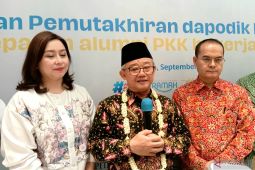
Jakarta (ANTARA) - Minister of Primary and Secondary Education Abdul Mu’ti has called on formal, informal, and non-formal educational institutions to work together to expand opportunities for people to access education and skills training.
He emphasized the importance of building a synergistic education ecosystem, including through the involvement of course and training institutions.
"I call for the need to build a synergistic ecosystem between formal and non-formal educational institutions," Abdul Mu’ti said at the launch of the updated Basic Education Data (Dapodik) system for course institutions to strengthen governance toward integrated data collection, here on Thursday.
He cited course institutions as an example, saying they have important links with vocational high schools (SMKs) and even with non-vocational educational institutions.
"Therefore, we do not need to create a dichotomy between formal, informal, and non-formal education," the minister said.
Abdul Mu’ti said course institutions play an important role in education at SMKs and other educational institutions, particularly in providing skills that people can use to enter the workforce.
He said taking courses or training should not be viewed as an educational option for people with below-average abilities. Instead, the choice is more closely related to people’s opportunities, available time, and access to education.
"Therefore, taking courses and training is not a last resort in education," the minister said.
He gave the example of people who are unable to pursue formal education due to financial constraints.
They can take courses to acquire skills that, in the future, can help them earn an income and provide the means to continue their education through an equivalency program.
Abdul Mu’ti stressed that diplomas issued through equivalency programs have the same status as diplomas from formal education at the equivalent level.
"They acquire skills, and those skills enable them to earn an income. They can then use that income to pursue education. They may not be able to attend formal schools due to time constraints, but they can enroll in equivalency programs," the minister said.
He said equivalency education is also relevant for people whose professional activities prevent them from pursuing formal education on a full-time basis.
One example, he said, is national athletes who must spend most of their time at training centers and participating in various tournaments.
"They cannot attend formal school because most of their time is spent at training centers and participating in various tournaments," the minister said.
Abdul Mu’ti said the education system needs to accommodate these various options so that people can continue their education while developing skills suited to their circumstances and needs.
Therefore, he believes that synergy among formal, informal, and non-formal education is essential to ensure that financial, time, and access constraints do not prevent people from improving their competencies and continuing their education.
Related news: Indonesia integrates STEM into early childhood education program
Related news: Indonesia speeds up electricity supply for school digitalization
Related news: Vocational education must equip workers with relevant skills: Minister
Translator: Hana Dewi Kinarina Kaban, Katriana
Editor: Azis Kurmala
Copyright © ANTARA 2026
KioskNews shows a cleaned-up reading view extracted from the publisher’s page — the original always lives on their site, not ours.