US-China differences offer Taiwan opportunity: expert
DIPLOMACY: Washington should be reluctant to squander one of its greatest strategic advantages, its network of capable allies and partners, an analyst said
Fundamental differences between the US and China make major disputes difficult to resolve, but create an opportunity for Taipei to deepen economic and security ties with Washington, China expert Miles Yu (余茂春) said Saturday.
Yu, director of the China Center at the Washington-based think tank Hudson Institute and a former China policy adviser in US President Donald Trump’s first administration, made the remarks on the sidelines of a Double Ten National Day event in Maryland.
Regarding Trump’s meeting with Chinese President Xi Jinping (習近平) last month and their expected meetings later this year, Yu said differences in the two countries’ political systems and how their governments operate make major disputes, including over tariffs and regional security, difficult to resolve.
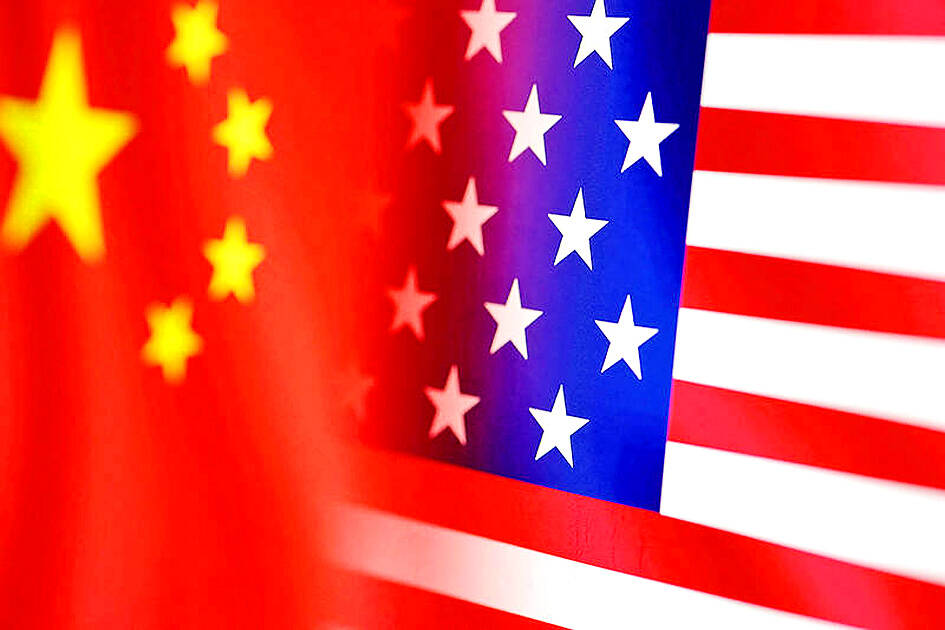
US and Chinese flags are depicted in an illustration photograph taken on Jan. 30 last year.
Photo: Reuters
The two sides aim to maintain strategic stability, avoid an unintended clash and buy time to bolster their positions, he said.
The need for repeated summits and elaborate ceremonies suggested the two countries had “many fundamental problems that cannot be resolved,” he said.
Washington’s and Beijing’s inability to “come together on some fundamental issues” represented “an opportunity” for Taiwan, Yu said.
Further integration between Taiwan and the US in trade and economics is important, but “the most crucial thing is integration on security,” he said.
“For Taiwan, the foreign hostile force is the Chinese Communist Party,” which is also the US government’s top foreign hostile force, he said.
Taiwan and the US require a “common defense,” with a high degree of security integration, and defending Taiwan also serves US national security interests, Yu said.
At a separate forum last week, Hudson Institute Asia-Pacific Security chair Patrick M. Cronin said a temporary US-China trade truce showed that neither side intended to surrender its “most valuable source of leverage.”
Ahead of last month’s summit, US Treasury Secretary Scott Bessent said the truce, originally set to expire on Nov. 10, had been extended for two months to Jan. 10 next year.
Beijing “has little reason” to give up its critical minerals advantage, while Washington “should be equally reluctant to squander one of its greatest strategic advantages: its network of capable allies and partners,” Cronin said.
The temporary easing of tensions should be used as a period of “accelerated American and allied renewal,” rather than simply as a respite from confrontation, he said.
With China set to mark the centennial of the Chinese People’s Liberation Army next year, the US and its allies need to enhance “deterrence by denial around Taiwan and elsewhere in the Western Pacific,” Cronin said.
However, military deterrence alone would not be enough, he said, calling for stronger industrial capacity in areas including energy, shipbuilding, munitions, autonomous systems, semiconductors and artificial intelligence to “sustain deterrence over the long term.”
KioskNews shows a cleaned-up reading view extracted from the publisher’s page — the original always lives on their site, not ours.