Beau Lamarre-Condon trial shown crime scene reconstruction as ballistics expert traces bullet trajectories
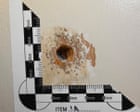
A computer-generated reconstruction of the alleged double murder of Jesse Baird and Luke Davies has been played to a Sydney jury, as pictures showing gun marks on a bedroom door were examined by the supreme court.
Beau Lamarre-Condon, 31, has been accused of shooting dead the Sydney couple with his police service weapon in Baird’s Paddington home on 19 February 2024.
He has pleaded not guilty to two counts of murder and one charge of aggravated break and enter.
The defence has argued the couple were accidentally shot in two separate struggles and Lamarre-Condon acted in self-defence.
The prosecution has told the court that Lamarre-Condon shot Baird twice in the kitchen before shooting Davies through a bedroom door.
A computer-generated video outlining the crown’s version of events was played to the New South Wales supreme court jury on Wednesday.
A 3D recreation of the Paddington terrace on the night of the shootings allowed the jury to see the alleged path Lamarre-Condon took through the home. The reconstruction included photos of bullet holes and marks.
The potential trajectory of the bullets was also highlighted.
Before the video was shown, justice Natalie Adams said it was the crown case that Baird was shot at close range but the defence argued he was shot from further away.
The judge warned the kitchen was not shown to scale and that not all the evidence relevant to the angle or distance of the shot to Baird’s head had been adduced.
The NSW police firearms examiner Lucas Van Der Walt said he was more certain of the trajectory of the bullet through the bedroom door because it had passed 35mm thick wood.
Van Der Walt told the court that “stippling” had been found on the door around a bullet hole that the prosecution alleged was covered with putty and a plastic hook.
Stippling is the pattern made by gun shot propellant particles. The closer a target is to a barrel, the smaller the spread pattern would be, Van Der Walt said on Wednesday.
“[It] is going to pepper itself into that softer surface – in this case a painted door,” he told the jury.
The court was shown a video of police taking the door from Baird’s bedroom and shooting it with the same gun and ammunition that was allegedly used by Lamarre-Condon.
The pictures of both the original and test bullet hole were compared and shown to the jury. Van Der Walt said there was a “very similar spread pattern of the propellant particles impacting with the paint and the wood in the door”.
He suggested the muzzle of the firearm was 10 to 20cm away from Davies when it was discharged.
On the side of the door the bullet would have exited, he noted the splintering looked more opaque in the original hole, but he said that was because wood putty had been used to fill the hole.
Asked why there was no other bullet marks or bullets found in the room, the expert said it could have hit a hypothetical pillow, jacket or similar item.
“If that bullet continued and penetrated any of these surfaces and that object was removed and discarded, we’ll never find that bullet,” he told the court.
“If it slowed down enough and it only lightly impacts with a surface, it might leave behind a scuff mark that’s not convincing that it’s a bullet impacting – it might look like normal wear and tear.”
Bullets shot in this way fell to the ground, he said, and given the scene had been cleaned extensively, a casing could have been picked up by cleaners, Van Der Walt told the jury.
KioskNews shows a cleaned-up reading view extracted from the publisher’s page — the original always lives on their site, not ours.