David vs Goliaths: Singapore builds most accurate clock ever, leaves US and China in dust
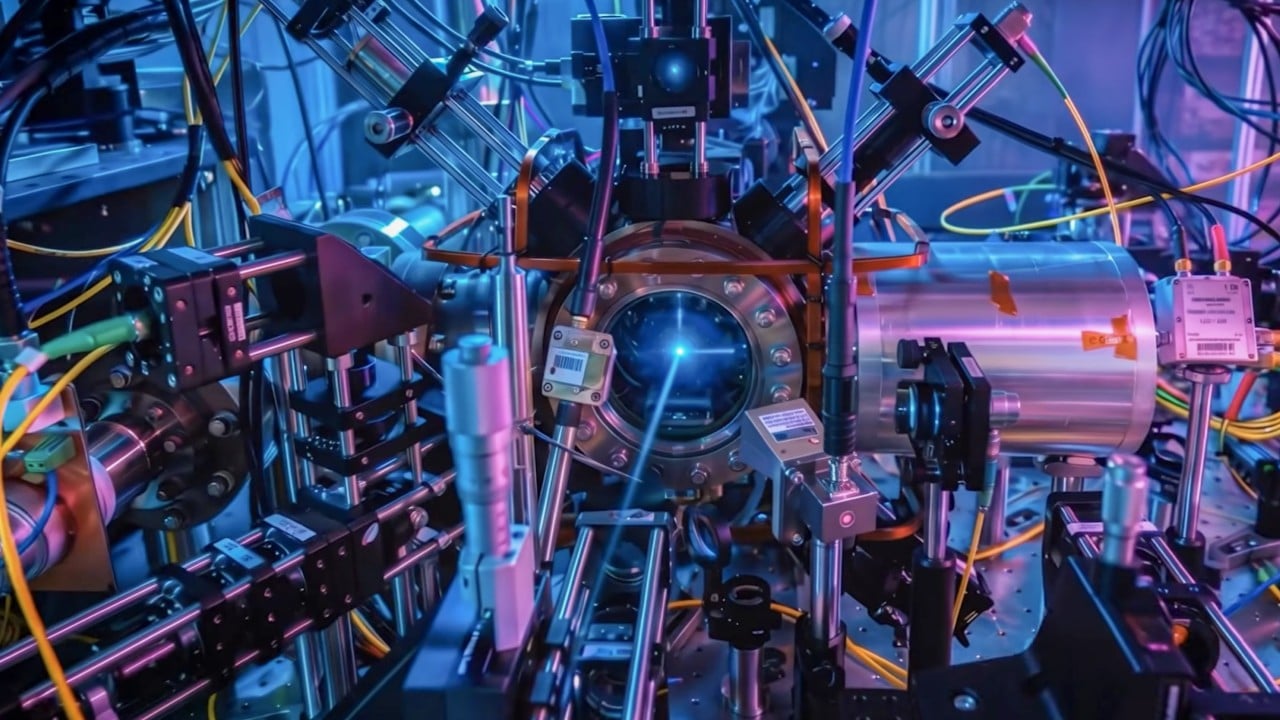
A small Singaporean research team has beaten scientists in China and the United States to build the world’s most accurate atomic clock.
The clock, built with a single ion of a rare earth metal element known as lutetium, is so precise that it would lose one second every 260 billion years – nearly 20 times the age of our universe.
It is about four times as accurate as the previous record holder, a calcium-ion clock developed by a Chinese Academy of Sciences team in Wuhan, and also surpasses an aluminium-ion clock unveiled last year by the US National Institute of Standards and Technology.
The decade-long work could improve timekeeping and help pave the way for a redefinition of the second, according to the team at the National University of Singapore’s Centre for Quantum Technologies.
It could also provide a powerful tool to test fundamental physics, from Einstein’s theory of general relativity to the search for dark matter, the researchers wrote in a paper published last week in the journal Nature.
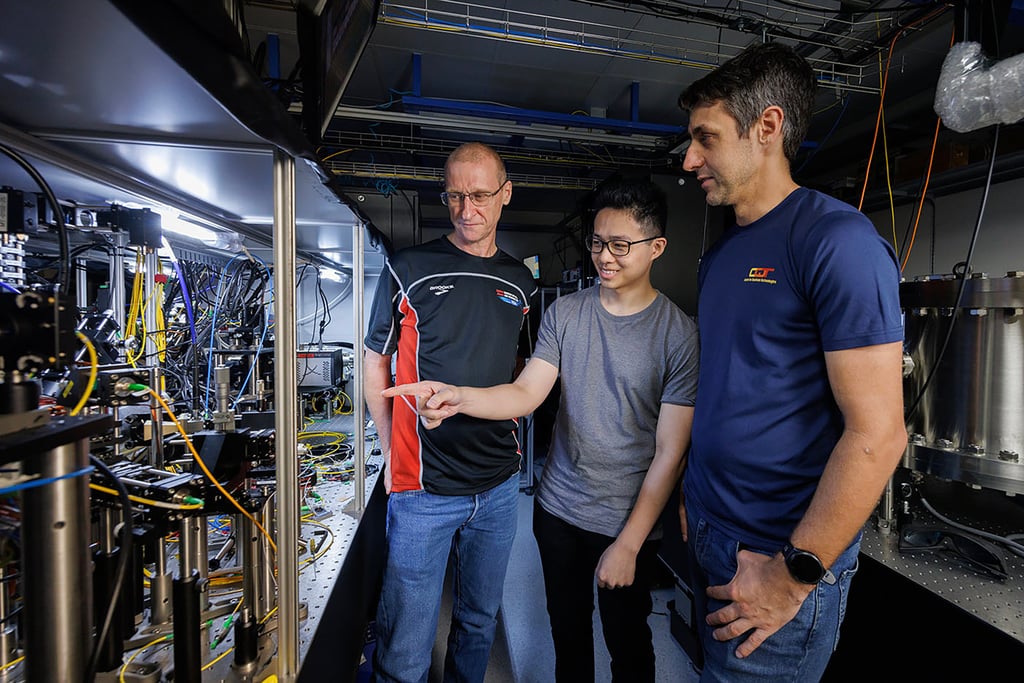
Murray Barrett, the research team leader, said he did not see how their clock “can be beat” in the future, pointing to lutetium’s unusual resistance to changes in temperature and magnetic fields.
The clock would remain stable “from the hottest place recorded on Earth in Death Valley to the coldest place in the Antarctic plateau”, a university statement quoted Barrett as saying.
In an email to the South China Morning Post, Barrett said that developing an atomic clock did not require a large team, but getting such a project off the ground could be difficult.
He credited the Centre for Quantum Technologies for backing the research early on, when it might have seemed risky, and Singapore’s funding agencies for their continued support.
“I think that this effort is an example of Singapore’s ability to internationally compete through backing good ideas, strategic investment in core technologies, and development of technical competencies,” Barrett said.
For most of human history, time was measured by watching the heavens – from the movement of the sun across the sky to the Earth’s rotation and the motion of the moon. When mechanical clocks appeared in Europe in the 13th century, gears moving at a steady rate made it possible to keep time without watching the sky.
Atomic clocks took precision much further, using microwaves or lasers to measure atoms whose electrons jump back and forth between energy states, like tiny pendulums swinging in sync. Their precise timing is essential for modern technologies such as GPS, telecommunications and navigation systems.
Laboratories around the world are racing to improve the technology. Leading optical clocks in the United States, China, Europe and Japan have used elements such as strontium and ytterbium, whose atoms have extremely stable transitions that can be precisely measured with lasers.
The Singapore team said it was probably the only group in the world using lutetium for atomic clocks.
Lutetium has another unusual advantage: it can remain in an excited state for about a week, compared with just a few minutes for strontium. This gives scientists more time to measure its frequency precisely, according to the paper.
To verify the clock’s accuracy, the researchers built two independent lutetium clocks and compared them directly. After 200 hours of measurements, the two agreed to within 5.7 parts in 10¹⁹ – the most precise comparison between two atomic clocks ever reported, they wrote.
The researchers said their next step is to miniaturise the clock into a transportable system so that it can be taken out of the laboratory without sacrificing accuracy.
Passionate about science? Dive deeper with the Dark Matters newsletter, a weekly in-depth analysis on China’s rise in science, technology and military that goes beneath the surface. Sign up for free now.
KioskNews shows a cleaned-up reading view extracted from the publisher’s page — the original always lives on their site, not ours.