Packaged food labels: Experts want red flags for even one high-risk nutrient
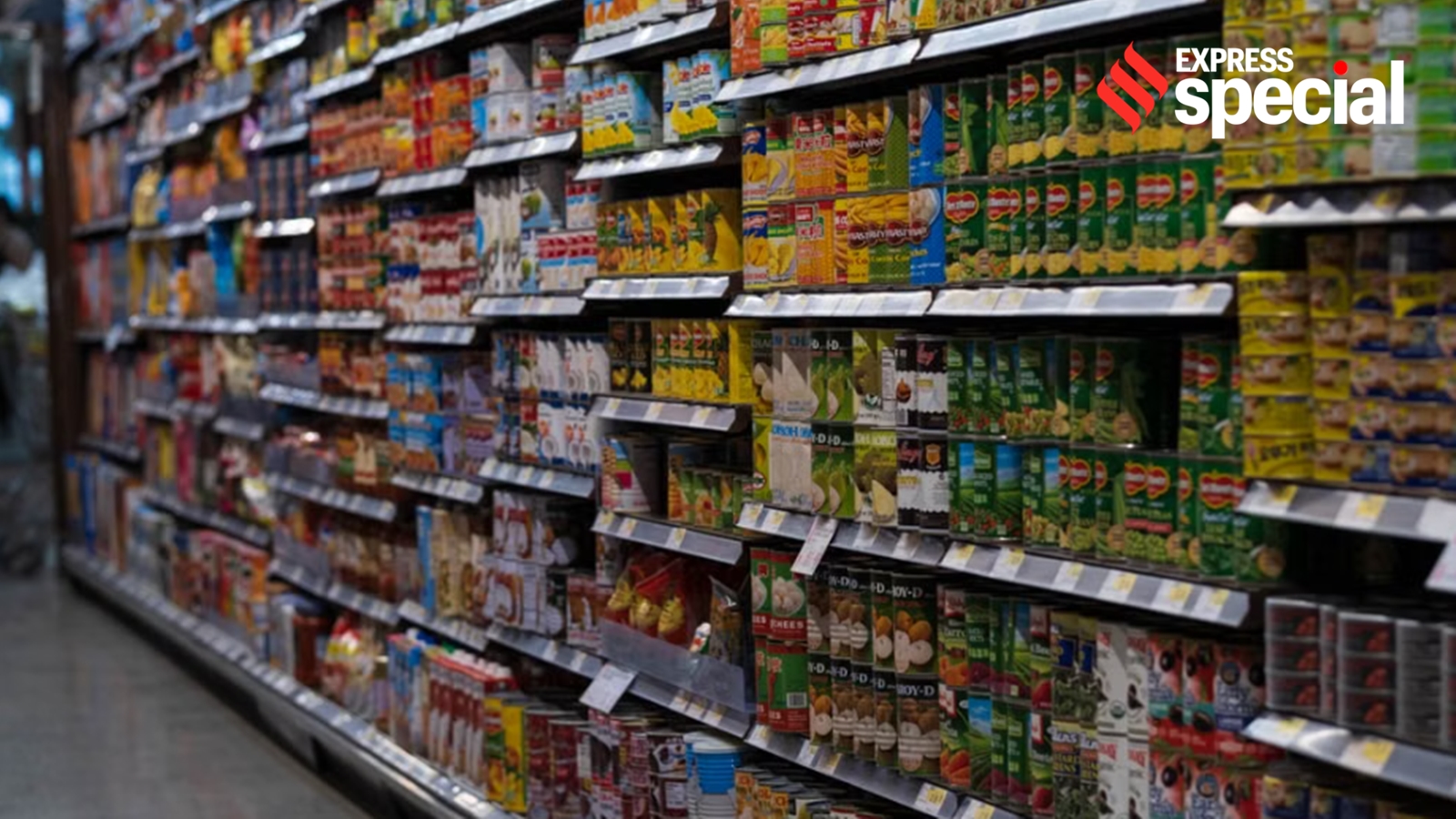
Experts have appreciated the FSSAI’s move to implement the red hexagonal warning label on the front of packaged food items. (File photo)
As the Supreme Court considers a petition seeking mandatory front-of-pack warning labels on packaged foods high in fat, sugar or salt, global experts have called for a key change: a warning should be triggered even when a food is high in just one of these nutrients.
The suggestion is significant because the country’s food safety regulator, the Food Safety and Standards Authority of India (FSSAI), has proposed introducing such warnings in phases. Under its proposal, the warning would initially be triggered when a product is high in two of the three nutrients, with warnings for individual nutrients to follow in the second phase. The expert panel wants everything at one go.
The experts’ position is also supported by the Indian Council of Medical Research (ICMR) and India’s National Institute of Nutrition (NIN), whose ‘Dietary Guidelines for Indians 2024’ have been used as a reference while determining the nutrient thresholds for the proposed warnings. The global experts are affiliated with organisations including the International Food Policy Research Institute, Harvard Medical School, Johns Hopkins University, the National Institute of Public Health Mexico, the University of Chile and the University of Sydney.
What have the experts said
The global experts have welcomed FSSAI’s proposal to introduce red, hexagonal warning labels on the front of packaged foods. They said warning labels are the only type of front-of-pack label with real-world evidence showing that they can influence consumer perceptions and behaviour, encourage improvements in the nutritional quality of food products, and lead to healthier purchasing and dietary choices.
But they have made two key suggestions on how the system should work.
Warnings should apply to each nutrient
First, the warning should be triggered separately for each individual nutrient. In other words, if a packaged food is high in both salt and fat, it should carry two warning labels—one stating that it is “high in salt” and another that it is “high in fat.”
Story continues below this ad
The experts cited evidence from Chile showing that consumers understand that products carrying more warning labels are less healthy than those with fewer or no warnings. Their concern is that requiring a product to cross the threshold for two nutrients before receiving a warning could allow foods that are extremely high in just one nutrient to escape attention.
Make the warnings stand out
The second suggestion relates to the design of the warning. The experts have recommended using black hexagonal boxes instead of red ones, or at least requiring red warnings to be placed against a white background.
The reason is visibility. A warning label needs to be immediately noticeable when a consumer looks at a package. If the label is placed against a similarly coloured background or surrounded by prominent packaging graphics, it could blend into the design and become less effective. The experts said black-and-white designs may be harder to visually mask on colourful packaging and therefore easier for consumers to spot at a glance.
What about the NIN’s suggestions?
The National Institute of Nutrition has also made several recommendations to FSSAI.
Story continues below this ad
In a letter to the FSSAI CEO, the NIN director said the thresholds used to identify foods high in fat, sugar and salt should take into account the total energy density of the food.
The institute said added-fat and added-sugar cut-offs should ideally not be considered in isolation from the food’s overall energy content and other nutrient considerations. This is significant because, in its affidavit before the Supreme Court, FSSAI said the proposed warnings would be triggered based on the levels of added sugar and added fat in food products.
NIN also wants single-nutrient warnings
NIN has also recommended that a warning be triggered when a product is high in just one of the nutrients. The institute said that otherwise, products that contain very high levels of a single nutrient could escape consumers’ attention.
This is different from FSSAI’s proposed first phase, under which warnings would be triggered only when a product is high in two of the three nutrients—fat, sugar or salt. FSSAI has proposed that warnings based on individual nutrients be introduced in the second phase.
A phased approach but with a deadline
Story continues below this ad
NIN has, however, suggested that if implementation needs to be phased, it should happen through a time-bound transition. It has proposed that higher thresholds could initially be used and then progressively lowered to the recommended levels. This, it said, would give food manufacturers adequate time to reformulate products while avoiding a situation in which the second phase is postponed indefinitely.
What has the court said?
During the most recent hearing last week, the Supreme Court considered FSSAI’s proposal for implementing the red-hexagon warning labels in two phases. The court asked for a scientifically justified and clearly defined timeline for the second phase. Without such a timeline, the court said, implementation of the next stage could be pushed back or indefinitely postponed.
The court also sought clarity on which categories of sweetened beverages would carry the warning label in the first phase.
The case is, therefore, now focussed not only on whether front-of-pack warnings should be introduced, but also on how quickly they should be implemented, which foods should carry them, and whether a single high-risk nutrient should be enough to trigger a warning.

Anonna Dutt is a Principal Correspondent who writes primarily on health at the Indian Express. She reports on myriad topics ranging from the growing burden of non-communicable diseases such as diabetes and hypertension to the problems with pervasive infectious conditions. She reported on the government’s management of the Covid-19 pandemic and closely followed the vaccination programme. Her stories have resulted in the city government investing in high-end tests for the poor and acknowledging errors in their official reports. Dutt also takes a keen interest in the country’s space programme and has written on key missions like Chandrayaan 2 and 3, Aditya L1, and Gaganyaan. She was among the first batch of eleven media fellows with RBM Partnership to End Malaria. She was also selected to participate in the short-term programme on early childhood reporting at Columbia University’s Dart Centre. Dutt has a Bachelor’s Degree from the Symbiosis Institute of Media and Communication, Pune and a PG Diploma from the Asian College of Journalism, Chennai. She started her reporting career with the Hindustan Times. When not at work, she tries to appease the Duolingo owl with her French skills and sometimes takes to the dance floor. ... Read More
KioskNews shows a cleaned-up reading view extracted from the publisher’s page — the original always lives on their site, not ours.