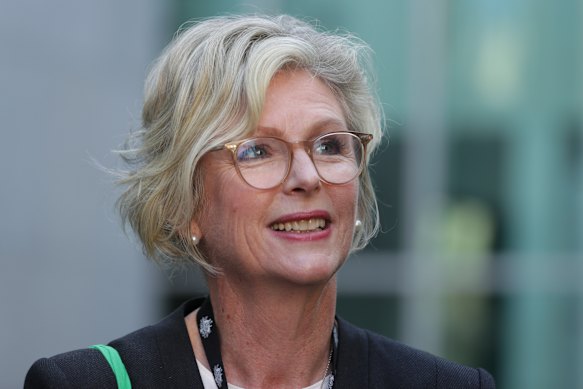
Helen Haines once said she had no mortal enemies. That remark hangs heavily over this town
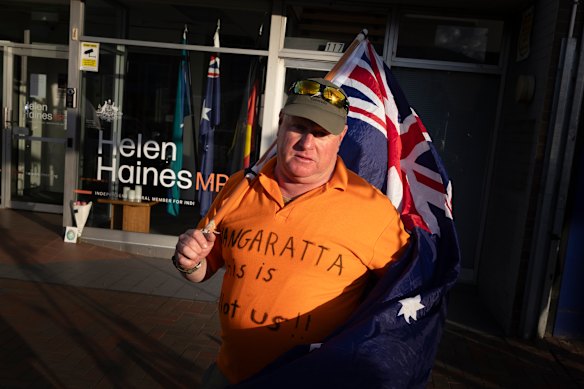
By seven o’clock on Tuesday morning, Chris Wernert had pulled on an orange T-shirt and made his way to the stretch of Murphy Street where something unthinkable had happened.
Across his chest were five words: “Wangaratta, this is not us.”
Wernert is a One Nation supporter. He didn’t vote for Helen Haines, but politics seemed a pretty small thing as he stood outside the independent MP’s electorate office, where less than 24 hours earlier it is alleged she had been deliberately run down by a four-wheel-drive.
“No matter what side of politics you’re on – I will be a One Nation voter – we’re talking about humans,” he said. “This shouldn’t be happening anywhere in Australia. I never in my life thought I’d see this happen.”
Neither did much of Wangaratta. In a town of 30,000 people 250 kilometres northeast of Melbourne, where the local MP is as likely to be encountered at a coffee shop as on the 6pm news, the events of Monday afternoon have left people struggling for words.
There was shock, anger and pure disbelief. A nagging question lingered about what has become of a country where an elected representative can be attacked outside her own office in broad daylight.
Haines, the 65-year-old former nurse and midwife who helped change the face of Australian politics, was fighting for her life after being struck repeatedly by a two-tonne Toyota Land Cruiser.
Police allege a 43-year-old man, Brendan Nugent, from nearby Tarrawingee drove past as Haines retrieved something from the back of her car, turned around and deliberately struck her, pinning her against her vehicle. He then allegedly reversed and hit her again.
What happened next unfolded in a matter of terrifying seconds.
From the outdoor shop nearby, 20-year-old Cody Lepoidevin heard it unfold.
“All you could hear were the jolting screams,” he said.
Lepoidevin was among about 10 people, including Haines’ own staff, who raced into the street. He said he watched in horror as the vehicle reversed and drove at the MP again.
He thought the driver was escaping. Instead, he said, the vehicle came back over her “at least three times”.
“It was quite a horrific scene, not something you would expect to see on a regular working day, but we all decided to do what we could to help out,” he said. “There was a lot of pain for her … but she came across lovely … even in that moment.”
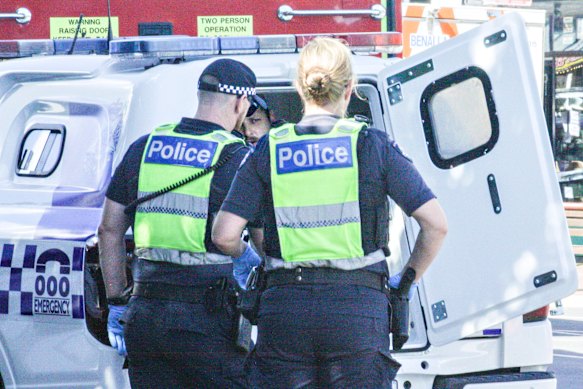
Then there was the driver. Lepoidevin said the man was mumbling, screaming and repeatedly mentioning Haines by name. He helped prevent him from leaving.
A few doors away, barber Ricky Jefferies had also rushed into the street.
Jefferies is a father of three who cuts hair at Ricky Chops, right next to Haines’ electorate office. On an ordinary Monday afternoon, his biggest concern would usually be whether a customer wanted a No.2 or a No.3.
Instead, he found himself confronting the man allegedly responsible for one of the most shocking attacks on a politician in modern Australian history.
Jefferies said he ordered the driver out of the car and got him onto the ground. The man had a knife in his pocket.
“He didn’t pull it out. I just wasn’t comfortable with his movements, and so I basically just took it out of his pocket and threw it away,” Jefferies said.
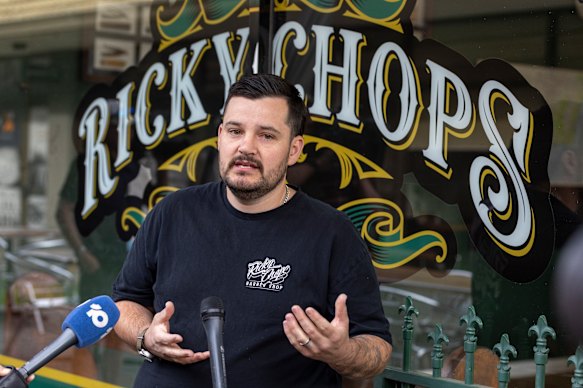
Then came an extraordinary act of restraint. Rather than striking the man or screaming abuse, Jefferies stayed with him, making sure he could not escape until police arrived.
“Everything is alright, mate, you’ll be alright,” he told him. “It was the right thing to do and to show him kindness and grace at a time that could have escalated from there.”
By Tuesday morning, Jefferies was back at work with a customer in the barber’s chair and little interest in being called a hero.
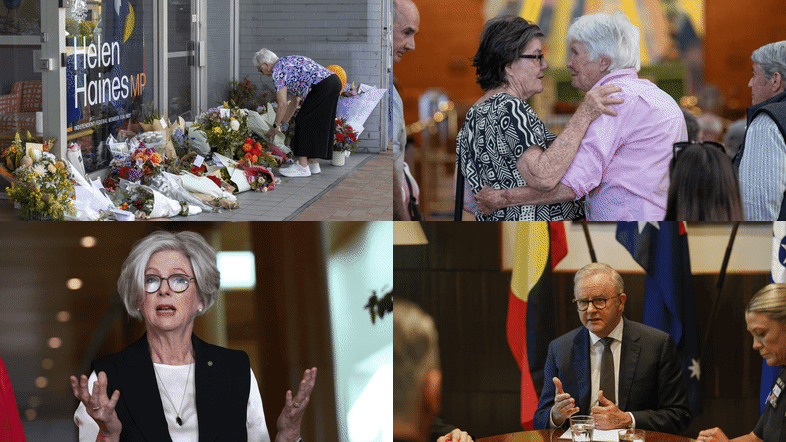
Outside, flowers were gathering beneath the enormous photograph of Haines that fills the window of her office. There were handwritten notes, too, as constituents, volunteers friends and well-wishers paid respects.
Haines is renowned around these parts for sending personal cards. Not the mass-produced political rubbish that arrives at election time, but proper notes, signed in her own hand, often recalling something about the recipient or their family. Now her constituents were writing back.
Her staff had witnessed the aftermath, inside the office when the attack occurred. They had confronted a scene no colleague should ever have to see. On Tuesday, they were at work, fielding constituency requests and comforting each other.
Steve Manning, a local independent candidate for the state election next month who came to lend a hand, could hardly believe it.
“Not only are they traumatised – they’re actually clocked on and gone back to work this morning,” he said. “They love her and they love working for her.”
That affection is not difficult to understand. Haines is not your normal politician with talking points assembled by party headquarters.
She grew up on a dairy farm, trained as a nurse, became a midwife and spent decades working in regional healthcare before entering parliament at 58. In Canberra, she can be formidable, particularly when exposing the grubby business of political grants and government secrecy.
Florist Jess Woodrow says she would often drop into the shop when not in Canberra.
“It’s the last thing you would think would happen here,” she said, adding she is a “a beautiful person” who “didn’t have a bad bone in her body”.
There is something peculiarly cruel about what happened to Haines, who made her name arguing that politics did not have to be nasty.
When Cathy McGowan shattered the Liberal Party’s hold on Indi in 2013, the orange-clad volunteers of Voices for Indi helped establish a new kind of political movement. It was built around kitchen-table conversations, community meetings and listening to people who believed the major parties had stopped paying attention.
Haines inherited that movement in 2019 and made history as the first independent to succeed another independent in the same federal electorate. She then won again in 2022 and 2025, helping prove that community-backed independents were no passing fad.

Haines has never been interested in the theatrical side of politics, instead she opted for evidence, consultation and getting on with the job. She pushed harder than anyone for a national anti-corruption commission, fought pork-barrelling and championed better healthcare for the bush. She’s never been a political bomb-thrower.
In a revealing interview in this masthead, she was once asked to nominate her mortal enemies in parliament.
“I’ve knocked heads with a few people on policy issues but I don’t have mortal enemies. Well, I don’t think I do.”
Now that remark hangs heavily over Wangaratta.
Police have not established a motive for Monday’s alleged attack, and it remains unclear whether Haines was targeted because of her political position. The accused was known to at least one other politician’s office.
State Nationals MP Tim McCurdy, whose electorate office is a few hundred metres away, said Nugent had contacted his staff on September 4. A staff member described him as appearing “a little spaced out”.
McCurdy, emotional as he spoke about Haines, said she’s “well liked, very popular throughout the community and very inoffensive”.
“She had no enemies,” he said.
Mayor Irene Grant spoke of the gaps in mental health services across regional Victoria, an issue Haines has long campaigned to address.
Grant was careful not to reduce the attack to a simple explanation. There were questions about the violence, she said, but also questions about how communities cared for people in distress.
Like so many others, she was struggling to absorb what had happened.
“You think, well, the world’s changed for us, and there’s so many ways,” she said. “This is going to have a huge impact, not only on our community, but on the region, and Australia.”
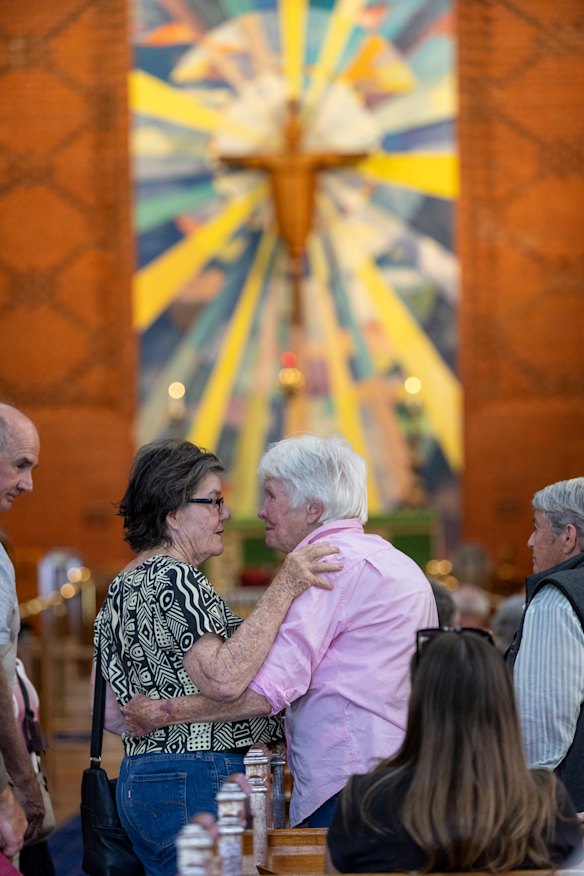
By lunchtime, the people of Wangaratta had begun making their way into Holy Trinity Cathedral. The old building, completed a few years after Ned Kelly was captured just up the road and hanged for his crimes, has stood through droughts, floods and generations of family triumphs and tragedies.
Its bells, cast in 1806, are older than the town itself. There was no political colour in the pews. Just neighbours, friends and strangers sitting together beneath the cathedral’s soaring roof.
Bishop Clarence Bester spoke of Haines as a woman of “courage, grace, and deep integrity”. He urged the congregation not to give in to fear or allow division to take hold.
For 30 minutes, a bruised community found comfort in being together, hugging friends and strangers alike and lighting a candle.
There was also a lesson in the efforts of those people who had rushed into Murphy Street.
A young shop worker who ran towards screaming rather than away from it. A barber who disarmed a man carrying a knife. Staff who returned to their desks despite the worst moment of their lives.
In a nation becoming accustomed to politicians treating one another as enemies, the decency of those ordinary people was difficult to ignore.
More from our Helen Haines coverage
- Suspect named: Police had attended the property of the man arrested
- Allegra Spender: If we’re going to make the country safer, it starts in parliament
- Jacqueline Maley: Sinister meme appeared hours before the attack
- Hero barber: Ricky thought it was a car accident. Then he saw the knife
- What we know: The attack on Helen Haines
- Turn down the temperature: Spy chief’s urgent warning on violent rhetoric
Cut through the noise of federal politics with news, views and expert analysis. Subscribers can sign up to our weekly Inside Politics newsletter.
KioskNews shows a cleaned-up reading view extracted from the publisher’s page — the original always lives on their site, not ours.