Taiwanese leader welcomes talks between Washington and Beijing ‘to reduce risk of war’
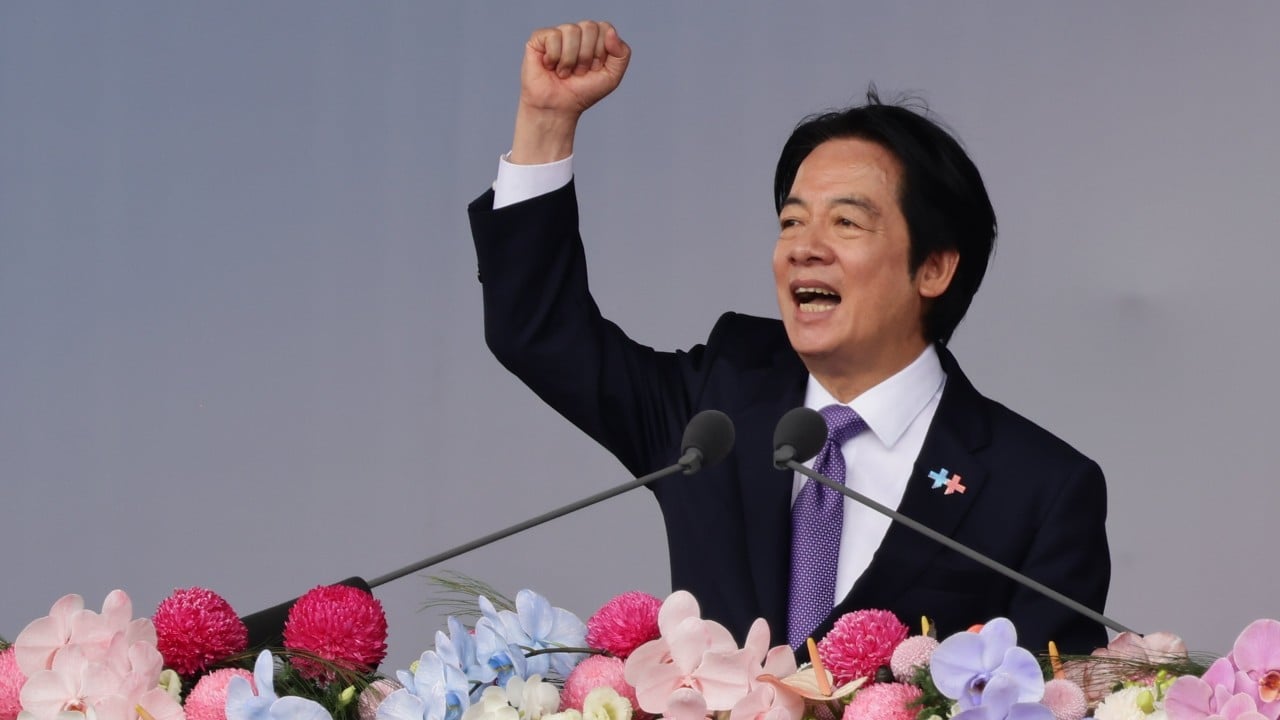
Taiwanese leader William Lai Ching-te has welcomed talks between Washington and Beijing aimed at reducing the risk of conflict.
Lai’s annual Double Tenth address, marking the anniversary of the foundation of the Republic of China, Taiwan’s official name, also called for democracies to work together to safeguard regional peace and for the Taiwanese people’s right to exist to be respected.
But Beijing said he had shown his true colours and accused him of “stirring up confrontation across the Taiwan Strait”.
“Lai Ching-te’s speech disregarded facts ... misled the public and revealed sinister motives, constituting a performance true to form by a ‘pragmatic worker for Taiwan independence’,” said Zhang Han, a spokeswoman for the mainland’s Taiwan Affairs Office, using a label Lai had previously attached to himself.
Zhang also accused him of “stubbornly clinging” to a “separatist mindset” and playing up the alleged “mainland threat”
She said Beijing would resolutely crack down on separatist forces, oppose interference by external forces and safeguard peace and stability across the Taiwan Strait.
She also said Beijing would promote “peaceful and integrated” cross-strait relations and “advance the great cause of national reunification”.
On Saturday, Lai said: “We welcome the US and China managing their competition through dialogue to reduce the risk of conflict and war.”
Chinese President Xi Jinping and his US counterpart Donald Trump met in Washington last month, where Xi urged Trump to handle the Taiwan question prudently and oppose independence.
Lai added that maintaining regional peace and stability required “rejecting distortions of World War II history”, respecting the Taiwanese people’s right to exist and joint efforts by democracies in the Indo-Pacific region to preserve the status quo.
During their meeting, Trump and Xi highlighted their countries’ alliance during World War II, prompting criticism from Taipei, which says it was the Republic of China government, rather than the People’s Republic of China – which was established in 1949 – that fought alongside the allies.
Beijing has described such arguments as “a betrayal of history”.
02:20
US accuses mainland China of targeting Taiwan leader’s family in surveillance case
Saturday’s address was Lai’s third Double Tenth speech since taking office in May 2024. The annual address has traditionally served as a platform for the government in Taipei to outline its policies and is closely watched by Beijing and the international community for signals about cross-strait relations.
Speaking outside the Presidential Office Building in Taipei, Lai accused Beijing of “continuing to exert pressure through military and grey zone activities [methods of exerting pressure without resorting to outright warfare] in an attempt to change the status quo in the Taiwan Strait”.
Faced with the “expansion of authoritarianism,” Lai said Taiwan’s resolve was not only about its own survival but also about “whether the international community still believes that force cannot override rules and that powerful countries cannot deprive people of the right to determine their own future”.
Lai also warned of the challenges posed by “red supply chains”, a term commonly used in Taiwan to refer to supply chains centred on mainland China.
“Peace cannot rest on wishful thinking,” he said, adding that Taiwan would continue to strengthen its defences and use its strengths in sectors such as semiconductors to develop a more self-reliant defence system.
In last year’s address, Lai outlined plans for a missile shield dubbed the “T-Dome” to counter growing military pressure from Beijing and said Taiwan’s defence spending would pass 3 per cent of gross domestic product this year and reach 5 per cent by 2030.
On Saturday, Lai said the increase in defence spending was not intended to provoke, but to deter war. He also said Taiwan was willing to engage in dialogue with the mainland, but insisted that it must take place on an equal and dignified footing.
Beijing regards Taiwan as part of China and has not ruled out the use of force to achieve reunification.
It has stepped up its pressure on the island since Lai, whom it views as a “separatist”, took office and has since conducted several large-scale military exercises around the island, including one that came days after his first Double Tenth speech in October 2024.
Most countries, including the United States – Taiwan’s main arms supplier and international backer – do not recognise the island as an independent state. Washington, however, is bound by law to arm Taiwan for self-defence and opposes any attempt to change the status quo by force.
On Saturday, Lai avoided repeating some of his more contentious remarks from earlier addresses, including the assertion two years ago that Taiwan and the mainland “are not subordinate to each other”.
Zhu Songling, a professor at the Institute of Taiwan Studies at Beijing Union University, said Lai’s speech was largely in line with expectations, noting that he did not use other provocative phrases.
His welcome for the dialogue between Washington and Beijing reflected Lai’s “awareness of new developments in US-China relations and the situation across the Taiwan Strait,” Zhu said.
“The broader US-China relationship clearly has a significant impact on the Taiwan issue,” he added.
However, Zhu said Lai’s pro-independence position remained unchanged, and he was increasingly framing Taiwan’s security in international terms and linking it to democratic values.
“The speech placed greater emphasis on repackaging the separatist narrative around Taiwan independence in terms of democracy and international engagement,” he said.
02:20
Xi and Trump meet for tea at the White House
During Saturday’s speech, Lai also highlighted Taiwan’s economic performance, saying the island’s annual economic growth was expected to exceed 11 per cent, its highest rate in 39 years.
He also pledged to make Taiwan a “city upon a hill” – invoking a biblical metaphor widely used in the United States to invoke a model for others to follow.
Lai also outlined a range of policy priorities, including expanding social benefits, tackling drugs and strengthening Taiwan’s advanced technology industries.
KioskNews shows a cleaned-up reading view extracted from the publisher’s page — the original always lives on their site, not ours.