Flavio Bolsonaro says he would work with China and US as Brazil’s president
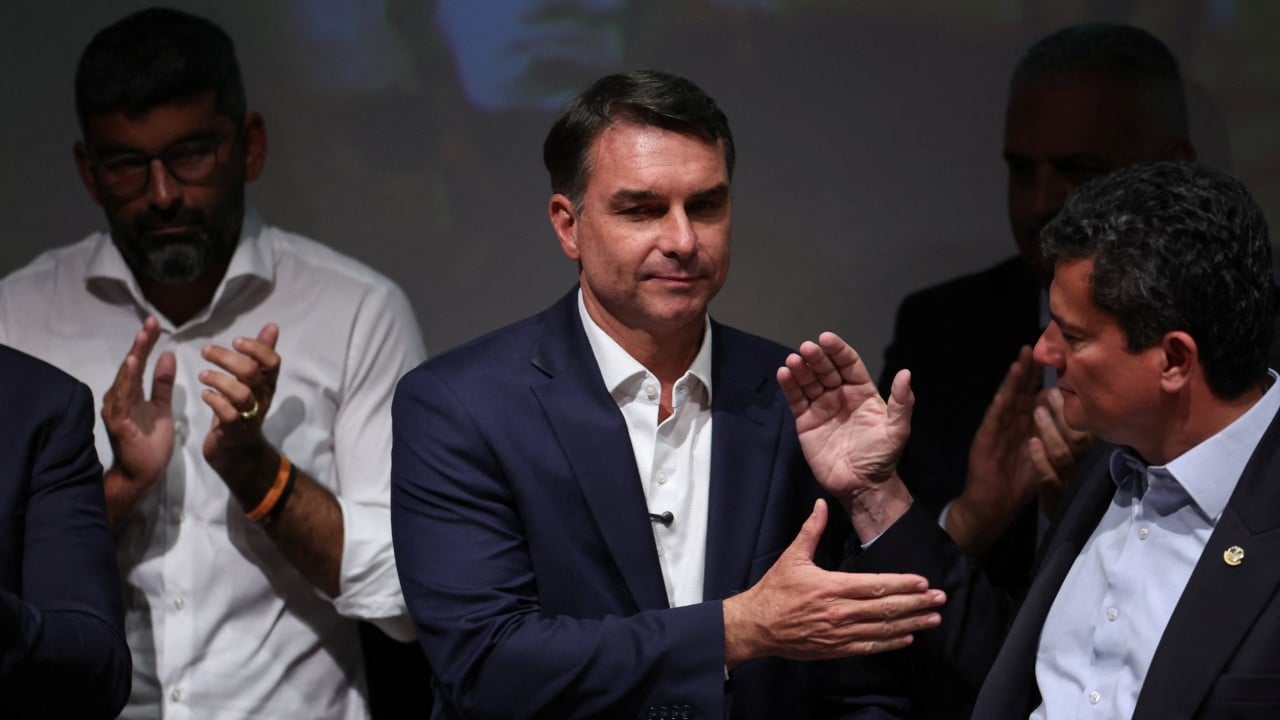
Flavio Bolsonaro said he would work with the US and China if he becomes Brazil’s president, after a surprise election performance left him poised to join a wave of conservative leaders pushing Latin America closer to Washington.
“I’m not going to pick sides,” Bolsonaro said at an event in Brasilia on Thursday. “My side will be the Brazilian people, whether we’re dealing with China, Israel, the Middle East, Argentina or India. It doesn’t matter. That’s how I’m going to govern.”
Bolsonaro finished ahead of President Luiz Inacio Lula da Silva by about two points in Sunday’s first-round election, a result that sparked a surge in Brazilian assets due to investor views that he is more likely to pursue market-friendly financial policies.
Bolsonaro would take 52 per cent to Lula’s 48 per cent of valid votes, excluding blank and invalid ballots, in the October 25 run-off, a Datafolha poll released on Thursday evening showed. The survey has a margin of error of plus or minus two percentage points. Bolsonaro outperformed Datafolha’s final poll of the first round by about five points.
Victory for Bolsonaro would complete a conservative sweep of South America’s major economies for right-wing allies of US President Donald Trump, who has sought to reassert US influence over a western hemisphere that has moved increasingly closer to China.
Bolsonaro, the son of former president Jair Bolsonaro, has pledged to work closely with the Trump administration on trade and crime while outlining plans to join the US-led Shield of the Americas security initiative. He visited Trump at the White House in May.
But as president, he would assume control of an economy that is heavily dependent on China. The country is by far Brazil’s largest trading partner and the chief buyer of agricultural exports that form the backbone of Latin America’s largest economy.
Chinese companies have also poured money into Brazil’s energy, electric vehicles and manufacturing industries, and large amounts of China-produced consumer goods enter the country every day.
Lula has deepened Brazil’s ties to Beijing while also pushing to diversify its trade relationships with other parts of the world. He has had a hot-and-cold relationship with Trump since the US placed tariffs on many Brazilian goods last year as part of an unsuccessful effort to help Jair Bolsonaro avoid conviction on coup attempt charges.
Datafolha surveyed 2,520 people from October 6 to 7, according to Folha de S.Paulo. The poll has a margin of error of plus or minus 2 percentage points, a confidence level of 95 per cent and is registered with Brazil’s electoral court.
KioskNews shows a cleaned-up reading view extracted from the publisher’s page — the original always lives on their site, not ours.