Carson Jerema: L’État, c’est Carney
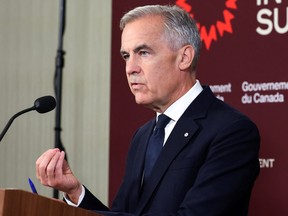
In between ignoring Parliament after walking away from trade negotiations with the U.S. and ignoring Parliament to speak to the European Union, Prime Minister Mark Carney ignored Parliament to announce a suite of new economic policies, while hosting his “investor’s summit” in Toronto this week.
Sign In or Create an Account
Previous prime ministers certainly viewed the House of Commons as inconvenient. What makes Carney unique is that he doesn’t seem to consider it at all, not even as an obstacle to overcome or a tedious obligation of his office. It would be too much to say he wished Parliament didn’t exist, because in his mind it is not clear that it does, unless he is physically in the building.
To be clear, the tax reform on new investments that would slash effective rates to half of what the U.S. offers announced by Carney on Tuesday is definitely welcome policy. Just as privatizing airports is appropriate for incentivizing private investment, assuming that doesn’t mean excessive government subsidy. But the venue of these policy announcements had more to do with Carney’s “L’État, c’est moi” worldview than with signalling Canada is “open for business.”

Columnist Jesse Kline keeps you up to date with what’s happening in Israel and the effects of antisemitism on life here in Canada. Friday mornings.
By signing up you consent to receive the above newsletter from Postmedia Network Inc.
A welcome email is on its way. If you don't see it, please check your junk folder.
The next issue of Channel Israel will soon be in your inbox.
We encountered an issue signing you up. Please try again
Because, despite everything Carney says, Canada is only marginally more open for business than it has been in the past. The Trudeau-era regulations that strangle investment in the resource sector that would permit us to benefit from the critical minerals, oil and gas this country has been blessed with largely still exist, even if they have been streamlined.
The projects that will be built, assuming they ever receive approval, whether public or private, under this government will be projects that Mark Carney himself approves. That is the whole point of the Major Projects Office.
And that is also, it seems, the whole point of the “Canada Investment Summit 2026,” which is, apparently, supposed to drive a trillion dollars in new investment by 2031. What this signals more than anything is that business in this country operates at the pleasure of the government, and at the pleasure of the prime minister in particular. Carney wants to expand the government’s public infrastructure footprint while directing private business on what it should be doing.
According to the Prime Minister’s Office, some $500 billion in new investment had been announced during the summit. That sounds impressive until you realize the majority of it comes from investors or is being financed by those with close ties to the government (the Canadian Pension Plan Investment Board), that are heavily protected by Ottawa (the five major banks, Telus), or that have direct connections to Carney himself (Brookfield Asset Management).
The government also announced it will be financing a new internet network, what the prime minister called “a sovereign broadband backbone.”
It’s possible such a splash was needed to send clear political signals that Canada will support investment after a decade of economic stagnation, and this summit could potentially lead to faster growth. A better signal would be taking on the hard work of comprehensive tax and regulatory reform that this country so badly needs.
Either way, Liberal-friendly journalists are eating it up.
The Globe and Mail’s Campbell Clark was quite impressed with the array of foreign investors present at the summit. “No other prime minister ever brought the global finance bros to this kind of party to buy Canada’s assets,” he gushed. “That’s in part because Mr. Carney has the contacts in global finance to fill the guest list.”
Carney and his “guest list” are, ultimately, what it is all about.
The prime minister’s speech Tuesday was a variation on pretty much every speech he’s given since assuming office. When recounting his government’s accomplishments, he lists one exaggeration after another. “We have already referred 27 nation-building initiatives to the new Major Projects Office,” he says, without noting not a single one has been approved and nearly every single project was in development before Carney became prime minister.
“We have begun building one Canadian economy by removing every federal barrier to internal trade,” Carney bragged, but that ignores the fact that nearly all internal barriers are at the provincial level and comprise a complex web of regulatory misalignment, such as the standards for construction site toilet seats, or weight restrictions on long-haul trucks.
The prime minister crowed about signing “more than 20 trade and security deals across five continents,” which is an exaggeration if there every was one. Many of these “deals” are either minor, or simply plans to come to a larger agreement later. No trade deal worth waving around can be counted as among 20 signed in a year.
Justin Trudeau approached private business like a stubborn rash, treating it like if it must exist, it must face the constant threat of eradication. Carney’s approach has been to present himself as the man with all the economic answers ever needed. It isn’t that the government is always right, it is that Carney always is. He has become, in a very shorty while, the face of capital spending. Whether public or private, it is Carney’s ship.
For decades, political scientists have observed how the Liberals function as the “Government Party,” which is suggestive of far more than simply the party that is in power the most. It is instead reflective of a system where party and state have largely merged. Under Carney, this is fast becoming a system where an individual prime minister, rather than the political party as a whole, is interchangeable with the state.
National Post
Join the Conversation
This website uses cookies to personalize your content (including ads), and allows us to analyze our traffic. Read more about cookies here. By continuing to use our site, you agree to our Terms of Use and Privacy Policy.
KioskNews shows a cleaned-up reading view extracted from the publisher’s page — the original always lives on their site, not ours.