Adam Pankratz: Mark Carney’s elitist quest to turn us into Europeans
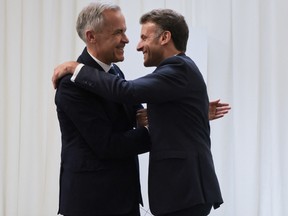
This weekend, the Wall Street Journal reported that Prime Minister Mark Carney is pushing for associate membership with the European Union in an effort to diversify Canada away from the United States. Though, on Sunday evening Carney downplayed the story, and said he is seeking a “unique alliance” with the EU. It’s a convenient dodge in any case as both terms are undefined in any legal sense and Canadians deserve to know what the Prime Minister is actually up to.
Sign In or Create an Account
While there are solid economic and security reasons to pursue greater integration with Europe, it is far from clear that these are the only forces driving the government. One senior Canadian official was quoted by the Journal as saying “Canadians, we sound like Americans, we dress like Americans, but as a society we’re much more European.”

The National Post newsletter that doesn’t hold back, giving readers the unvarnished truth on media, politics and culture.
By signing up, you consent to receive the above newsletter from Postmedia Network Inc.
A welcome email is on its way. If you don't see it, please check your junk folder.
The next issue of Right? will soon be in your inbox.
We encountered an issue signing you up. Please try again
That is reflective of an elite and out of touch attitude which may sound good in urban Toronto, Montreal and Vancouver, but which does not reflect the reality of most Canadians and could end up seriously harming them.
Elements under discussion between Canada and the EU reportedly include “ways to let Canada’s goods, services and workers involved in strategic supply chains such as energy, AI, defense and critical minerals move freely” and “laying underwater cables, jointly constructing data centers, cloud storage and new satellite networks and infrastructure to ship Canadian energy to the EU.”
While not all of those items may be desirable, some unequivocally are. On the negative side of the ledger would almost certainly be the free flow of workers between Canada and the EU. We have seen this play out in Europe before, notably in the United Kingdom. The simple reality is that more people in Europe (and the world) speak English as a second language than vice-versa. That affects the direction of travel of the workers. On pure linguistic grounds alone, it is nearly certain that Canada, as a primarily English-speaking nation, would be opening its workers up to far more competition from English speaking Europeans, than, say, Greek or German workers would face from Greek or German speaking Canadians. Any politician who avoids the difficulty of that question alone is in for a massive shock when push comes to shove. A “free flow” of people and workers goes both ways and isn’t an unalloyed good for Canadians.
However, the idea of Canada acting as a close and trusted European partner to host data centres and export energy to Europe is a fantastic one. How much oil and gas does Europe want from Canada? Whatever the answer, start building the pipelines to supply it tomorrow and then build five more. This is as much of an economic no-brainer as any country is likely to find.
Europe needs reliable gas that doesn’t come from Russia and Canada has enormous gas reserves. A more ideal partnership is hard to imagine, excepting of course the niggling problem that we can’t get the gas to our east coast in large quantities because the pipelines aren’t there.
Also of importance, and hidden behind the Wall Street Journal’s reporting, are the serious problems related related to any EU deal in general. Notably, given our recent blow up with the United States over our trading relationship, is the issue of sovereignty. Much about what exactly went wrong in that negotiation remains unclear, but Canadians were told by both the prime minister and chief trade negotiator Janice Charette that the United States sought provisions which would be “constraining or limiting (to) Canada’s ability to enter into future free trade agreements.” That threat to our sovereignty was unacceptable so Canada walked away. If true, we were right do so.
However, the notion that an EU association, or “unique alliance, would not come with similar or analogous restrictions on Canada’s sovereignty is pure fantasy. The European Union negotiates trade deals on behalf of the bloc of member countries. Individual countries are not permitted to unilaterally enter into trade deals on their own. That is to say, they sacrifice a piece of their sovereignty for the large negotiating power which comes from the 27 member countries acting together. Further, the EU does not even allow Norway, not an EU member but a member of the European Economic Area (a type of EU association), to negotiate trade deals that allow backdoor entry to the EU.
That is to say, Norway’s sovereignty is limited beyond what would be expected in a typical trade agreement, despite not being an EU member, just as Canada’s could be, depending on exactly what is being pursued. To believe that this country will somehow be given a free ride and can keep doing just as we please if we enter the close cooperation apparently being discussed, is to conveniently ignore the harsher realities of European integration.
Further worrying is the lens Canada seems to be putting on European association, with a senior official telling the Wall Street Journal that “as a society we’re much more European.”
It is hard to imagine a more out of touch comment being made by any negotiator. I have no doubt that many highly educated members of Canada’s elite wish to think of themselves as Europeans, perhaps they even live as though they are. The vast majority of Canadians, however, do not.
In our current situation it may not be comfortable to recognize that we share far more with Americans than any other country, but that is our reality. I say this as someone who lived and studied in Europe for years and speaks French, Spanish and German. Indeed, there’s every reason to think close EU association might be very beneficial to me personally. So, can believing the unnamed senior official be superficially appealing? Sure. Is it reflective of the reality of most Canadians? No, and it never will be.
If Prime Minster Carney can position Canada as the European energy and critical mineral supplier of choice, this is unequivocally something he should do. In that area there is real fit and synergies to be found. However, anyone who believes that Canada’s natural home is Europe and that EU association won’t come with limits on our deeply cherished sovereignty, needs to step out of their faculty lounge or book club echo chambers to understand the reality of our country and how what is being proposed is likely to affect a majority of Canadians.
National Post
Join the Conversation
This website uses cookies to personalize your content (including ads), and allows us to analyze our traffic. Read more about cookies here. By continuing to use our site, you agree to our Terms of Use and Privacy Policy.
KioskNews shows a cleaned-up reading view extracted from the publisher’s page — the original always lives on their site, not ours.