With more to give, S’pore seniors turn a lifetime of skills and experience into volunteer work
SINGAPORE – It was a career break during the Covid-19 pandemic in 2022 that set Santhanam Srinivasan on an unexpected path.
Looking to fill his time meaningfully, the IT professional came across an open house by RSVP Singapore, a non-profit organisation that encourages senior volunteerism. He signed up to teach seniors how to use digital applications and tools. He returned to work in 2023, but continued volunteering.
The 64-year-old, who retired from GovTech in 2025, teaches three to four times monthly, with each session lasting for three hours. He also serves on RSVP’s project steering committee to help implement new volunteer and donation management systems.
More older Singaporeans like Santhanam are bringing decades of professional expertise to help others, besides taking on traditional roles like befriending.
Younger seniors today are generally more educated, digitally connected and want more flexibility and meaning in their volunteer experiences, said RSVP Singapore’s executive director Edna Claudine Leong.
“Not just as a way to help others, but also as a way to continue using their expertise, remain engaged and create meaningful impact,” she added.
The skills being put to use are varied.
Retired manicurist Mak Lai Yeong, 74, provides free manicure and pedicure services at THK Active Ageing Centre @ MacPherson.
For three years, she has spent about five hours monthly helping seniors care for their nails and maintain personal hygiene. Some have uneven and crooked nails due to past injuries, while others need special care due to ailments like diabetes and cancer.
“Since I have the skills, why not help other seniors?” she said. “I will volunteer for as long as I can so that I don’t lose or waste my skills. And what I gain from helping others is this inner happiness that money cannot buy.”
RSVP works with over 160 community partners, including schools, social service agencies and active ageing centres (AACs), to create opportunities that suit different skills and interests.
While traditional volunteering roles such as befriending and community outreach remain popular, RSVP has seen rising interest in opportunities allowing seniors to share their professional knowledge and contribute specialised skills, Leong said.
These include mentoring students, teaching other seniors digital skills and being guides in the community. Senior volunteers also provide administrative support, data entry and data analysis, contributing through skills developed over their careers.
Karen Wee, executive director of Lions Befrienders, said there is increasingly room for professional skills-based volunteering, including digital coaching, translation and mentoring.
For some, personal experiences can become useful skills too.
Patricia Lee’s husband was a rehabilitation client at PCF Sparkle Care @ Yew Tee. After he died four years ago, she started volunteering there as a “transport kaki”, accompanying frail seniors to medical appointments.
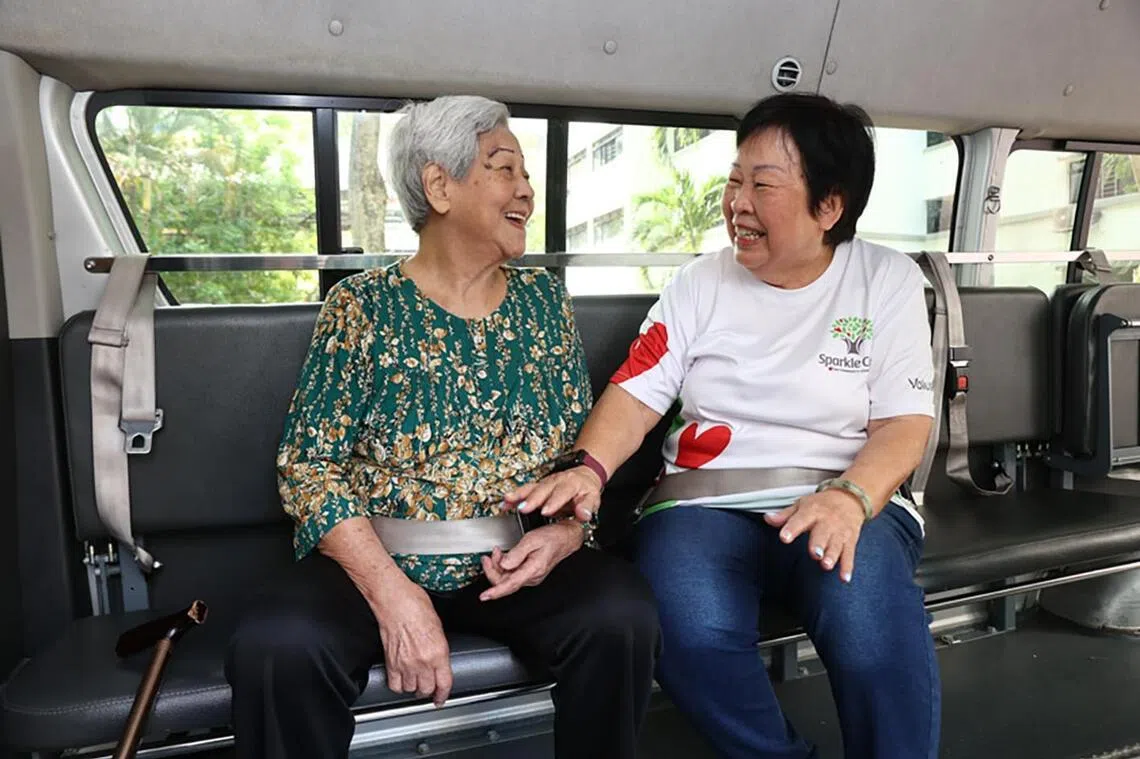
Patricia Lee (right) volunteers as a “transport kaki” at PCF Sparkle Care @ Yew Tee by accompanying frail seniors to medical appointments.
PHOTO: PCF SPARKLE CARE
She was initially nervous about interacting with seniors who have different needs, including wheelchair users and those with dementia, but she grew more confident with experience and now volunteers at least twice a week.
“I remember one senior who was in her 90s and could not speak very well. I would joke with her, and she would make an effort to respond to me,” the 78-year-old said.
“I feel happier and more energetic,” she said. “I enjoy talking to other seniors and hearing about their lives and families.”
Retired civil servant Mok Loi Wong, 73, found another way to contribute: storytelling.
As he enjoys writing and telling stories, he shares jokes and personal experiences with seniors at NTUC Health Day Centre for Seniors in Serangoon twice weekly.
His first attempt five months ago did not go as planned. No one laughed at a humorous story he wrote, and he was disheartened. His wife suggested that he talk instead about his childhood in Kampong Ubi, where he helped his parents rear pigs, chickens and ducks, and grow vegetables and fruit trees.
The seniors began to respond with interest, and some would ask what his next story would be.
“Their enthusiasm and anticipation have become one of the greatest rewards of my volunteering journey,” he said.
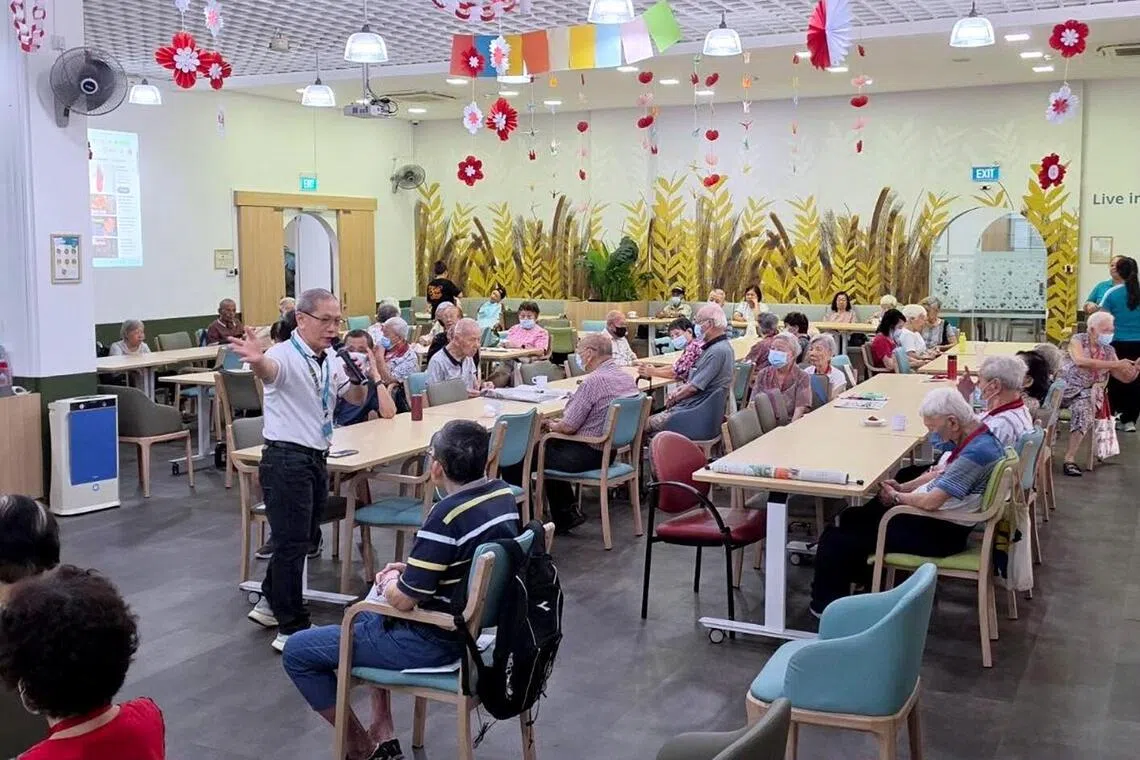
Volunteer Mok Loi Wong conducting a storytelling session at NTUC Health Day Centre for Seniors (Serangoon Central) on Sept 22.
PHOTO: NTUC HEALTH
Attracting more senior volunteers
Still, there is more room for seniors to get involved.
The National Volunteer and Philanthropy Centre’s (NVPC) National Giving Study 2025 found that 10% of respondents aged 65 and above had volunteered in the past 12 months. This compares with 20% of youth aged 15 to 35, 28% of adults aged 36 to 49, and 24% of those aged 50 to 64.
But an earlier study by NVPC in 2023 had also found that older age groups volunteered more regularly and for longer periods than younger people.
Social networks are a way to bring in more senior volunteers. NVPC said those whose close friends volunteer are more likely to volunteer themselves, and do so more frequently.
Semi-retired preschool education consultant Sanesa Salleh, 61, who has volunteered as a Silver Generation Ambassador for almost four years, roped in two of her sisters to do the same. These ambassadors visit seniors to support their health and social needs.
The Silver Generation Office, the outreach arm of the Agency for Integrated Care, has about 9,000 ambassadors, about triple the number when it started in 2014. About half of them are aged 50 and above.
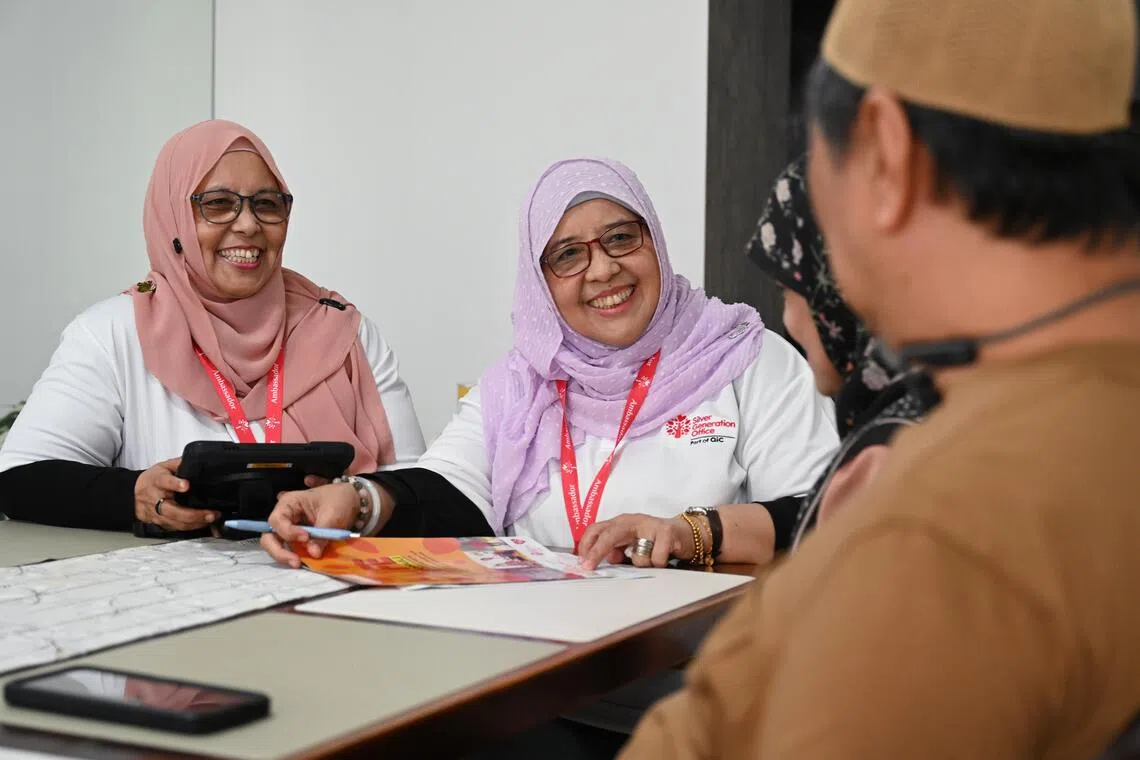
Sanesa Salleh (centre) has been a Silver Generation Ambassador for almost four years and has roped in her sister, Junaidah Salleh (left), to volunteer as well.
ST PHOTO: NG SOR LUAN
RSVP’s volunteer pool has grown from 100 in 1998 to nearly 3,500 today, of whom 90% are aged 60 to over 80.
It launched a referral programme in 2025 encouraging volunteers to invite friends to join them.
In the past two years, its number of active volunteers grew by 12% to 885, while volunteer hours rose by 13% to 41,703.
New volunteers must attend a half-day training session to understand the fundamentals of volunteerism. Depending on the role, more training will be given to help them engage with their beneficiaries.
Some seniors who want to volunteer have difficulty navigating digital platforms and online registration, said Singapore Red Cross assistant secretary-general of operations Charis Chan.
To help them, the organisation, which has 465 active senior volunteers aged 55 and above, personally guides these applicants to register as volunteers. It also uses familiar channels such as WhatsApp or phone calls to share information and reminders.
Lions Befrienders’ Wee said volunteering must be accessible and flexible. This includes bringing volunteering opportunities closer to homes and allowing micro-volunteering, where even 30 minutes or an hour can make a difference.
Its number of senior volunteers grew by between 20% and 30% from 2025 to 2026, with over 400 of them as at August.
“Instead of creating a role and expecting a senior to fit into it, perhaps we should first ask what this person can contribute, and how we can enable them to do it.”
Someone who may no longer be able to stand for four hours at an event can call another lonely senior. Someone who finds travelling difficult can still help a neighbour.
PCF Sparkle Care’s chief operating officer Andy Seet said the eldercare service provider has developed micro-jobs – bite-sized and flexible opportunities for seniors to contribute. Participants get a stipend of around $12 to $15 per three-hour block.
Its pool of active senior volunteers aged 60 and above who contributed at least 20 hours increased by 67.7%, from 62 in 2025 to 104 in 2026.
It aims to increase volunteer hours through its micro-jobs initiative from 2,400 to 40,000 by 2027.
Finding purpose and connection
Ultimately, the draw may be less about volunteering itself than what seniors get from it.
In a 2026 survey of RSVP’s volunteers, the top reasons cited for wanting to continue volunteering included ageing with dignity and purpose, and having avenues for social bonding.
For 78-year-old Chua Chor Keng, volunteering has meant helping lower-primary pupils overcome anxiety about maths, supporting museum educators on learning journeys for children and befriending seniors at an AAC in Bukit Purmei.
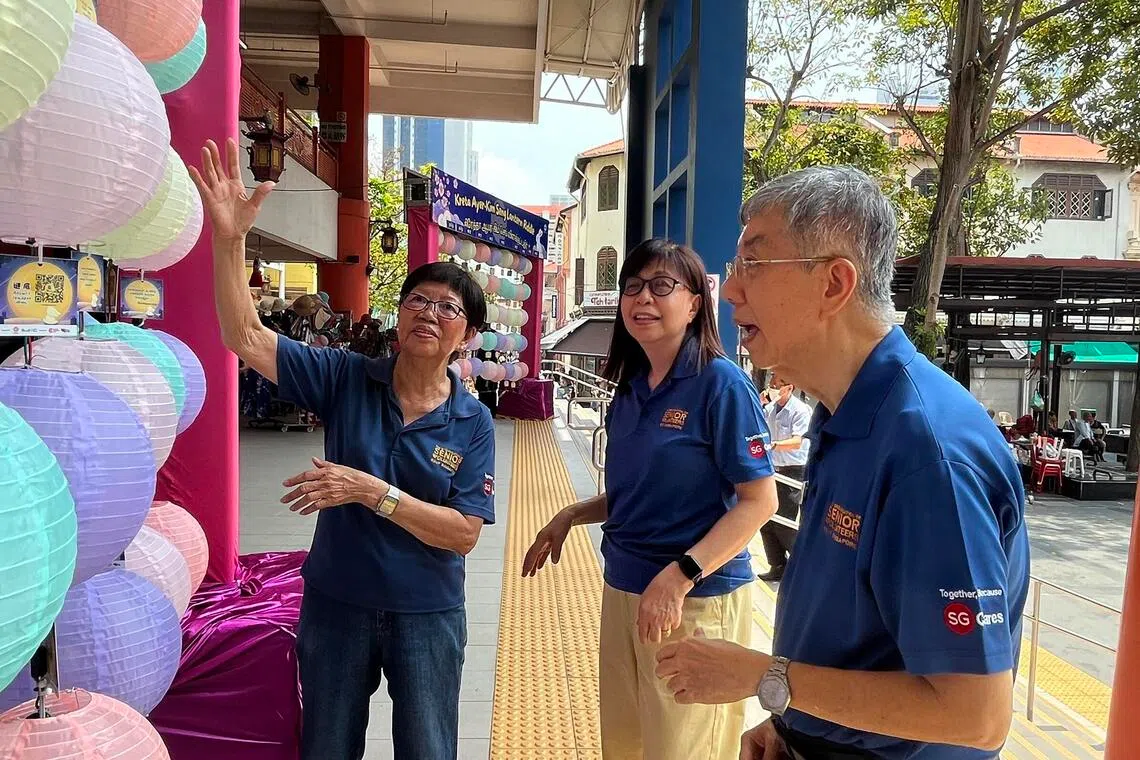
(From left) RSVP Singapore volunteers Chua Chor Keng, Hum Swee Kin, and Teo Wei Min at Kreta Ayer Square on Sept 21. They support museum educators in facilitating learning journeys for primary school pupils at Kreta Ayer Heritage Gallery.
PHOTO: RSVP SINGAPORE
The retired administrative clerk and former tutor spends at least five hours volunteering monthly.
“When I volunteer, I make others and myself happy,” she said. “It also widens my social circle and allows me to acquire new knowledge and information along the way.”
It is also what keeps fellow RSVP volunteer Santhanam going.
“Volunteering fills a void that appeared on retirement. It also gives me a sense of belonging,” he said. “Without it, I would be left with nothing to do, which is not a healthy prospect.”
KioskNews shows a cleaned-up reading view extracted from the publisher’s page — the original always lives on their site, not ours.