Chris Selley: What does Olivia Chow’s ‘progressive base’ think it’s defending?
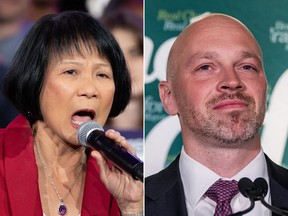
Olivia Chow was re-elected mayor of Toronto Monday night after what can at best be called three years of ineffectual leadership.
Sign In or Create an Account
Certainly on issues that tend to preoccupy National Post readers: the cost of living, traffic, crime and disorder, the Jewish community’s safety, collapsing public transit, the opioid disaster. But most of those issues are among the leading concerns for everyone in this city.
On finding people an affordable place to live, Chow’s only real competitor, Brad Bradford, championed more inclusive residential zoning in his years on council, and promised to scrap the municipal land-transfer tax.

Columnist Jesse Kline keeps you up to date with what’s happening in Israel and the effects of antisemitism on life here in Canada. Friday mornings.
By signing up you consent to receive the above newsletter from Postmedia Network Inc.
A welcome email is on its way. If you don't see it, please check your junk folder.
The next issue of Channel Israel will soon be in your inbox.
We encountered an issue signing you up. Please try again
Meanwhile, Chow’s solutions were very … Chow-ish. In pursuit of cheaper groceries, she said she would offer tax breaks to independent and “mom-and-pop” stores opening shop in priority neighbourhoods. This is just a (thankfully) less ambitious bad idea than Zohran Mamdani’s government grocery stores in New York City. “Small,” “mom-and-pop” and “independent” are not bywords for cheaper groceries — rather for the opposite.
That’s not because the proprietors live under Galen Weston Jr.’s thumb; it’s simple economies of scale. But it sure seems to sound nice to people who don’t live in those neighbourhoods and have never been to a discount grocery store in their lives. Of course we would be much better off luring No Frills or FreshCo to under-groceried areas; better still to eliminate obstacles to every kind of business that wants to open shop in Toronto. Bradford was less obsessed with grocery price manipulation, and quite rightly so.
On the situation facing Toronto’s Jewish community: Chow, the mayor who loves to be seen, is completely missing in action — physically, policy-wise, and in dealing with the feckless police (last seen removing Bradford campaign signs in a Jewish neighbourhood so as to keep the peace at a protest by the you-know-whos).
It almost doesn’t matter what her problem is with the Jewish community. There are no bridges left to burn. But she and her campaign clearly don’t see it as a liability, and unfortunately, they seem to have been right. (Bradford has been very vocal in his support for the Jewish community. Chow wouldn’t even show up at the annual Walk for Israel.)
On housing, Chow was the mayor who blinked in the face of opposition to legalizing sixplexes city-wide, declining to use her “strong mayor powers” to overrule NIMBY opponents on council. This was on principle, she said, because “I don’t believe a top-down way of doing things will mean that people are going to rush out and build housing,” and because “we need to work with the homeowners so that they feel comfortable doing it” — and more of the same status quo-preserving nonsense that never goes anywhere useful.
Bradford didn’t have anything revelatory to offer on cost of living, but it’s not an easy problem to solve. There was the promise to end the land-transfer tax and a promise to reduce water bills … which is more compelling, at least, than mom-and-pop grocery.
It wasn’t the most captivating second-place campaign. Bradford clearly has a bit of a charisma problem, if you care about charisma in your politicians, which I don’t. (Few in Canada have much of note to begin with.) Could not care less. Tell me what you plan to do and why I should trust you to actually do it. Fin.
Which brings us to the elephant in the room: Canada’s least popular premier, Doug Ford. Not many things in Toronto politics aren’t about Ford at some level. The skating- and swimming-lesson registration portal, I suppose. Beach maintenance. But he will happily dive into the minutiae of his own obsessions, most recently ripping out city-installed bike lanes. Whatever you think of the lanes, this really isn’t something the transport minister of a trillion-dollar economy should be concerned with, never mind the premier.
The irony is that many in Chow’s progressive core see her as the anti-Ford candidate. But why? She hasn’t saved any of the things they love: bike lanes (though Ford is only tearing them out so far at the periphery); the Ontario Science Centre; Ontario Place; a jet-free Island Airport (the feds are currently against it, but could always change their minds). By any reasonable reading of his own words, Ford endorsed Chow. They’re good friends, have been for decades.
I’m old enough to remember when progressives tore former mayor John Tory to shreds for capitulating to Ford’s menaces against the city. He had to fight, fight, FIGHT for Toronto, whatever that meant. Chow gets a free pass.
Perhaps it’s too simplistic to call it a double standard: Perceived progressives get a benefit of the doubt on basic probity and good intentions that perceived conservatives do not — and to be perceived as “the progressive one” and “the conservative one” doesn’t take much if any actual evidence of progressivism or conservatism. We need simplistic narratives above all else.
Bradford was the one taking most of the shots at Ford during this campaign. But he got zero credit for it. Part of that is just the powerful drug of incumbency: It’s a small sample size, but since the 1998 “amalgamation” between downtown and outer ridings, no sitting mayor has ever been unseated. Still, that didn’t save two councillors from richly deserved defeats on Monday, including the transparently ineffectual TTC chair, Jamaal Myers. (One fun revelation from the mayoral campaign: Chow doesn’t take public transit!) But incumbency didn’t stop voters in Hamilton — Steeltown! Old-time NDP religion! — from busting former provincial NDP leader Andrea Horwath from the mayor’s chair down to third place in the election.
Bradford was no political colossus. But he was … perfectly serviceable. This is Canadian municipal politics; we’re not looking for JFK or Wilfrid Laurier. A vote for him was at least a vote for something inoffensively different. We must try to take solace that it won him 404,000 votes — more than Rob Ford or David Miller ever managed, and 41 per cent of the total.
Could be worse. Could always be worse.
National Post
cselley@postmedia.com
Join the Conversation
This website uses cookies to personalize your content (including ads), and allows us to analyze our traffic. Read more about cookies here. By continuing to use our site, you agree to our Terms of Use and Privacy Policy.
KioskNews shows a cleaned-up reading view extracted from the publisher’s page — the original always lives on their site, not ours.