Users report smooth recycling process as beverage container return scheme fully kicks in on Oct 1
SINGAPORE - With most drinks on shelves here now carrying the Return Right logo and barcode, the full implementation of Singapore’s beverage container return scheme (BCRS) on Oct 1 was off to a smoother start after many delays.
The Straits Times checks at about 15 reverse vending machines across the island on Sept 30 and Oct 1 showed people depositing armloads of empty beverage containers to retrieve their deposits.
Housewife Avis Chong, 32, was seen using a machine at the MacPherson food centre on Oct 1.
She told The Straits Times that her young children enjoy drinking canned beverages and sodas, and that she collates the containers for recycling once a week. She said she has not experienced any issues with the refund process.
Cedric Kuo, who works in finance, said the initiative has helped him be more diligent at recycling. He was seen returning a plastic shopping bag full of cans at a reverse vending machine at Holland Village on Sept 30.
Added Kuo, 29: “I initially thought that keeping the bottles and cans will be troublesome, but after trying it out, I realised that it’s actually quite convenient and I can make a few dollars from it, especially because I always buy cartons of drinks.”
Under the scheme, all plastic bottles and cans from 150ml to 3 litres must be labelled with the 10-cent deposit mark and barcode.
Customers pay an extra 10 cents for each drink purchased under the scheme, but get the money back when they drop the used containers into a reverse vending machine, also called a Return Right machine.
From Oct 1, it will be an offence for anyone, including supermarket operators, to supply any regulated beverage if the container is not affixed with the scheme’s deposit mark and a barcode. Under the Resource Sustainability Act, those found guilty can face fines of up to $10,000 and/or up to three months’ jail.
More than 1,000 machines became operational on April 1, but the National Environment Agency (NEA), which is administering the scheme, gave producers and retailers an extra six months to clear old stock.
More drinks carrying the requisite logos and barcodes only started appearing on shelves here toward the later end of the six-month period.
The transition period ended on Sept 30, although some small retailers have been given another month to clear stocks of non-compliant drinks.
Users interviewed suggested ways of improving the scheme.
These ranged from placing the machines in more prominent locations, to ensuring machines are emptied regularly and increasing the size of the logos.
Thomas Ng, 60, who was seen returning containers at the reverse vending machine in Our Tampines Hub, told The Straits Times: “The first time I came here to deposit my drinks, it was so hard to find the machine as it was hidden inside the supermarket. Even now, I would forget where it is sometimes and have to find it again which is very troublesome.”
The retiree added: “Supermarkets hide the machine at random places in the store… It would be good if they can put the machines at the entrance where everyone can see.”
Lab researcher Ong Pei Xuan, 28, who returned her containers at a machine outside the Sheng Siong outlet in Bedok, noted that there is a lack of machines in the area. She had encountered situations where the bin she was at was full, and other machines were too far away.
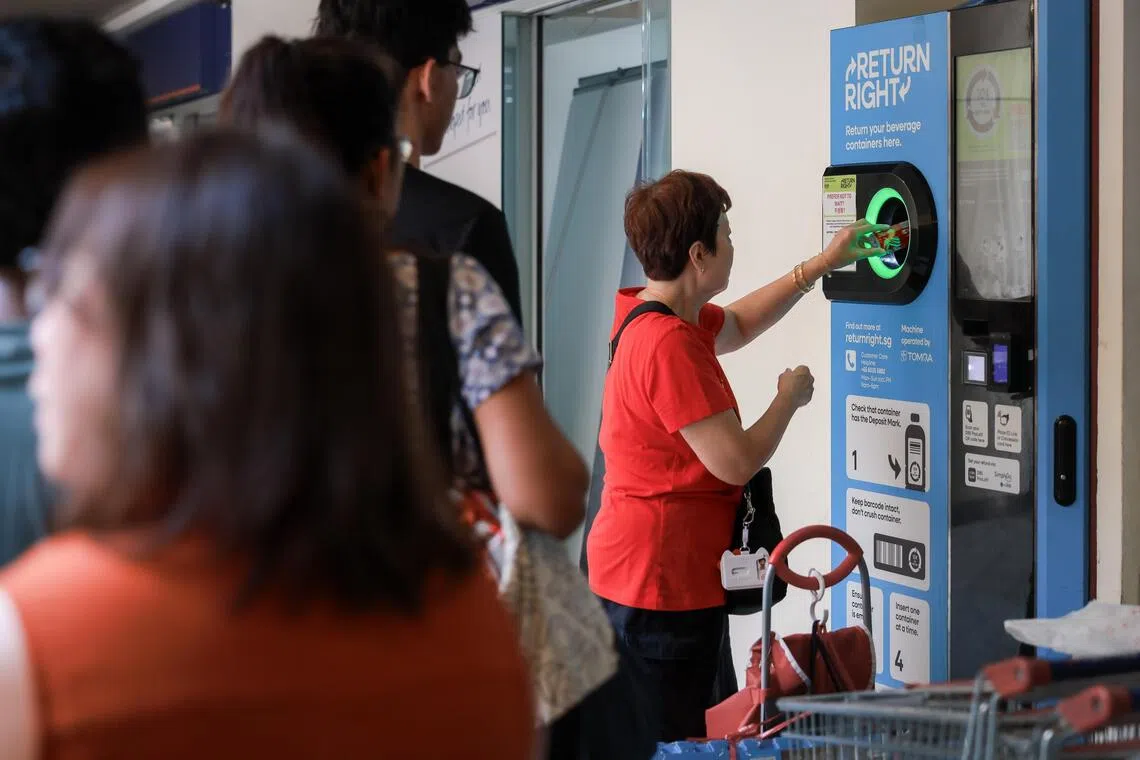
A line of people using the Return Right machine at Toa Payoh Central.
ST PHOTO: GAVIN FOO
Administrator Megan Lim, 47, said she found the Return Right logo too small, unlike other labels like the Healthier Choice one.
Air-con engineer Foo Kai Teck, 58, who was observed using a machine in Bishan, said his experience has been generally smooth, but wishes the machines would accept slightly dented cans.
In an update on Oct 1, the NEA said the scheme had collected over 48 million beverage containers as of Sept 27. This means that over 823 tonnes of material was saved from incineration.
Small retailers apply for 1-month extension
About two weeks before the full implementation of the scheme, The Straits Times reported on Sept 15 that retailers were slashing prices – offering half-priced beers and discounted teas – to clear non-compliant stock.
The National Environment Agency (NEA) subsequently announced on Sept 18 that small retailers could apply for a one-month extension until Oct 31 to clear unlabelled beverages.
NEA said it has received approximately 2,700 applications as at Sept 30, 12pm. These were mainly from small retailers such as provision shops, neighbourhood convenience stores and standalone food shops. Around 90 per cent of the 2,300 processed applications have been approved.
In response to ST queries, an NEA spokesperson said that in assessing the applications, it takes into consideration factors such as the nature of the business, the number of outlets owned by the company, the applicants’ existing stocks of non-compliant beverages and their efforts and plans to deplete the existing stocks.
The NEA spokesperson added that applicants that were not granted the grace period have been informed not to supply non-compliant beverages. She added: “They are advised to consider options such as affixing BCRS stickers or donating to non-profit organisations.”
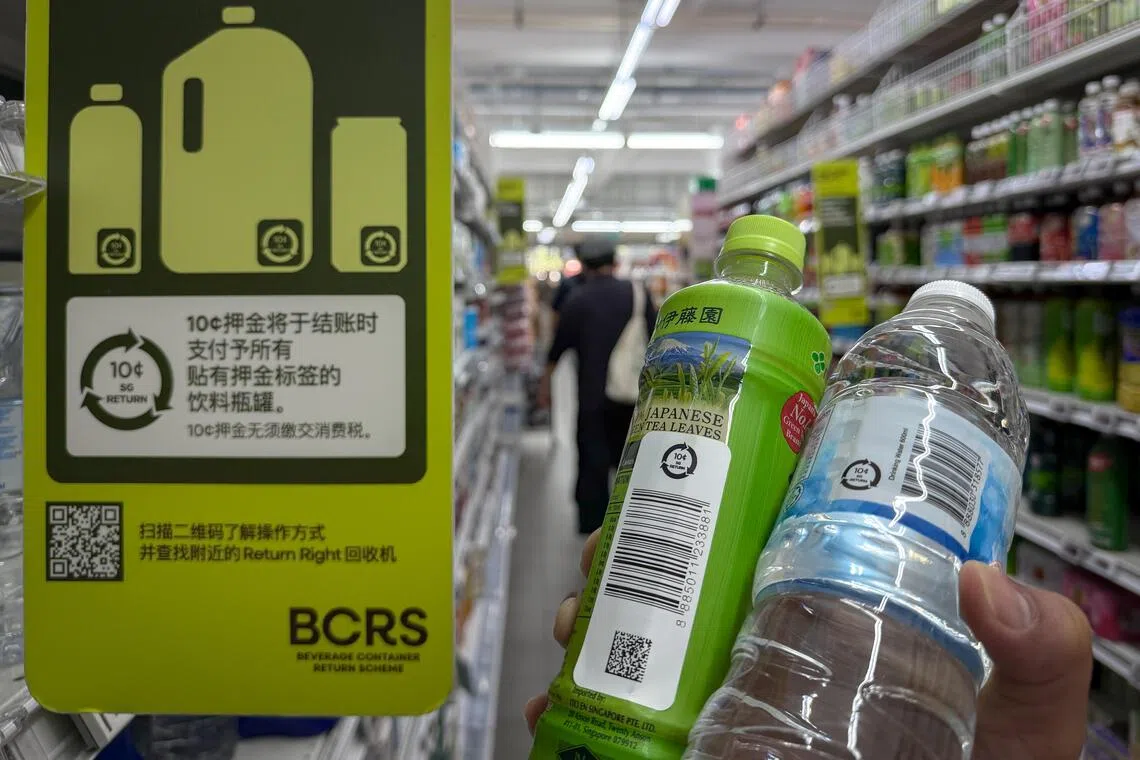
Bottled and canned drinks with the BCRS Deposit Mark seen on shelves at a supermarket in Lorong 4 Toa Payoh on Oct 1, the day the Beverage Container Return Scheme takes effect.
ST PHOTO: GAVIN FOO
Several small retailers interviewed said they have applied for and successfully received the month-long extension to continue selling non-compliant drinks.
But if these items still remain unsold by the end of October, they generally plan to keep the beverages for their personal consumption.
At Hwa Lee Provision Store in Shunfu, owner Kelvin Lim said he applied for the one-month extension on Sept 28 and received approval for it. While over 90 per cent of his stock carries the Return Right logo, slower-moving items like energy drinks remain unlabelled.
“If the non-BCRS beverages are not sold by the grace period, I will bring them home and consume them myself,” Lim said. He added that retailers are also facing extra wholesale costs per carton, which he chooses to absorb.
At Ah Seng Durian eatery in Alexandra, manager Cedrik Shui noted that 70 per cent of his stock now have the required logos. His application for the one-month extension was successful.
“We are not a big enterprise with fast-moving sales in huge amounts. I believe that even this one month will not be enough for us,” he said. “We will just consume it because it will be the festive season soon… We can just use it as our Chinese New Year drinks.”
Vaigai minimart’s director Aakash, who said he goes by one name, said his shop now has about half its shelves filled, as many suppliers do not have enough stock of drinks with the Return Right logo. “They give priority to big shops who order in bulk,” he said. “When smaller shops like us order, they say they have no stock.”
KioskNews shows a cleaned-up reading view extracted from the publisher’s page — the original always lives on their site, not ours.