Scientists, firms deny backing deep-sea mining project
A US firm claimed universities and research institutes had shown “strong” interest in its deep-sea mining plans without ever speaking to them, an Agence France-Presse (AFP) investigation has found.
American Deep Sea Minerals said it would contact regulators to “provide clarification” after a host of supposed backers told AFP they had nothing to do with the project.
“We had no interaction whatsoever with ‘American Deep Sea Minerals,’ and would not collaborate with them in any way,” said marine ecologist Jon Copley from the University of Southampton, which is named in the firm’s mining exploration proposal.
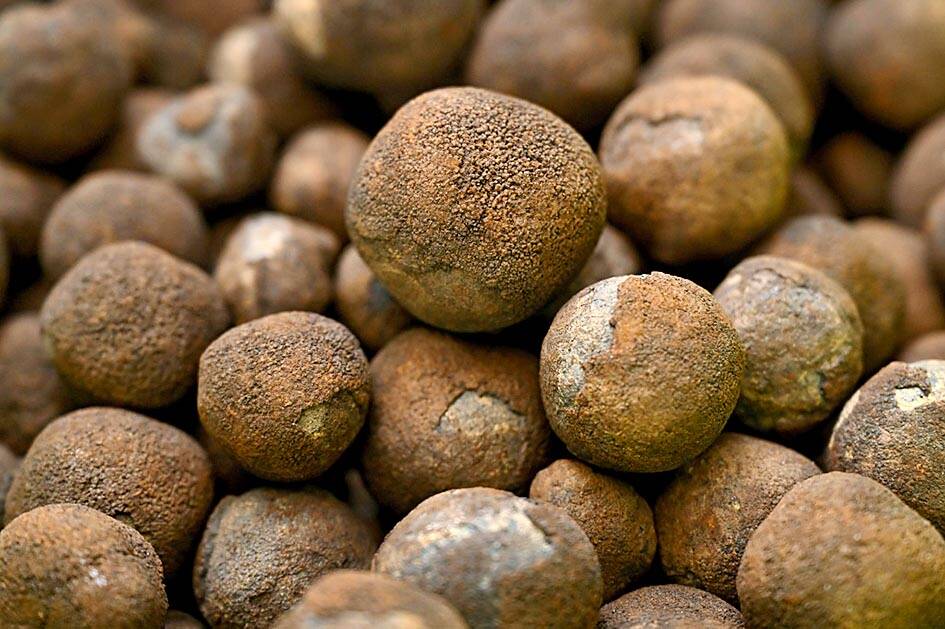
Swathes of the Pacific Ocean are covered in polymetallic nodules that contain coveted metals and rare earth elements.
Photo: AFP
American Deep Sea Minerals is among a growing number of firms jostling to mine the depths of the Pacific Ocean, hunting for lucrative deposits of critical minerals and rare earth elements. It has applied for an exploration license covering 100,000km2 in the South Pacific, nestled between the exclusive economic zones of the Cook Islands, Kiribati and French Polynesia. The fledgling industry is already hugely contentious — seen by some as a rich source of economic growth and feared by others as a grave danger to the environment.
The firm’s application looks promising on paper, name-checking major metals companies among prospective investors and touting interest from scientists.
“Interest in collaboration is strong among recognized research institutes, including the Natural History Museum [UK], the University of Southampton and the UK’s National Oceanography Centre,” it reads in part.
However, when contacted by AFP, many of these organizations said they had nothing to do with American Deep Sea Minerals and had no interest in working with them.
It would be “effectively illegal” for the University of Southampton — a leader in deep-ocean science — to aid mining in international waters given the UK’s treaty obligations, Copley said.
The UK Natural History Museum said it did not want its name attached to the plan.
“We do not work with American Deep Sea Minerals Inc and have not had any interaction with them or know much of their work, we are asking them to remove our name in connection to this work,” a spokesman said.
The UK’s National Oceanography Centre likewise said it had “not given permission” to be named.
“The National Oceanography Centre has no agreement to collaborate with American Deep Sea Minerals and has not been approached by the company about its application,” he said.
Presented with this pushback, American Deep Sea Minerals said it would submit a “written clarification” to the US deep-sea mining regulator.
“It will confirm that the Natural History Museum, the University of Southampton and the National Oceanography Centre have no relationship with ADSM, and that none should be inferred from the application,” the firm told AFP.
Large tracts of seabed in the South Pacific are carpeted in small polymetallic nodules that are laden with coveted metals like copper, nickel and manganese. American Deep Sea Minerals has its eyes on a region called the South Penrhyn Basin, which it believes harbors “exceptionally high” concentrations of cobalt. Cobalt is a high-value metal used in everything from jet engines to rechargeable batteries.
A separate section of the company’s application deals with “prospective investor groups,” listing companies that could help process and sell the nodules.
This included Japanese materials giant Sumitomo and leading global metals refiner Korea Zinc.
“Regarding your enquiries about American Deep Sea Minerals, we are not acquainted with them at all,” Sumitomo told AFP.
Korea Zinc said it was not an investor and that AFP should “seek clarification directly” from American Deep Sea Minerals.
American Deep Sea Minerals said it did not mean to suggest Sumitomo and Korea Zinc had committed to the project.
“We recognize that the wording could have been clearer and will provide clarification to NOAA,” the firm said, referring to the US National Oceanic and Atmospheric Administration.
Critics fear deep-sea mining will cause major ecological damage, smothering marine life in plumes of waste and disrupting oceanic migrations with the thrum of heavy machinery. Deep-sea mining efforts have stalled as companies wait for the International Seabed Authority to hash out rules and regulations from scratch. However, the US is not among the authority’s 171 member states — and has declared it does not need international permission to start mining on the high seas.
American Deep Sea Minerals is one of five firms seeking to sidestep the international regulator by applying directly to the NOAA. The administration in June said that American Deep Sea Minerals’ application was “fully compliant” with information requirements. Leading deep-sea mining firm The Metals Co has also applied to the NOAA, announcing earlier this month that it expected a decision by the middle of next month.
KioskNews shows a cleaned-up reading view extracted from the publisher’s page — the original always lives on their site, not ours.