8 Years Later, Taylor Sheridan’s Greatest Western Still Says Everything About America

Michael John Petty is a Senior Author for Collider who spends his days writing, in fellowship with his local church, and enjoying each new day with his wife and daughters. At Collider, he writes features, reviews, recaps, and conducts interviews. In addition to writing about stories, Michael has told a few of his own. His novella, The Beast of Bear-tooth Mountain, was released in 2023. His Western short story, The Devil's Left Hand, received the Spur Award for "Best Western Short Fiction" from the Western Writers of America in 2025. Michael currently resides in North Idaho with his growing family.
Sign in to your Collider account
Since the Taylor Sheridan-helmed Western drama Yellowstone premiered on the Paramount Network in the summer of 2018, the series rose to prominence relatively quickly. Ignoring the initial wave of mixed-to-negative reviews upon release, the series, which concluded its five-season run in December 2024, was a hit with audiences and by Season 3 became one of the most-watched shows in America. Everyone who's heard of Yellowstone has their own opinions on the show, but love it or hate it, there's no denying that Sheridan's overnight takeover as one of the most sought-after creators in Hollywood has largely been met with a desire for more. Even after Yellowstone's finale, that appetite has hardly disappeared. But while Sheridan’s universe has continued to expand, American TV still hasn’t produced anything that has truly replaced the original series’ reach or cultural footprint.
‘Yellowstone’ Made Taylor Sheridan One of TV’s Biggest Creators
If we could say anything about Taylor Sheridan, perhaps best well-known before Yellowstone as the scribe behind Sicario, Hell or High Water, and Wind River, it's that the cowboy-turned-actor-turned-filmmaker seems to know what he's doing. If this wave of prestige Western and blue-collar dramas is indeed a limited run, then Sheridan's getting his money's worth before the clock runs out. Yellowstone prequels 1883 and 1923 were instantly met with favorable reviews as they returned to the traditional Western format (the latter being Paramount+'s biggest series debut), while Sheridan's other projects, Mayor of Kingstown and Tulsa King, which star Jeremy Renner and Sylvester Stallone respectively, have made waves themselves. By 2026, Sheridan's television empire had grown even larger, while the Dutton story itself continued beyond Yellowstone through shows such as Marshals and Dutton Ranch. Needless to say, folks love what Sheridan brings to the table, and for good reason.
Collider Exclusive · Taylor Sheridan Universe Quiz
Which Taylor Sheridan
Show Do You Belong In?
Yellowstone · Landman · Tulsa King · Mayor of Kingstown
Four worlds. All of them brutal, complicated, and built on power, loyalty, and the price of survival. Taylor Sheridan doesn't write heroes — he writes people who do what they have to do and live with the cost. Ten questions will reveal which one of his worlds you were made for.
🤠Yellowstone
🛢️Landman
👑Tulsa King
⚖️Mayor of Kingstown
01
Where does your power come from? In Sheridan's world, everyone has leverage. The question is what kind.
02
Who do you put first, no matter what? Loyalty in Sheridan's universe is always absolute — and always costly.
03
Someone crosses a line. How do you respond? Every Sheridan protagonist has a line. What matters is what happens after it's crossed.
04
Where do you feel most in your element? Sheridan's worlds are as much about place as they are about people.
05
How do you feel about operating in the grey? Nobody in a Sheridan show has clean hands. The question is how they carry the dirt.
06
What are you actually fighting to hold onto? Every Sheridan character is fighting a war. The real question is what they're defending.
07
How do you lead? Authority in Sheridan's world is never given — it's established, maintained, and constantly tested.
08
Someone new arrives and tries to change how things work. Your reaction? Every Sheridan show has an outsider disrupting an established order. Sometimes that outsider is you.
09
What has your position cost you? Nobody gets to where these characters are without paying for it. The bill is always personal.
10
When it's over, what do you want people to say? Sheridan's characters all know the ending is coming. The question is what they leave behind.
Sheridan Has Spoken You Belong In…
The show that claimed the most of your answers is the world you were built for. If two tied, both are shown — you're complicated enough to straddle two Sheridan universes.
🤠 Yellowstone
🛢️ Landman
👑 Tulsa King
⚖️ Mayor of Kingstown
You are a Dutton — or you might as well be. You understand that some things are worth protecting at any cost, and that the modern world's indifference to history, to land, to legacy, is not something you're willing to accept quietly. You lead from the front, you carry your family's weight without complaint, and when someone threatens what's yours, you don't escalate — you finish it. You're not cruel. But you are absolute. In Yellowstone's world, that combination of ferocity and loyalty doesn't make you a villain. It makes you the only thing standing between everything that matters and everyone who wants to take it.
You thrive in the chaos of high-stakes negotiation, where the money is enormous, the margins are thin, and the wrong word in the wrong room can cost everyone everything. You're a fixer — the person called when a situation is already on fire and needs someone with the nerve to walk into it. West Texas oil country rewards exactly what you are: sharp, adaptable, unsentimental, and absolutely clear-eyed about what people want and what they'll do to get it. You're not naive enough to think this world is fair. You're smart enough to be the one deciding who it's fair to.
You are a Dwight Manfredi — someone who has served their time, paid their dues, and arrived somewhere unexpected with nothing but their reputation and their wits. You adapt without losing yourself. You build loyalty through respect rather than fear, though you're not above reminding people that the two aren't mutually exclusive. Tulsa King is for people who are still standing when everyone assumed they'd be finished — who find, in an unfamiliar place, that they're more capable than the world gave them credit for. You don't need a throne. You build one, wherever you happen to land.
You carry the weight of a system that is broken by design, and you do it anyway — because someone has to, and because you're the only one positioned to do it without the whole thing collapsing. Mike McLusky's world is for people who are comfortable operating where there are no good options, only less catastrophic ones. You speak every language: law enforcement, criminal, political, human. That fluency makes you invaluable and it makes you a target. You've made your peace with both. Mayor of Kingstown belongs to people who understand that keeping the peace is not the same as being at peace — and who do the job regardless.
Yellowstone itself takes place primarily in Paradise Valley, Montana, a beautiful and lush mountainscape that seems as endless as the show's ever-long-running summer. As someone who has spent the better part of his adult life in Bozeman, Montana (another primary setting for the Paramount series), it's easy to tell the difference between the fact and the fiction of Yellowstone's depiction of the "Last Best Place," but regardless of the small inconsistencies (which there are in everything since most screenwriters hail from Hollywood), that doesn't stop one from suspending their disbelief enough to engage in Sheridan's rocky and often violent world. At its height, Yellowstone became one of the most-watched series on cable (surpassing even The Walking Dead before it ended its eleven-year run). Yellowstone has made a name for itself, but what does its popularity say about America?
'Yellowstone's Appeal Lies in Its Western Roots
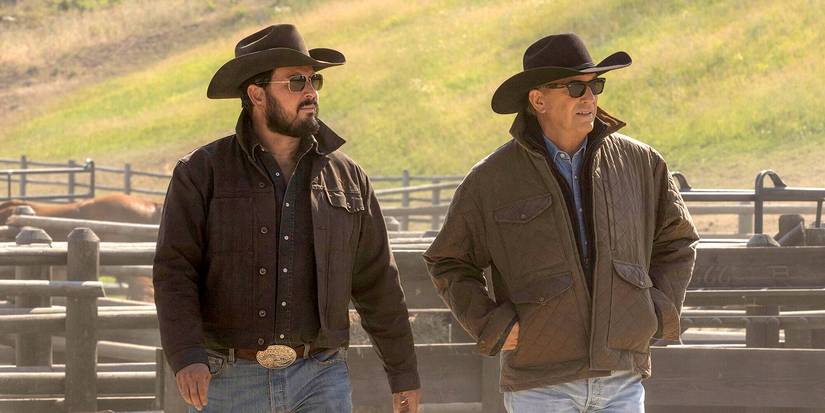
To understand the appeal of Yellowstone is to understand the American myth of the West. In this country, there is a continued tradition of post-Civil War myths that are retold again and again, even in contemporary times. In fact, other genres, including science fiction, are often rife with Western tropes; it's ingrained into American society, and, by extension, modern filmmaking as a whole. Yellowstone, a neo-Western itself, is naturally no exception. In fact, its popularity seems to prove this point all too well. In the past, Hollywood made history with the Western, producing more a year than any other genre combined. Films like Stagecoach, The Searchers, True Grit, and plenty of others are still highly beloved today and remain influential nearly everywhere movies are made. No wonder Australian, Italian, and Indian cinema, among others, have often adapted these Western legends themselves.
There’s something to the Western that seems forever appealing. Basic human ideas of freedom, liberty, family, vengeance, and justice flow through the genre like streams of rushing water; you can’t really tell the myth without it. Sheridan clearly understands this, as Yellowstone and its prequels are no different, except for maybe the fact that the dysfunctional Duttons tend to avoid paying their dues year after year. Other Western themes, such as the mistreatment and struggles of Native Americans, the harsh realities of cowboy living, the consequences of violence and stolen land, and the battle against progress, are also clearly depicted in Yellowstone, which has only helped open the door for more stories like these to be told in the future. No wonder a more traditional Western like 1883 was so popular.
'Yellowstone' Benefits From Having Western Star Kevin Costner

Of course, Yellowstone also featured one of the most recognizable faces in the genre not named John Wayne or Clint Eastwood, at least in a modern context. Kevin Costner, known for his Westerns Dances With Wolves, Open Range, and Wyatt Earp, to name a few, gained newfound popularity through Yellowstone playing the tough-as-nails ranch tycoon John Dutton. Dutton is not only on a path to protect his family’s long-standing way of life but that of the entire state of Montana as well (ironic, given that the series' popularity has pit lifelong Montanans against the same folks that the Duttons fight against). Naturally, Costner’s presence and experience with the genre were, ahem, paramount to the show’s success, pulling in those who might’ve never otherwise heard of the neo-Western series.
No doubt, people are hungry for Westerns again, as made evident by the recent resurgence in the genre. Admittedly, it's never fully gone away and may never be as prolific as it once was, but it's certainly more popular again than it's been in years as Yellowstone (and other shows like it) allow for the further romanticization of the way of life out in the West. Sure, there’s something slow, profound, and especially beautiful about the Western United States, but people there often live tough lives. Thankfully, Sheridan and company hold nothing back, giving us rough-around-the-edges characters like cowboys Rip Wheeler (Cole Hauser) and Lloyd Pierce (Forrie J. Smith) to chew on.
'Yellowstone' Focuses on the Working Class

There's a slow-building movement throughout Hollywood that is opening the door for different sorts of stories to be told. After decades of shows set in big cities on either coast (particularly Los Angeles or New York), audiences throughout Middle America have grown tired of these characters and settings with whom they have little to nothing in common. Instead, they'd prefer to cling to stories about your everyday average people living in average places (i.e., not big cities). Shows such as Friday Night Lights, Longmire, Last Man Standing, and even a show like Bob's Burgers prove time and again that the audience for these sorts of working-class, and often rural, misadventures is there, and will show up for something they deem worthy of their dollar. Interestingly, HBO's Succession, set in New York, shares many parallels with Yellowstone, though the latter show's vast landscapes and Western aesthetic set it apart as a bit more interesting.
Yellowstone itself relies heavily on the workings of the Duttons' Yellowstone Ranch that borders Paradise Valley, the fictional Broken Rock Indian Reservation, and America's first national park. Within this ranch lies a bunch of hard-working cowboys who spend their days on horseback and their nights playing poker in the bunkhouse or dancing at a local bar. Though not everyone in Yellowstone is a blue-collar worker — Wes Bentley's Jamie is a sleazy lawyer and the ever-controversial Beth Dutton (Kelly Reilly) is a private financier — the overall message of the series exudes working-class rhetoric. Given that so very few shows touch on cowboy life, it's admittedly refreshing to watch one that centers on it, especially given Sheridan's own life experience as a real-life Texan cowboy.
The slow rise of blue-collar stories that highlight the working class of farmers, ranchers, industrial workers, tradesmen, those in rural law enforcement, and members of the armed forces is understandably appealing to those who feel their voice is rarely heard by the mainstream media. Adrian Horton of The Guardian noted that "[Yellowstone] performed particularly well in smaller cities whose agricultural foundations resonate with the show’s bread-and-butter sequences of ranching and focus on property disputes." She goes on to list smaller cities in Texas, Idaho, Iowa, Kansas, Kentucky, and, naturally, Montana where Yellowstone consistently plays well. This should come as no surprise, given the show's highlight on small-town issues and attitude towards the wealthy, coastal elites. The backbone of America is going to show up for something that promotes their strenuous way of life — even if it often skimps out on their morals.
Of course, there's a good chunk of moviegoers and television connoisseurs who can rightfully acknowledge that Hollywood often seems out of touch with its blue-collar audience. The amount of high-budget box office bombs and one-and-done seasons of television proves that a fact rather than some sort of politically-charged fiction. However, Yellowstone's ever-growing audience coupled with the show's presence on the Paramount Network and Peacock streaming service has turned this once-maligned series into a powerhouse drama that brings in unprecedented numbers for a series of its caliber. Thankfully, it seems to be inspiring other networks and studios to look into reaching the same demographics.
Yes, 'Yellowstone' Is a Little Political (No Matter What Taylor Sheridan Says)
Montana is one of those places that, once you’re there, you don’t really want to leave. There’s something about the “Big Sky Country” that appeals to your inner desire to survey creation, get your hands dirty, and live off the land. Of course, for many, that’s just not a reality, nor could it be. Thus, Yellowstone is something of what The New York Times author Tressie McMillan Cottom rightfully calls a “conservative fantasy,” but that's not exactly a bad thing. For most, this means wanting to own a home and land, fight for your family and legacy, and ultimately conserve what you've worked so hard to build.
Conservatives rarely get their due in Hollywood, and shows that accurately highlight conservative talking points are even more obscure. Yellowstone, however, isn’t afraid to tell things like they are, which is part of the appeal. John Dutton and his ilk don't mince words, especially with those who encroach on their livelihood. While some may see this type of dialogue as "lacking," others see it as realistic. The series sheds light on real and pressing issues that people in Montana, and places just like it, face, issues that speak to conservative audiences because they live them day in and day out. The entire plot of the series is that the Duttons are fighting to literally conserve their way of life while highlighting their “pull yourselves up by your bootstraps” attitude as they work against the "progress" that threatens to reshape their land. The ideology is clear.
Prime Video's The Terminal List, another "conservative" show headlined by Chris Pratt, similarly received mixed reviews upon the release of its first season, though it's been a hit with audiences. In response, author Jack Carr, who wrote the original novel, told The Hollywood Reporter that, "[The Terminal List's] 95 percent...audience rating makes it all worth it. We didn't make it for the critics. We made it for those in the arena." As Yellowstone's popularity grew, so did the appetite for stories aimed at similar audiences. In an ever-growing world full of an endless supply of content providers and streaming services, there's certainly room out there for everyone.
Admittedly, Sheridan has pushed back on the “conservative” label, no doubt to avoid alienating other audiences, but that doesn’t stop those from America's heartland from tuning in, nor does it sever the show's ties to greater conservative culture. In fact, if anything, Yellowstone has served as a gateway for other stories of the same merit to be told. Be they Westerns, crime dramas, or simply more "traditional" right-leaning stories, the Yellowstone effect has become clear. The Terminal List is only one example, but there are others too, such as Prime Video's Outer Range, AMC's Dark Winds, and Joe Pickett. So what does Yellowstone's popularity say about America? Well, it says what we've already known: that the dreams of the West aren't dead, that the working class has finally been heard, and that left-wing politics are only one side of the equation.
More than a year after Yellowstone itself rode off into the sunset, its influence is arguably even easier to see. Sheridan's television slate remains expansive, while the Dutton story has continued through Marshals and Dutton Ranch. The original series may be over, but its success proved that its particular brand of modern Western storytelling could outlive the show that started it all. The Dutton universe may live on, but Yellowstone itself remains the Western American television show that still hasn’t been replaced.
KioskNews shows a cleaned-up reading view extracted from the publisher’s page — the original always lives on their site, not ours.