‘Sunflower Queen’ indicted on drug trafficking charges
By Wang Ting-chuan and Jake Chung / Staff reporter, with staff writer


The New Taipei City Prosecutors’ Office earlier this month indicted former Sunflower movement protester Johanne Liou (劉喬安) on suspicion of smuggling 590g of cocaine into Taiwan by air in 2021.
Liou entered the public eye during the 2014 Sunflower movement protest after her looks caught the attention of the media, which dubbed her the “Sunflower Queen.”
She quickly fell from favor following allegations that she had introduced Taiwanese women to a ring that enlisted females for prostitution in the US in 2015.
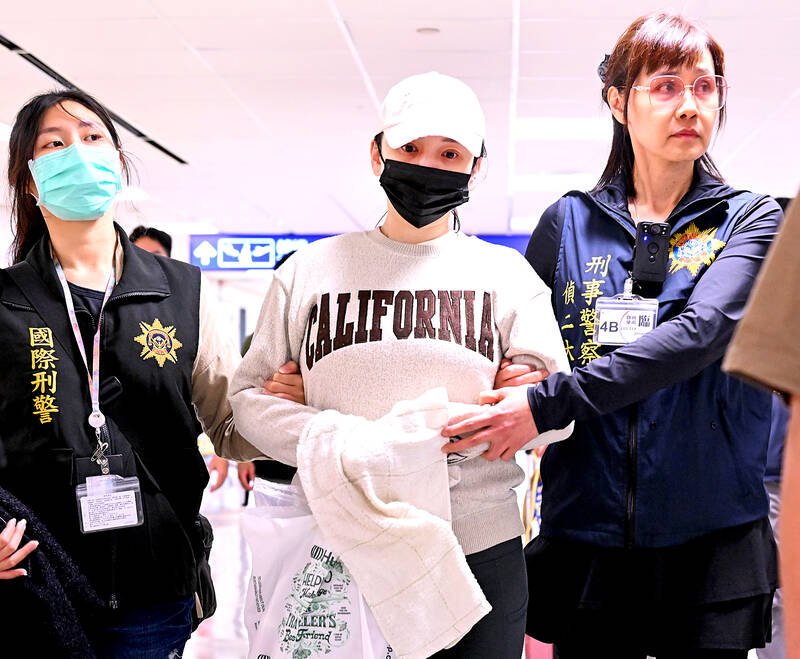
Johanne Liou, center, is escorted by Criminal Investigation Bureau officers to the New Taipei City District Prosecutors’ Office on June 4.
Photo: CNA
She fled Taiwan after becoming a suspect in separate investigations, including embezzlement, fraud and drug-related cases, as well as being charged with brokering Taiwanese women to serve as prostitutes in the US.
She returned to Taiwan and was arrested upon arrival in June after being repatriated from the US for overstaying her visa amid US President Donald Trump’s anti-immigrant push.
Prosecutors said she had joined a drug-trafficking group in the US led by Wei Yip Lou, who was linked to the Hong Kong-based 14K triad.
The cocaine, worth millions of New Taiwan dollars, was allegedly shipped to Taiwan as part of the operation, investigators said.
Wei allegedly supplied the drugs, while a man surnamed Lin (林) was responsible for mailing the drugs and another man surnamed Tzou (鄒) collected payments from buyers, they said.
After joining the group in 2021, Liou was allegedly responsible for finding buyers in Taiwan, prosecutors said, accusing her of contacting an air hostess surnamed Hsieh (謝) to discuss smuggling the drugs into Taiwan.
Hsieh then allegedly recruited a man surnamed Chang (張) to receive the shipment, while a man surnamed Yang (楊) handled customs clearance, they said.
In July 2021, Liou and the others allegedly hid the cocaine inside candles and placed them in a package with clothing, chocolate and metal trays to disguise the shipment, prosecutors said.
An unwitting courier company was hired to deliver the package to Taiwan, they added.
Liou allegedly used Telegram to communicate with Hsieh and the other suspects about how to retrieve the cocaine by melting the candles, they said.
When the package arrived in Taiwan in October 2021, customs officials suspected it contained drugs and opened it. They referred the case to prosecutors, prosecutors said.
Investigators linked the shipment to Hsieh, Chang and Yang, and Liou was detained for questioning after arriving back in Taiwan on June 4.
A source said Liou initially denied involvement, but later admitted transporting the drugs after meeting repeatedly with her lawyer at the detention center.
She wrote a letter expressing remorse, the source said.
Prosecutors indicted Liou on charges of transporting a Category 1 drug, smuggling controlled goods and participating in a criminal organization, and asked the court to impose a heavy penalty for transporting the Category 1 drug.
According to the Judicial Yuan’s sentencing information system, the average sentence for people convicted of transporting a Category 1 drug who qualify for sentence reductions under the Narcotics Hazard Prevention Act (毒品危害防制條例) and admit their crimes during trial is 15 years.
The accomplices in Taiwan have all been convicted, with Hsieh sentenced to seven years after identifying her supplier, Yang receiving nine years after turning himself in, and Chang sentenced to eight years.
Prosecutors said they would ask the court to reduce Liou’s sentence if she pleads guilty in her trial.
KioskNews shows a cleaned-up reading view extracted from the publisher’s page — the original always lives on their site, not ours.