From NCC Rifle Shooting To Asian Games Silver: Keralam's Vidarsa Vinod Scripts History
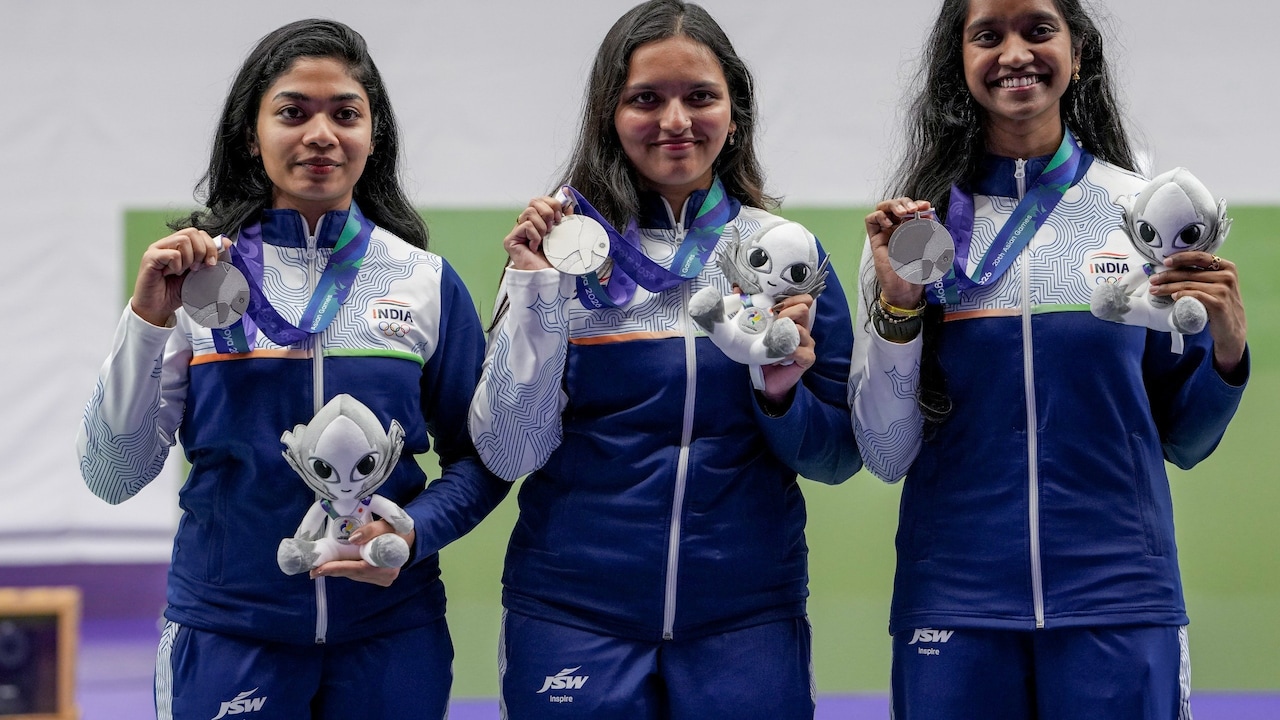
Vidarsa Vinod (left) was part of the Women's 10m air rifle team that won silver.
The first serious rifle that Vidarsa K. Vinod ever held in her hands did not belong to her, or to her family, or to anyone she knew. It was a Walther with a peep sight, donated some years ago to the Kozhikode District Rifle Association by the Calicut Parsi Anjuman Trust, which is the sort of gift that one small institution makes to another and that usually ends its life gathering dust in a storeroom. She turned up at the association in 2018, sent along by the NCC like hundreds of students before her.
In Japan, shooting for India at the Asian Games, she put up 630.4 points and came home with a silver medal.
It is worth dwelling on how close the whole thing was. India's three shooters, Sonam Uttam Maskar (634.1), Elavenil Valarivan (633.5) and Vidarsa (630.4), finished with a combined 1898.0, while Japan, shooting in front of their home crowd, ended on 1897.1. That is a margin of nine-tenths of a single point, which, in a sport measured in tenths, is barely a margin at all. China won gold with a world record of 1904.2.
This was a team event, which means the scores are simply added together and every shot belongs to everybody. Vidarsa was the third scorer, the one carrying the smallest number, and if she had dropped a single point anywhere across her 60 shots, India would have finished fourth and the three of them would have had no medals.
What's interesting is that nothing in her life before 2018 pointed anywhere near a shooting range. She grew up with music and dance, and at Sacred Heart UP School in Thiruvambady she competed in both, going as far as the district level, which in Keralam is a perfectly respectable place for a childhood talent to end. Then she enrolled at Guruvayurappan College in Kozhikode for a BA in Sociology, signed up for the National Cadet Corps the way students do, and the NCC put a rifle in her hands.
Vipin Das V. was at that camp. He is now the chief coach at the Kozhikode District Rifle Association, and he began coaching her the same year.
"I saw her talent in an NCC camp," he says. "It was a basic kit. I noticed her steady hands. I insisted she take membership in Kozhikode."
— Sony Sports Network (@SonySportsNetwk) September 20, 2026
Following his instructions, she started with an hour and a half of training at a time. These days, she averages five to six hours.
"She had no qualms about practising longer hours," Vipin Das says. "She totally surrenders to the coach. She would follow instructions to the tee. That was her specialty. In competition, she is never seen tense. That is something rare about her."
By 2020, he had decided she could make a national final. He thought she had it in her to be among the top eight in the country, which is a considerable thing to conclude about a shooter from a club with facilities like his.
Here is what those facilities amount to. There is no electronic range in Kozhikode. Every serious competition in the world is now shot on electronic targets, which register each shot instantly and to a fraction of a millimetre, and a shooter who has not trained on them arrives at a match having to learn the equipment and the pressure at the same time. Vidarsa trained on what the club had and travelled to Thiruvananthapuram to shoot on an electronic range.
"We all got together to make arrangements for her because I truly believed in her talent," says her first coach.
From 2021, she was based in Delhi, and there she made the top eight nationally, exactly as her coach had predicted. Only the top three go on to represent India internationally. She made that too.
A club rifle, though, will only take a shooter so far, because beyond a certain level everything in this sport becomes personal and expensive at the same time. You need a rifle fitted to your own body, a jacket stiffened to hold your stance, proper shoes and pellets that you buy by the tin and fire by the thousand. Her kit alone came to somewhere around Rs 10 lakh, and that was before the coaching fees, travel costs and the years over which all of it had to be sustained.
Her father, Vinod, is a mesthri, a skilled mason, the man who actually lays the brick and plaster on other people's buildings. His money comes in by the day or by the job, rises and falls with the season, and stops altogether when the work does. Anitha runs the household. There was never going to be a salary slip in that family strong enough to carry the cost of a rifle, a jacket, a coach and years of travel, and no bank was going to lend against one either.
What they did have was a parcel of land in Thambalamanna, a village in the hills above Kozhikode, so they sold it and borrowed whatever else was needed.
"The current debt is in six digits," says the family. "It's all for her achievement. It really doesn't matter," her father says with pride.
A competition rifle costs about as much as a small car. The way the family tells it, there was not much debate to be had. Their daughter was good at this, and they were not going to let money be the reason she had to stop.
It is worth being clear about what that decision actually cost them. A man who builds other people's houses for a living sold his own land to buy his daughter a rifle.
Institutional help did eventually arrive, though it arrived in the order these things usually do, which is to say only after the family had already taken the risk on their own. Once she made it into the Indian team, a scholarship followed.
Somewhere along the way, she also found someone who understood what this life actually demands. Manu S. Ravi, who is from Aryanad in Thiruvananthapuram, is also a shooter and belongs to the same association. The two married in 2025, in part so that two competitive shooting careers could be run out of a single household.
She is the first Malayali woman to win an Asian Games shooting medal, and only the second Keralite to do so. The first was P.T. Raghunath, who took individual bronze at Doha in 2006 and who happens to be an honorary member of the very same Kozhikode association that lent Vidarsa her first rifle.
Two Keralam medals, twenty years apart, both emerging from the same clubhouse.
Abijith Sabareesh, the association's honorary secretary, has watched all of it from the clubhouse. He gave her permanent membership in 2022 and says she has trained there since 2018.
"She was promising," he says. "She got the right facilities."
She is not finished either. She has qualified in the 50m rifle three positions and prone events, and the 50m discipline is the one she has been building towards all along. She shoots on September 26.
Beyond that, according to those at home, there is a larger ambition she has been talking about: qualifying for the Olympics and not merely going, but coming back with a medal. That is a very long way from a clubhouse with no electronic range, and she knows it better than anybody.
The story is certainly fascinating. A rifle donated by a trust, a coach who spotted her at a camp and kept believing in her, a club that made room for her, and a mason who sold land he was not planning to sell.
Almost all of it was built on goodwill, all to find a girl in Thiruvambady and help send her to Japan.
Her parents made that bet years ago with nothing whatsoever promised at the end of it, and it came back to them by nine-tenths of a point.
Whatever happens on the 26th, that bet is still running.
Featured Video Of The Day
India Ends CWG Boxing Campaign With Record-Breaking Seven Gold Medals
KioskNews shows a cleaned-up reading view extracted from the publisher’s page — the original always lives on their site, not ours.