Delhi mental health & well-being policy: 1 counsellor per 500 school students, 100 college students
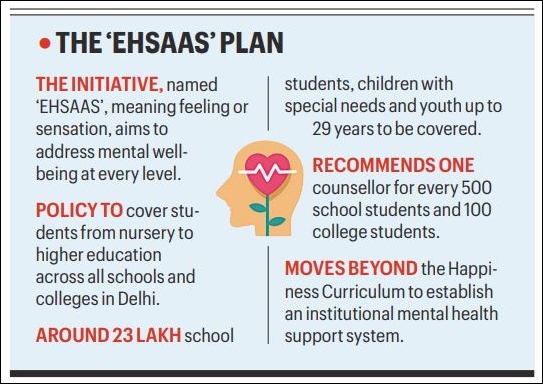
The Delhi government’s Mental Health and Well-Being Policy, set to be launched on Thursday, proposes an ambitious plan to appoint one counsellor for every 500 students in schools and one for every 100 students in higher education institutions, senior officials said.
The policy, which is expected to cover students from nursery through higher education, will apply to government, government-aided, CM SHRI and private schools, as well as colleges across Delhi.
Significantly, the policy seeks to make mental health awareness and emotional support a routine responsibility of all key stakeholders who interact closely with children in the school ecosystem, rather than placing the onus solely on counsellors and psychologists, senior officials said.
“An important feature of the policy is that responsibility for a child’s mental well-being will not rest with teachers alone. Administrative, non-teaching and transport staff who regularly interact with children will also be part of the support system,” an official said.
“Whether it is a teacher noticing a student’s sudden withdrawal, a school attendant recognising signs of distress or a bus staff member responding sensitively to a child’s emotional needs, the policy seeks to make such everyday interventions an integral part of the education system,” said the official, who was closely involved in finalising the policy.
Training and implementation
Under the policy, educational institutions will receive dedicated handbooks containing structured questions, practical exercises and activities to help staff identify early signs of emotional distress and respond appropriately, the official said.
“The assessment will be a months-long exercise across schools and colleges. This will be the first stage. In the second stage, students identified as requiring support through the mental health assessment may be provided counselling, if needed,” the official said.
Story continues below this ad
Officials said the policy had been finalised after a review by a team headed by Education Minister Ashish Sood and incorporates scientific and technical inputs from NITI Aayog, UNESCO and the Institute of Nuclear Medicine and Allied Sciences (INMAS).
“In addition, we have consulted specialists from government departments, private institutions and universities. The comprehensive consultation was undertaken to make mental and emotional well-being an integral part of education, rather than limiting interventions to situations where a student is facing a crisis,” the official said.
“We must look at education beyond classrooms, textbooks and examination results. Every child deserves an environment where they feel safe, heard and understood. Mental well-being should not be a conversation that begins only when a child is facing a crisis. We want to build a culture where speaking about one’s emotions and seeking support is natural, without hesitation or stigma. Our responsibility is to prepare children not just for examinations, but for life,” Sood said.
The policy is expected to bring around 23 lakh school students under uniform mental health support standards, including nearly 15 lakh students in schools run by the Directorate of Education and around eight lakh in private schools. Children with Special Needs and young people up to the age of 29, including those outside the formal education system, will also be covered, the official said.
Story continues below this ad
The policy also proposes psychometric assessments of personnel who work closely with children. These will involve structured tests designed to assess behavioural tendencies and emotional responses.
The policy will be formally launched on Thursday, November 19, at the Indira Gandhi Indoor Stadium in the presence of Lieutenant Governor T S Sandhu, Chief Minister Rekha Gupta and spiritual leader Sri Sri Ravi Shankar.
An official said the new policy differs from the Happiness Curriculum introduced by the previous AAP government through the State Council of Educational Research and Training (SCERT) in 2018 for students from nursery to Class VIII.
“While the Happiness Curriculum focused on classroom-based activities, the new policy seeks to establish an institutional support system extending to schools, colleges and young people across Delhi,” another official said.
KioskNews shows a cleaned-up reading view extracted from the publisher’s page — the original always lives on their site, not ours.