What is an ‘associate member’ of the EU? Nobody in Europe seems to have a clue
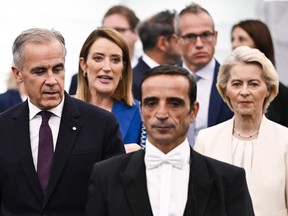
STRASBOURG, FRANCE — What does it mean for Canada to become an “associate member” of the European Union? At the European parliament, no one seems to have a clue.
Sign In or Create an Account
And while some members of the continental parliament seem excited at the prospect, the move has blindsided European governments, who were never asked to sign off on the announcement and are struggling to understand what it means, according to media reports.
On Wednesday morning, EU President Ursula von der Leyen officially extended an invitation for Canada to become an “associate member” of the 27-state block. The result of that invitation — and ongoing negotiations between both parties — is expected to be announced at a Canada-EU summit in Montreal in late October.
The announcement by the EU head was cheered by most of the hundreds of members of European parliament (MEP) in the room for her State of the European Union speech. In their replies to von der Leyen’s speech, many Parliamentary leaders celebrated the news.
But after the fact, European journalists, political staffers and MEPs were left scratching their heads about what it actually meant for Canada to become an “associate member” of the EU — a status that does not exist.
“It is a new category,” summarized Teresa Ribera, the European Commissioner for Competitiveness and a key figure in von der Leyen’s Commission. “What being an associated member today could mean will need to be developed and detailed in the time to come.”
She, like a half-dozen other MEPs interviewed by National Post after von der Leyen’s speech, was elated at the push between the EU and Canada to deepen their relationship unlike any other non-European country.
But as to what that actually looks like, no one seems to have a clue beyond Carney and von der Leyen.
Tobias Cremer, a centre-left German MEP who sponsored a spring resolution urging closer Canada-EU ties, said no one knows what “associate member” means, but it’s “provocative” — and he likes that.
“The signal should really be that we want as close in lines with Canada as possible. But I also think it might it will be interesting how it will be spelled out… It’s the first time that we are doing these things with non-geographically European countries.”
Speaking to reporters Wednesday afternoon, Canada’s incoming ambassador to the EU Jonathan Wilkinson explained that “associate member” was a name chosen by the Europeans to define the new deepening alliance.
After the Wall Street Journal reported last week that Carney and the EU were working towards an “associate membership” for Canada, the prime minister came out firmly denying that he was seeking any kind of formal membership within the European bloc.
“I think we’re still a ways away from actually landing on what we think is the best way to describe it,” Wilkinson said while avoiding to use the terms “associate member”.
A key concern with any form of membership in the EU would be submitting Canada to the union’s legendarily heavy regulatory regime in a wide swath of sectors.
Wilkinson said that there was a chance Canada would be bound by at least some of the EU’s regulations.
“It depends on the sector. We are focused on the things that we think we can make a lot of progress in the short term. Of course, there aren’t a lot of sectors in which we’d need to change regulations… But we can make progress without a lot of change to regulations,” Wilkinson said.
But what the final deal looks like is still up in the air, with both Canada and the EU submitting proposals as to how they could further collaborate short of fully integrating Canada into the union, the incoming ambassador said.
Dutch Labour politician Thijs Reuten said that he expects the new deal in the works with Canada will probably be extended to other interested non-EU countries eventually as well.
The important thing is that the countries share the same fundamental values.
“However, we need to see what is in the details of this, and surely how it also links to the most important topic, in my opinion: our collective defence and security,” Reuten said.
Virginijus Sinkevicius, an MEP from Lithuania, said the potential of a new class of EU member could be an opportunity to rethink the EU project.
A new, deeper relationship with Canada could lead to more labour and academic mobility between countries.
“But I think we start with the free movement of goods,” Sinkevicius said.
Could other non-EU countries, such as Ukraine or the U.K., eventually achieve associate member status?
“Who knows? Potentially. Who knows? It may be the case,” said Teresa Ribera, the first executive vice-president of the European Commission for a Clean, Just, and Competitive Transition and the European Commissioner for Competitiveness.
National Post
cnardi@postmedia.com
Our website is the place for the latest breaking news, exclusive scoops, longreads and provocative commentary. Please bookmark nationalpost.com and sign up for our politics newsletter, First Reading, here.
Join the Conversation
This website uses cookies to personalize your content (including ads), and allows us to analyze our traffic. Read more about cookies here. By continuing to use our site, you agree to our Terms of Use and Privacy Policy.
KioskNews shows a cleaned-up reading view extracted from the publisher’s page — the original always lives on their site, not ours.