Chinese engineers reduce cargo ship fuel use by 5% with high-speed torpedo tech
Supercavitating torpedoes can reach extreme underwater speeds by travelling inside a gas-filled cavity that sharply reduces their contact with water.
Beyond torpedoes, supercavitating projectiles can streak through the water at blistering speeds to intercept naval mines, incoming torpedoes and unmanned underwater vehicles, and even combat divers.
Now, Chinese engineers are applying a related drag-reduction principle to commercial shipping, with a bubble-lubrication system cutting net energy consumption.
Developed by the Shanghai Merchant Ship Design and Research Institute, a subsidiary of China State Shipbuilding Corporation, the second-generation intelligent Bubble Lubrication System (BLS) has been installed on a newly built 50,000-tonne product and chemical tanker.
The vessel has entered service, with the system achieving net energy savings of about 5 per cent during a five-month operational trial, according to a press release on October 17.
The savings could translate into significant reductions in operating costs for large commercial vessels. Based on a 50,000-tonne tanker with typical daily fuel consumption of about 20 tonnes, a 5 per cent reduction would save roughly one tonne of fuel a day, the press release noted.
This is an estimate based on typical consumption, rather than a direct measurement of daily fuel savings during the trials.
The system is designed for different types of commercial vessels and can operate with various energy sources. “The system is compatible with vessels powered by liquefied natural gas, electricity, methanol or ammonia,” the press release said.
02:57
China trials underwater data centres to solve energy woes
A 3,300 TEU (20-foot equivalent unit, roughly six metres long) feeder container ship equipped with the second-generation system is also expected to be completed and delivered soon. The technology has received recognition and undergone inspection by Italy’s classification society Rina and the China Classification Society.
The upgraded system builds on an earlier version successfully tested aboard a 1,800-TEU feeder container ship in April 2022. Development of the second generation began the following month, with engineers seeking to address the first generation’s reliance on manual operation.
The new system features an improved air-supply structure designed to reduce compressor power consumption, alongside automated controls and monitoring capabilities.
“An intelligent control system adjusts the air supply according to the vessel’s speed and draught,” the press release said. “A digital operational support system monitors and analyses the ship’s energy efficiency in real time.”
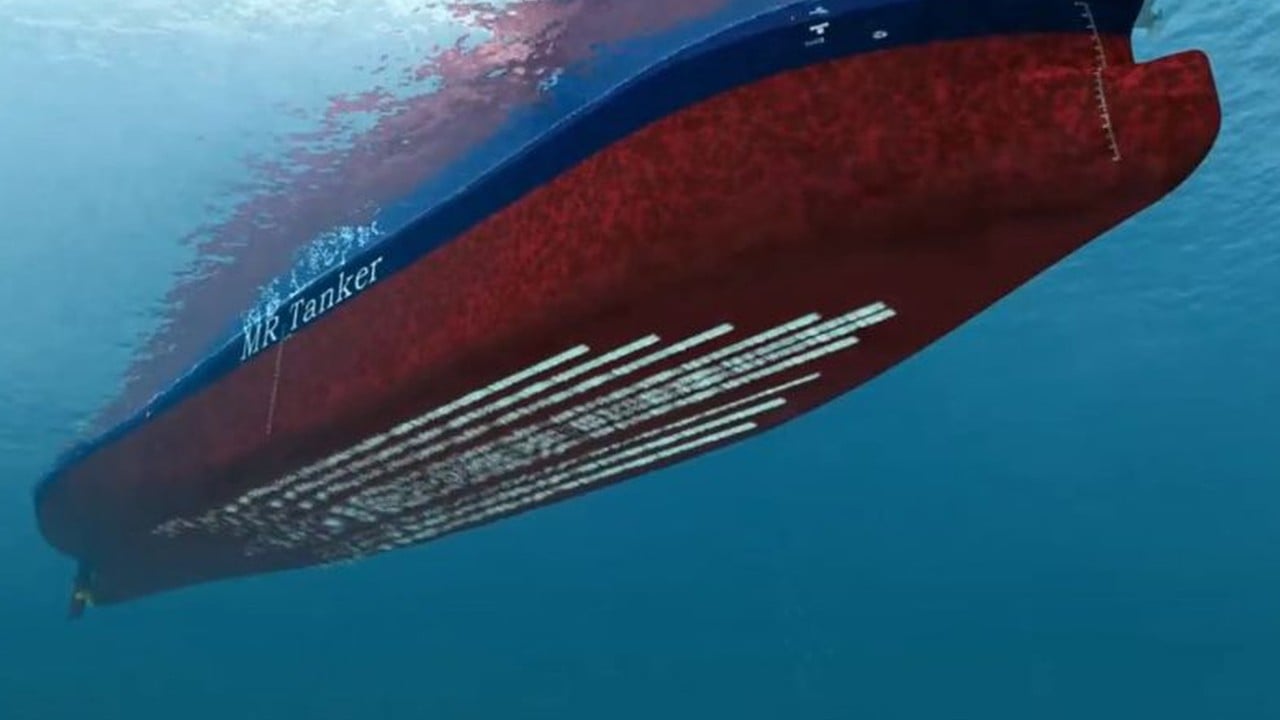
In operation, BLS continuously injects compressed air beneath the hull, forming a layer of microbubbles between the vessel and the surrounding seawater.
This changes the flow of water close to the hull, reducing frictional resistance and the energy required to propel the ship.
The system “turns the boundary layer of seawater around the hull into a gas-liquid mixture”, according to the press release.
However, the overall energy savings depend on whether the reduction in propulsion power outweighs the electricity consumed by the compressors generating the bubbles.
KioskNews shows a cleaned-up reading view extracted from the publisher’s page — the original always lives on their site, not ours.