‘I knew I was being followed’: Keira Knightley on her hacking nightmare – and new Stasi spy play The Lives of Others

Unpacking assorted tubs of carrot sticks and salad, Keira Knightley winces apologetically. “I just realised I’ve got very crunchy food,” she says. How apropos that she should consider the impact that her lunch might have on my audio recording when we are here to discuss The Lives of Others, a new play in which the characters are divided between the spies and the spied-upon.
Based on the Oscar-winning 2006 film and set in East Berlin in 1984, the play stars Knightley as Christa-Maria, a theatre actor in a relationship with a director, Georg, played by Luke Thompson. Earwigging on them is Wiesler (Stephen Dillane), the Stasi officer whose principles are gradually challenged and weakened by his round-the-clock exposure to this cultured couple.
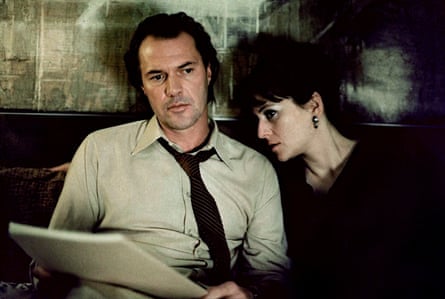
Florian Henckel von Donnersmarck’s original movie opens with an interrogation scene in which a persecuted citizen is grilled relentlessly for 40 hours – the length of time it takes, according to Wiesler, for a suspect to crack under questioning. I have only been allotted one-fortieth of that time with Knightley and Thompson, who has brought along his own leafy lunch to the north London town hall where rehearsals are under way. But I am still hopeful of extracting a few details about what the play’s visionary writer-director Robert Icke has up his sleeve. This is the man who introduced Sliding Doors-style alternate-reality scenes into Romeo and Juliet, put a countdown clock on stage in Oedipus (and others), and added the Beach Boys to Oresteia.
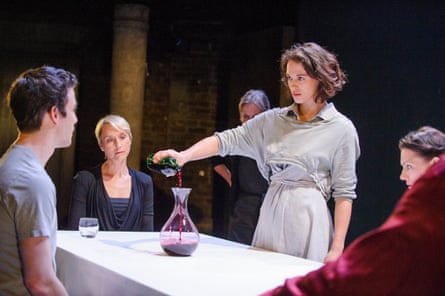
Interrogation techniques turn out not to be necessary today. “It’s quite a technical show,” volunteers Thompson, the 38-year-old Bridgerton star who worked with Icke previously on Hamlet (with Andrew Scott as the Prince) and Oresteia. “Rather than different scenes, it’s like one big set-piece with people coming in and passing batons. It’s almost musical.” Which is odd, laughs the 41-year-old Knightley, “because Rob hates dancing. He is not a man who dances.”
She has some beans of her own to spill. “We’re on a revolving stage,” she says, “so we’re always on the move.” This will enable the audience to see Christa-Maria and Georg at the same time as their Stasi eavesdropper. Thompson believes this lends the stage version an advantage over the movie: “Bringing a story about watching into the theatre is maybe even better, because the audience is literally peering in on what’s happening. Whereas in a film, there’s the barrier of the screen.”
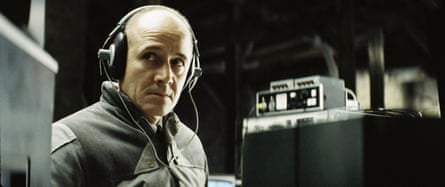
Only when I ask whether they are using the play’s new Max Richter score during rehearsals does Thompson become remotely tight-lipped: “I don’t know if I’m allowed to say that.” Knightley throws caution to the wind: “We are using it in rehearsal, yeah. It’s very beautiful. Everyone’s in the room: we’ve got the sound designer, the costume designer, the video designer …” Video, eh? Another hint. Icke used screens in the penetrating version of Orwell’s 1984 which he co-adapted with Duncan Macmillan; in his Hamlet, the Ghost turned up on CCTV. It’s a convention that risks seeming passe now. “Video can feel gimmicky,” Thompson concedes. “But it’s relevant here because it’s all about surveillance.”
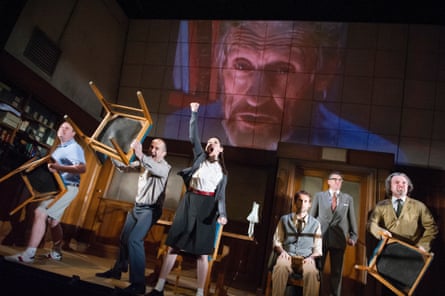
of 1984. Photograph: Tristram Kenton/The Guardian
The nature of surveillance in society has changed markedly, even in the two decades since the movie opened. “You want there to be a camera at the bus stop when your bag’s been nicked,” reflects Knightley, displaying a touching faith in police priorities. “You feel safer because of that surveillance. But then you ask: ‘Who is surveying me?’”
In the same year that The Lives of Others was released, she became part of the first wave of public figures to discover that their phone messages had been hacked by tabloids. How far has that helped her understand the sort of paranoia that dominates the play? “I do have a personal experience of what that is. Then again, I knew that my phone was being hacked because I had something tangible to show for it. There were stories. Or for me, it was mostly pictures. I knew I was being followed and then I could see that I was being followed. I didn’t feel like I was going mad. Whereas the characters are in a funny world where they don’t know when or if they’re being monitored.”

Modern parallels have been part of the rehearsal room discussions. I mention the likelihood that visitors to the US now have their social media accounts probed at immigration, and Knightley’s eyes light up. “Ah, but did that ever happen?” she asks. “Or is it enough that you say it’s going to happen for people to self-censor? You don’t even have to follow through on the threat. You just have to put it out there.” Thompson agrees: “It’s what’s so clever and efficient about the Stasi. The best way to create surveillance is for people to do it themselves.” And not only through self-censorship: estimates are that there was one informant for every 6.5 citizens in East Germany.
Top of the cast’s reading list for the play is Stasiland, Anna Funder’s 2003 account of life in the GDR. Funder has called Von Donnersmarck’s film “superb” but also “a fantasy narrative that could not have taken place (and never did) under the GDR dictatorship”. The Lives of Others, she wrote in 2007, “doesn’t accurately portray the way totalitarian systems work, because it needs to leave room for its hero to act humanely (something such systems are designed to prevent).” Another of her charges is that the movie inadvertently legitimised the ongoing campaign by former Stasi agents to launder their reputation.

In at least one documented instance, however, the movie has had a real-world benefit. In 2014, 43 veterans of an elite, clandestine Israeli military intelligence unit withdrew from participating in “the state’s actions against Palestinians”, protesting that their government was guilty of “political persecution” in refusing to distinguish “between Palestinians who are and are not involved in violence”. One Israeli whistleblower singled out The Lives of Others as the catalyst for his own awakening. He and his colleagues, he realised, “were similar to the kind of oppressive intelligence in oppressive regimes”.
Not everyone regards von Donnersmarck’s picture as a force for good. When a journalist recommended it to the actor Julie Christie in 2007, she replied: “I’m not sure I can bear to see a film they gave the Oscar to, that tells you what awful people communists are.” Thompson mulls this over. “There are characters who are mouthpieces for something along those lines,” he says. “But it’s not just a politics play. Part of the fun, I think, is that the characters are mysterious and you never know quite which way they’re going to go. If what audiences take from the play is ‘Communists are awful’, then I’d feel like we’d failed.”
Audiences can take what they like from it – as long as they don’t take photographs. It was the sight of phone cameras being whipped out for the curtain call at Icke’s Oedipus that sent its star, Lesley Manville, into a huff. (“Clap or don’t clap,” she later said, “but don’t just stick your phone in our face.”) Despite starring on stage in Ivo van Hove’s four-hour adaptation of Hanya Yanagihara’s A Little Life, where a phone ban failed to prevent the leaking of nude snaps of his co-star James Norton, Thompson trusts the audience. “I think people broadly follow the no-phone rule,” he says. Knightley may not have set foot on stage for 11 years (“Small children, no sleep” is her pithy explanation for the hiatus) but, as a punter, she notes approvingly the “absolute fucking fury from everyone if somebody’s phone goes off in the theatre”.
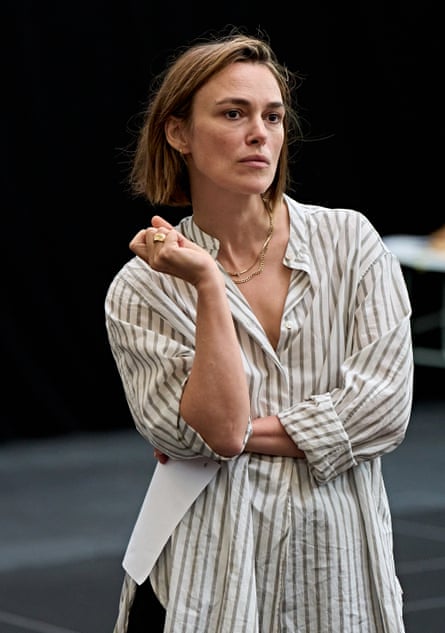
I wonder how they both feel about the standing ovations which have become ubiquitous to the point of meaningless at West End productions. Knightley thinks ticket prices might explain it. “I took my kids to see a musical recently and we really did enjoy it, but it cost so much that I was, like, ‘We are going to love this!’” With tickets for The Lives of Others peaking at £225, she and Thompson can expect to see audiences springing to their feet every night.
“In a strange way, though, the exchange that happens between actors and an audience during the clapping is the least important or interesting moment of it,” says Thompson. “If people see something good, it stays with them. Perhaps we’ve been missing that – and that’s why people get so excited.”
“I like your optimism,” says Knightley, clearing away the lunchtime detritus. “There’s me going, ‘Maybe it’s because the tickets are expensive.’ And you’re like, ‘It’s because the play transports you!’”
KioskNews shows a cleaned-up reading view extracted from the publisher’s page — the original always lives on their site, not ours.