The man who built Fremantle’s list of stars almost missed the job. This is why
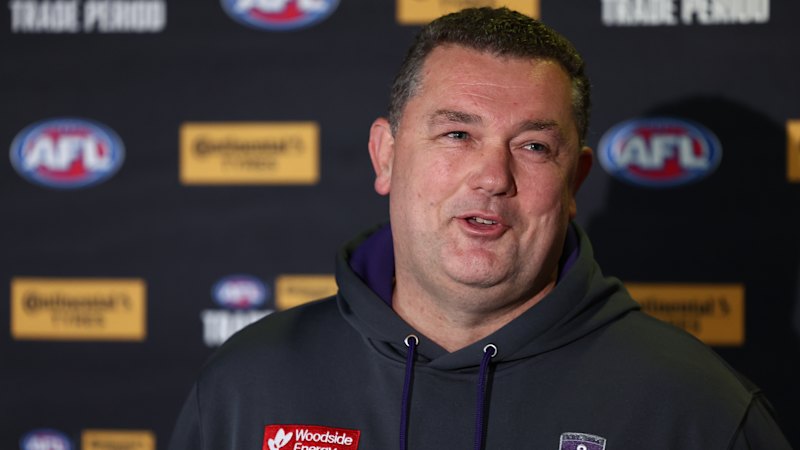
If Murphy Reid is the poster child for Fremantle’s list build, then David Walls is the silent achiever.
The son of the late, great Robert Walls is the Dockers’ affable list boss – technically the club’s head of player personnel – a man universally respected not only for his ability to unearth talent, but also to develop and maintain strong relationships in the tricky AFL climate.
Everyone this masthead spoke to about Walls this week, on and off the record, noted that he would hate the attention being on him. They all showered him with praise, anyway.
But Walls was not even the Dockers’ first choice to replace Brad Lloyd when the latter resigned to become Carlton’s football manager at the end of 2018. Many believed Walls was Lloyd’s obvious successor, but football boss Peter Bell instead opted for Mark Micallef.
Micallef lasted only a year in the job before parting ways with Fremantle, who belatedly promoted Walls from national recruiting manager – and the rest is history.
What has played out is a masterpiece that Picasso would be proud of.
Walls has pulled all the levers in the AFL’s player-movement mechanisms, from the draft to trades and free agency, recycled players and the pre-season supplemental selection period.
The Dockers plucked all of Patrick Voss, Corey Wagner, Mason Cox and Oscar McDonald off the scrapheap, and each will play in Saturday’s grand final against the Brisbane Lions.
“David’s done a phenomenal job,” said former Sydney and Brisbane list manager and recruiter Kinnear Beatson, who gave Walls his start as a low-level scout in the mid-1990s when his father was coaching the then-Bears.
“He’s not the sole decision-maker, and it’s been in conjunction with his team, but he drives it. His draft picks, by and large, have been spot-on. If you go through the list, and how he’s brought it together … ‘astute’ is the word I’d use.”
Those who know and have worked with Walls say his desk is fastidiously clean and uncluttered, he dedicatedly churns through game vision and is famously genial with the ability to be firm when required.
As Beaton puts it, “He is the type of guy who makes an impression, and parents would hope their son goes to his club”.
Walls prioritises home visits more than most in his position, according to industry sources, and that devotion ended up being critical in ignoring the groupthink noise around Reid.
“He gets to know the players and their families really well, and builds a rapport, which allows him to make really sound decisions on which players can come over to WA,” said Lloyd, who worked with Walls for 11 years.
Reid-ing the room
Reid is the crown jewel in Fremantle’s success, a whizkid whose output in his draft year – Vic Metro’s MVP, under-18 All-Australian and Talent League team of the year – screamed top-five pick. But, as has been well-told by now, he slipped to the Dockers’ first pick at No.17.
There were various concerns that led to Reid’s slide.
He was supposedly a flight risk who wouldn’t want to leave his family and friends behind. There was also the circulating story about an interaction with Ross Lyon’s kid that Reid recalls very differently.
On the field, recruiters feared he was too small, too slow and too often second in the possession chain rather than the one winning the ball at “the coalface”. He would need to make his living as a high half-forward.
But it is not like the Dockers were the only fans of Reid.
One experienced recruiter from a different club told this masthead in Reid’s draft year that his hands were so good he wouldn’t drop a catch if you fielded him at first slip. His decision-making in general was widely acclaimed.
Walls, recruiting manager David McMullin and the rest of Fremantle’s list-management crew, including Liam Woodland, Ed McMullin, Cam Allen and Nick Connors, did their due diligence across the board, including on character, and are reaping the rewards.
The go-home factor
The pick the Dockers used on Reid came via the same deal in which they secured Shai Bolton from Richmond, capitalising on the Tigers’ flagging fortunes to bring home a star.
Bolton’s arrival at the end of 2024 followed Fremantle luring West Australians Luke Jackson (2022) and Jordan Clark (2021) – who have both become All-Australians since – while they traded for Judd McVee last year.
Those three were all Perth-based player agent Jason Dover’s clients.
Walls loved Jackson and Clark as juniors, and was hellbent on trading for them after other clubs swooped. It was a different story with McVee. Walls admitted after seeing him thrive at the Demons that he evaluated him wrongly in his draft year.
“We have a relationship built on trust and working together,” Dover said of he and Walls.
“In an industry where you can’t trust a lot of people, he put the runs on the board really early in the piece.”
Jaeger O’Meara was another West Australian who returned to his home state under Walls’ watch, in a trade where Hawthorn agreed to pay a chunk of the experienced midfielder’s remaining contract.
The Big Cohuna
Reid might be the most recent and celebrated of Fremantle’s draftees, but the club’s list is littered with outstanding selections.
The Dockers importantly nailed their early picks, headlined by Caleb Serong, Hayden Young, Jye Amiss and Andrew Brayshaw.
In Serong’s case, they bundled selections to rise in the draft order to get him in 2019, using the collateral from Bradley Hill and Ed Langdon’s departures.
Fremantle selected Amiss with the prized pick from the Adam Cerra package after the midfielder left for Carlton.
But the Dockers also repeatedly struck gold later in the national draft, as well as in the rookie equivalent and the pre-season supplemental selection period (SSP), where they recruited Voss, Isaiah Dudley, Cox, Chris Scerri and Jeremy Sharp.
“Wallsy puts a value on those [later] picks,” Dover said.
“He goes harder at them, which you can afford to do when you’ve got the list they have now. Then, once they’ve hit the draft, they double down on getting better. They targeted Clark, Jackson and Bolton to be the cream on top of the cake, but the cake is built on lots of good draft picks.”
Lloyd said it was no accident that Fremantle had largely built through the draft because they “love growing their own”.
Treacy, known as “the Big Cohuna”, is one of Fremantle’s “own”. He and Karl Worner, two more members of the grand final team, were rookie-draft selections.
In an age when clubs are willing to write blank cheques for key forwards, Treacy came dirt cheap and has kicked almost 150 goals across the past three seasons.
But how did it happen? Treacy’s draft season coincided with the COVID-19 pandemic, so recruiters had far less to go on than most years. What limited vision scouts did have of Treacy showed a country kid with ability, but one who was carrying excess weight.
“David and his recruiters followed up, and they found out Treacy had got himself super fit, and they were impressed with his attitude,” Beatson said.
“It was a difficult time for recruiters during COVID, but David did it well.”
Among the Dockers’ other picks in that year were Heath Chapman, Nathan O’Driscoll and Brandon Walker. But nailing the draft is nothing new for Walls or McMullin, according to Lloyd.
Walls was the catalyst for Fremantle selecting Lachie Neale at No.58 in 2011, while McMullin convinced the Dockers to select a young Tasmanian by the name of Alex Pearce at No.37 two years later.
This is a club that has done things well for a long time to finally again be on the precipice of a maiden premiership after 31 years in the AFL. But arguably none has done it better than David Walls.
Keep up to date with the best AFL coverage in the country. Sign up for the Real Footy newsletter.
More:
KioskNews shows a cleaned-up reading view extracted from the publisher’s page — the original always lives on their site, not ours.