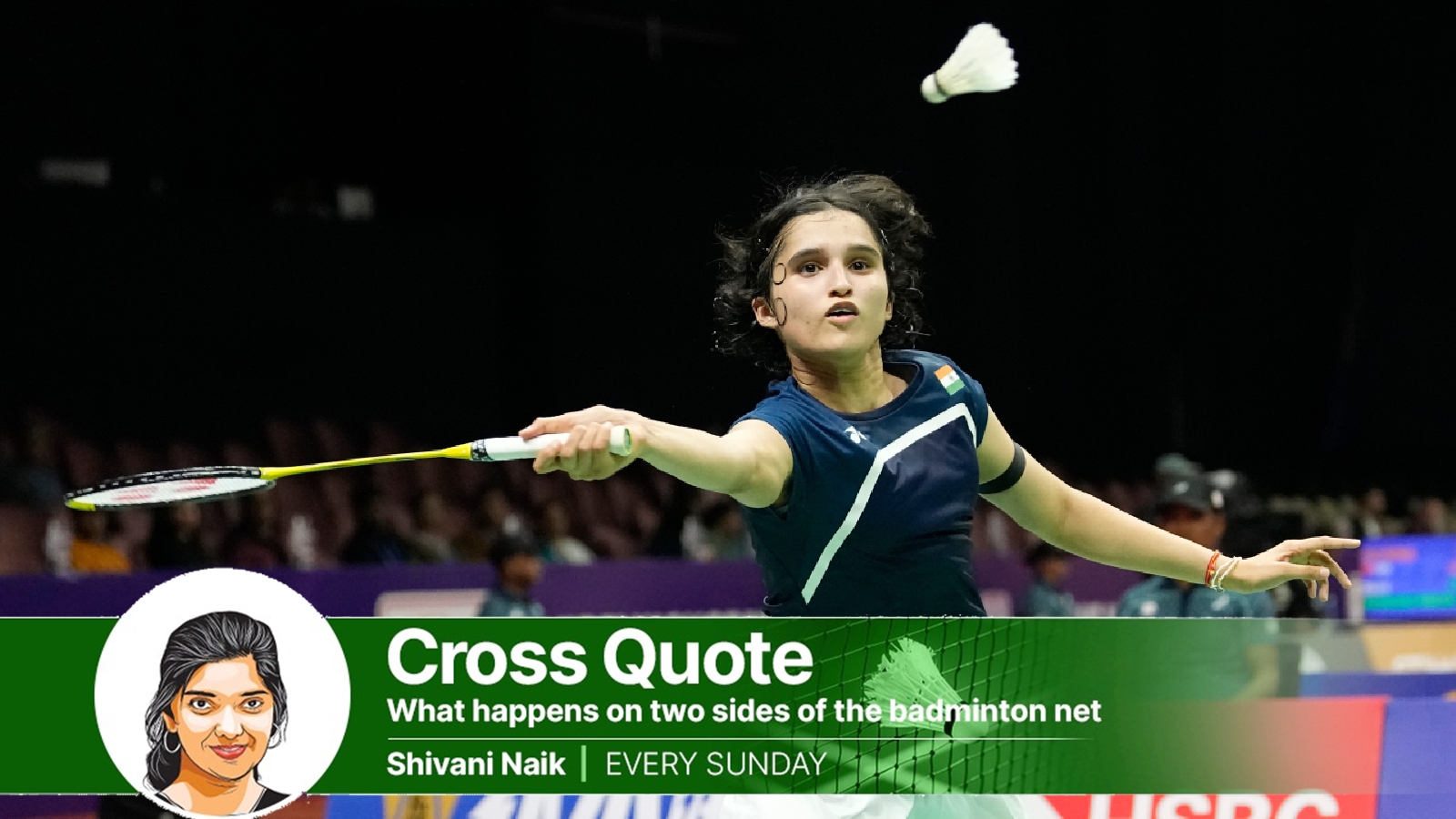
Unnati Hooda, the badminton player whose footwork social media won’t leave alone
They said Hariyanto Arbi moved funny. He broke from the past with his inside-out slice smash and drive attacks, and won world titles anyway, changing how men’s singles was played.
Former India international Aparna Popat cited him, not as a direct comparison, but as a way of looking at the much-maligned footwork of Unnati Hooda. “Unconventional has its advantages. When we crib about something looking different from the usual, we need to ask is there only one way to play? Is it hindering her? Is she expending too much energy or risking injury? Is it really that bad if she is playing well?” Aparna had asked.
Unnati went on to make the quarterfinals at the Asian Games while not even in the Top 20. She played three matches within 18 hours, beat a Top 10 player and put up one of the best fights against Akane Yamaguchi by an Indian not named Saina or Sindhu.
Coach Gurusaidutt was amused to see her footwork villainised on social media. He called her grit rare. He and Aparna agree that 10-15 per cent tweaks could make her life easier, but the footwork bashing could stop after she beat Putri Kusuma Wardani and gave Yamaguchi a tough time.
Unfazed by criticism and choosy about whose opinion she heeds, Unnati has trained on a range of things this year with strength and conditioning coach Atish More and physio Shruti Gharat, both stationed at Rohtak and funded by Reliance Foundation.
***
There is general consensus that Unnati has a long way to go on fitness, given she isn’t as strong or tall as Saina or Sindhu. The Haryanvi grasps sports science concepts quickly, and her natural recovery is encouraging for back-to-back matches. She didn’t exactly struggle with only four hours between two matches on a manic Saturday when several top names lost. Nobody is claiming her speed, power, endurance and movement patterns are at optimum. But the Asiad showed she is on the right track.
An Se-young sets the standard of court movement. For Unnati, mere “corrections” to striding would not get her to recover for the next return fast enough or strongly enough, so the approach was manifold.
Her anaerobic capacity is rising slowly, by 5-10 per cent, which is natural. When the team sensed her diagonal loading wasn’t quite up there, plenty of multi-directional drills were introduced. Interval training on the track is woven in more pointedly, More says. The footwork police weren’t entirely off the mark, though they exaggerated its impact on her game.
Story continues below this ad
Unnati’s lateral movement and net approach aren’t the most efficient. “We work a lot on multiplanar drills, for the (imbalanced) eccentric movements,” More says. Most of badminton, all of it, is about taking the shuttle early on a treadmill of micro-second eccentric movements. Core strength for anti-rotation movements has been the focus these past few months, especially in the 15 days between the World Championships and the Asiad. Kettlebell swings, pogo jumps and concentric jump squats are now intrinsic to her training, even if the lunges will take time to convince her critics.
With LA28 as the target, the goals are long term. “Her upper body strength isn’t great,” More explains; she generates power from her lower body for now. She returns shots at a fast clip with good hand speed, but the feet don’t always keep pace. Her speed is alright. Endurance will need work.
The biggest challenge in getting into the Top 30 was cutting down on continuous tournaments for points and avoiding overtraining, which took a lot of convincing.
Twisting and turning to chase shots on either flank, and hip-related issues, can affect footwork. Physio Shruti says one area of correction was her lunges. Shifting the weight forward is to be expected, but Unnati would also lean forward, which hurt her recovery for the next return. It was a small part of the “footwork problem”, the 10-15 per cent Gurusaidutt spoke of, and needed gradual addressing.
Story continues below this ad
***
A lot of resistance training also went into wrist elasticity, which helps deception and matters so much in the women’s game. She’s not a natural at it like Tanvi Sharma, but Unnati is known to work on weaker aspects of her game and get good at them, with the meticulousness of building blocks.
Her team is expanding an endurance bandwidth for the retrieving game, and it showed in her three matches in 18 hours. She follows 20-stroke rallies with higher-intensity shadows, to build solidity into her shots right after she hits the “Tired” button. She might look totally beat, but there are reserves she digs into that surprised opponents at the Asian Games. Thirty-second sprints on the track are also helping the footwork.
Aparna says there is no textbook way to move. As long as Unnati plays as she did at the Asian Games, nitpicking her striding serves no purpose. Unnati follows her own growth curve, and has a team backing her preparation.
KioskNews shows a cleaned-up reading view extracted from the publisher’s page — the original always lives on their site, not ours.