Share of drug offenders in prison dropping: agency
By William Hetherington / Staff writer, with CNA


The percentage of inmates serving sentences for drug use has fallen over the past five years, largely due to community-based addiction treatment for people whose crimes were relatively minor, the Agency of Corrections said yesterday.
The government uses deferred prosecution with court-mandated addiction treatment and other community-based measures for people who use drugs without committing serious crimes, reducing unnecessary incarceration and limiting their contact with drug dealers in prison, the agency said.
Drug policies have drawn renewed debate after Democratic Progressive Party Taipei mayoral candidate Puma Shen (沈伯洋) proposed anti-drug measures for schools.
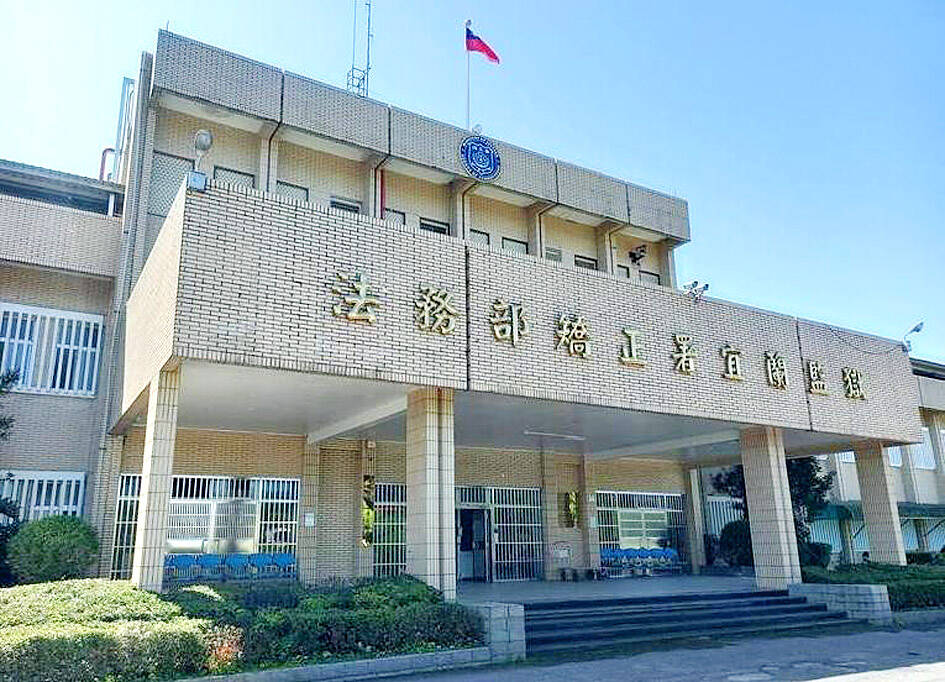
Yilan Prison is pictured in an undated photograph.
Photo: Chiang Chih-hsiung, Taipei Times
The Chinese Nationalist Party (KMT) subsequently cited an article Shen wrote in 2014, asking whether he had advocated providing drugs and clean needles at community centers.
Taipei Mayor Chiang Wan-an (蔣萬安) of the KMT, who is seeking re-election, said he supports methadone programs and the provision of clean needles, but opposes drug decriminalization and setting up community centers to provide drugs.
The two sides have over the past few days traded arguments over drug policy.
The third phase of the government’s New Generation Anti-Drug Strategy Action Plan, covering this year to 2028, draws on approaches adopted by other countries, and emphasizes differentiated referrals and a range of treatment options, Agency of Corrections data showed.
People whose cases primarily involve addiction and medical needs, and whose offenses are relatively minor, are given community-based treatment, while those who were involved in violence, serious crimes or other offenses are sent to correctional institutions, the agency said.
The approach allows people to receive the most appropriate treatment while reducing unnecessary incarceration and prison overcrowding, it said.
Agency data showed that 17,428 inmates were serving sentences for drug use in 2022, accounting for 35.1 percent of the total prison population of 49,720. That proportion fell to 33.2 percent in 2023, 31.7 percent in 2024 and 27.7 percent in last year.
As of June 30 this year, 14,521 inmates were serving sentences for drug use, accounting for 24.8 percent of the total 58,455 inmates, the data showed.
People who are sent to correctional institutions generally have more complex criminal circumstances, addiction problems and psychosocial needs, the agency said, adding that it is continuing its evidence-based drug offender treatment program and working with the Ministry of Health and Welfare on an integrated drug addiction treatment and quality improvement program in correctional institutions.
Since 2019, the agency has recruited psychologists and social workers, and formed interdisciplinary teams to expand services for inmates with high-risk needs, including addiction treatment.
Inmates in correctional institutions can also receive addiction treatment, the agency added.
People who complete deferred prosecution with mandated addiction treatment had a 66.3 percent lower risk of relapse compared with those who did not complete treatment, it said, citing research by the Crime Prevention Research Center at the Ministry of Justice’s Judicial Academy.
The agency said its overall policy emphasizes that targeted diversion and appropriate treatment are key to preventing recidivism.
Medical, psychological, social work and community resources should be coordinated in both settings to ensure that support continues after an inmate’s release, which would help reduce the risk of reoffense and help them reintegrate into society, it added.
KioskNews shows a cleaned-up reading view extracted from the publisher’s page — the original always lives on their site, not ours.