Canada can learn some hard lessons from Brexit as it pivots to the EU
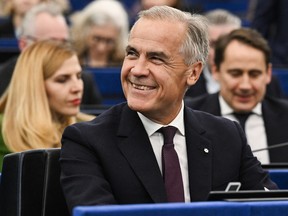
European Commission President Ursula von der Leyen’s State of the Union on Wednesday revealed that the European Union is opening the door for Canada to become its first associate member.
Sign In or Create an Account
That news came just days after Prime Minister Mark Carney spoke of forging a “unique alliance” with the bloc. To separate the geopolitical symbolism of the EU’s invitation from the economic constraints that would limit any attempt to make Europe a substitute for the United States, National Post spoke with Anand Menon, professor of European politics and foreign affairs at King’s College London and director of the UK in a Changing Europe initiative, about the lessons Canada might take from the United Kingdom’s Brexit experience.
Menon has spent years looking at the U.K.’s relationship with the EU, Brexit’s political economy, and the trade-off between sovereignty and market access — the same issues raised by von der Leyen’s associate-member overture to Canada.

Get a dash of perspective along with the trending news of the day in a very readable format.
By signing up you consent to receive the above newsletter from Postmedia Network Inc.
A welcome email is on its way. If you don't see it, please check your junk folder.
The next issue of NP Posted will soon be in your inbox.
We encountered an issue signing you up. Please try again
This Q&A has been condensed and edited for clarity.
Anand Menon: Bear in mind, the vast majority of Canada’s trade is still with the United States and will be, because that’s the key lesson, isn’t it? That geography is the major determinant of trade patterns, and you trade a lot more with countries that are close to you. I think that the untruth sold by Brexiters about trade was the argument that Asia’s growing a lot faster than Europe, so if we become free of the European Union, we can trade more with the part of the world that’s growing very fast.
Now, that’s true to a point, but it’s always going to be the case that we will trade a lot more with Europe than we will with Asia, and fundamentally, however much we do Brexit, we’re not going to reappear in Asia. So however fast Asia is growing, we’re not in it.
So you can do trade deals. One of the reasons why the European Union is willing to make all these very nice positive noises towards Canada, without being too cynical about it, is because Canada is bloody miles away. You’re not going to get livestock wandering over the border between Canada and the European Union. So, in a sense, it’s far easier to do this sort of thing with a country that’s miles away because you do far less trade with them, and the risks are far less.
Well, without being facetious about it, I’m not going to start eating fresh unfrozen seafood from Canada, because it’s going to be on a boat for a few days. It’s that constraint of geography again. You’re not going to do just-in-time automotive supply chains with Canada in the same way you will do it with partners that are across the short straits between Dover and Calais, because time matters when it comes to trade.
There are economic studies out there that show there’s a very strong geographical bias even when it comes to trade on eBay, which is partly because of language, partly because of time. If you want to buy something online, you want it to arrive quickly.
This isn’t to say that Canada can’t diversify. I just think there are limits to how much Canada can and will diversify. It’s very striking that the recent tariffs with the U.S. affect (a small percentage) of Canadian trade with the United States. It’s a relatively small proportion.
The way I read Carney is it’s a very, very good political narrative with slightly less in the way of economic substance behind it. Because ultimately, for all the rhetoric, the United States is going to remain your largest and most important trading partner.
That wasn’t a criticism because, actually, if you have a very good political narrative that you can sit by the reality of the fact that you’re still having the United States as your closest trading partner, then it’s a win-win.
Well, the UK is not leaving its economic relationship with the European Union, and this is the key difference: Brexit affected 100 per cent of our trade with the European Union. The U.S. tariffs are affecting 15 per cent of Canada’s trade with the United States.
(Editor’s note: The latest U.S. tariff package covers roughly 5 per cent of Canadian exports to the United States.)
So the people who are making the facile comparison of “Oh … you know, all those remainers praising Canada were very critical when we did the same thing.” But we didn’t do the same thing. We imposed a massive amount of costs on the whole of our trade with our largest trading partner.
Canada is the victim of a mercurial American president who’s a pain in the ass to deal with, but even so, it is a relatively small proportion of Canadian trade with the United States that’s being affected.
Geography sets limits. Canada never wants to be as reliant on the United States in the future as it was in the past, and that makes perfect sense. Again, geography imposes limits on that. I think the fact is, if you’re a medium-sized country stuck up on the border with a continental-sized economy, your worldview is going to be shaped decisively by what that continental-sized economy does, and that’s as true if you’re Vietnam next to China or as if you’re the United Kingdom next to the European Union or if you’re Canada next to the United States.
Well, it depends on how well you play the politics of your trade deals because if you go back to Liz Truss as U.K. trade secretary, she was massively successful on Instagram and on social media at promoting these trade deals as a big deal. And, you know, all the while she was doing that, my economist friends had their heads in their hands saying, “But it’s utterly trivial. It doesn’t make any difference economically.”
Well, you know, politics doesn’t really care about reality sometimes and, you know, I think from a political perspective, it makes sense for Carney to big these things up.
He’s economically savvy, but he’s in the world of politics now. So I imagine that Mark Carney’s never going to say, “Well, this deal with the European Union accounts for a very trivial amount of economic activity, but it’s quite a good deal, so this is a big deal. This is Canada de-risking. This is Canada striking out into the world and forging partnerships with other countries.”
It’s always going to be slightly less than it sounds just because of geography.
I think down the line, if Canada starts thinking about doing regulatory alignment deals with the European Union, that could have a massive impact. If you think about things like agriculture, if the Canadians say, “Okay, we’re going to align our agricultural rules with the European Union to make trade easier,” that will limit the ability to do deals like that with the United States.
If you start thinking about regulatory alignment, it will have an impact because aligning with Europe means it’s harder to do stuff with the United States. So they are the areas where you get trade-offs, but I don’t think anyone’s talking about that kind of thing yet.
Well, it is partly market access, isn’t it? It’s regulations. Tariffs are a trivial part of the constraints on international trade. It’s non-tariff barriers. It’s differing standards, it’s differing rules, it’s the need for checks. They are the things that impose costs on international trade. That’s why the European Union’s single market is such a powerful thing because it removes those obstacles.
In a sense, the test for Canada would be how far it wants to go in thinking about things like regulatory alignment above and beyond getting rid of tariffs and stuff like that. And there, you know, the CETA deal does a tiny amount, but not very much. And the question is whether the two sides are willing to go further.
It might be that actually the Canada-EU thing turns out to be something that’s far more about security and defense than it is about economics. We’ll have to wait and see because in (von der Leyen’s) speech today, there was obviously very little in the way of detail.
Well, it makes it harder because, of course, the European Union is in the process of doing what the U.S. did under Joe Biden to try and defend itself against unfair Chinese trade practices by essentially doing European preference on a lot of procurement. That’s having massive implications for the U.K. and will have massive implications for other trading partners of the European Union.
If there is a European preference, you know, the U.K. is engaged in a negotiation with the EU at the moment, trying to make itself count as European for these things, right? So that will be an issue for Canada as well, I would imagine.
I think the difference between now and sort of pre-COVID is that pre-COVID it was all about trade and openness and maximizing exchange with other countries. Now it is keeping in the back of your mind the need for resilience, the need for greater self-sufficiency, the desire not to be too dependent upon any one partner.
Well, I’m not sure (the U.K.) has realized that. I mean, in a sense, we still want to have our cake and eat it with the Chinese, don’t we? We want to, while acknowledging that they’re a threat and seeing intellectual IP theft and spying and all that going on, we still want to maintain our trading relationship with China as if none of that were going on.
I mean, that’s just a really difficult choice for European countries that we haven’t really addressed yet.
Everyone faces the same trade-offs because we’re in a world of increasing mercantilism, where the biggest economies are also countries that are far less reliable than they used to be. China’s more of a threat now than it used to be or is seen as such. The United States is Trump’s United States. So yeah, it’s all more complicated now. The trade-offs are far more complicated, and life is just not as simple as it used to be.
No. I think one of the really interesting things for me was that after Trump 1.0, attitudes towards the United States pretty much bounced back to where they had been beforehand.
I think now, particularly in specific countries that have seen themselves threatened directly. So, you know, the two countries where I think there has been a fundamental shift are Canada and Denmark because of direct threats to their territorial integrity from the United States. I don’t think you bounce back from that in the same way.
It’ll be interesting to see. I imagine everyone else will be on a sliding scale. Some countries will bounce back further than others because they haven’t been directly threatened in the same way, but I think these changes will be more permanent than they were after Trump 1.0. I’m just not quite sure to what extent, and it will vary by state.
Well, a strategy in which a future Donald Trump couldn’t try to extort Canada using economic levers, and you’re never gonna achieve that completely. So the question is to what extent you can achieve it.
Don’t get me wrong, I think Trump is going to come under massive pressure, particularly from U.S. states neighbouring Canada, to row back on this because it’s going to have a massive impact on Michigan, on New York, on places like that which are very reliant on those sort of open trading arrangements with Canada. So I think this is a story we need to judge over the medium term, not the short term.
We haven’t come to terms with the fundamental trade-off of Brexit, which is that trade-off between political autonomy and market access. We’ve gained a significant degree of political autonomy at the cost of significant amounts of market access, and we are living with the consequence of a significant impact, negative impact on our economy as a result.
I’m not sure that’s anything we come to terms with because we wrestle with that trade-off, which is we don’t like the idea of being tied into membership, but we certainly don’t like the idea of losing four percent of GDP over the medium term either, and we just don’t know where public opinion ends up going on that.
National Post
Our website is the place for the latest breaking news, exclusive scoops, longreads and provocative commentary. Please bookmark nationalpost.com and sign up for our newsletters here.
Join the Conversation
This website uses cookies to personalize your content (including ads), and allows us to analyze our traffic. Read more about cookies here. By continuing to use our site, you agree to our Terms of Use and Privacy Policy.
KioskNews shows a cleaned-up reading view extracted from the publisher’s page — the original always lives on their site, not ours.