Official warns of China poll risk
HISTORIC MILESTONE: After 30 years of democratic elections, Taiwan must ensure that the system continues to remain free from external influence, an official said
By Chung Li-hua / Staff reporter


Mainland Affairs Council (MAC) Deputy Minister Shen Yu-chung (沈有忠) yesterday warned of possible Chinese interference in next month’s local elections.
Shen made the remarks at the annual meeting of the Taipei-based Chinese Association of Political Science and an international conference titled “Rethinking Democracy: Continuity and Change in the Values and Practice of Modern Democracy.”
This year marks the 30th anniversary of Taiwan’s first direct presidential election. In 1996, despite missile threats from China, Taiwanese voters bravely went to the polls, marking a historic milestone in their ability to determine their own future through the ballot box, Shen said.
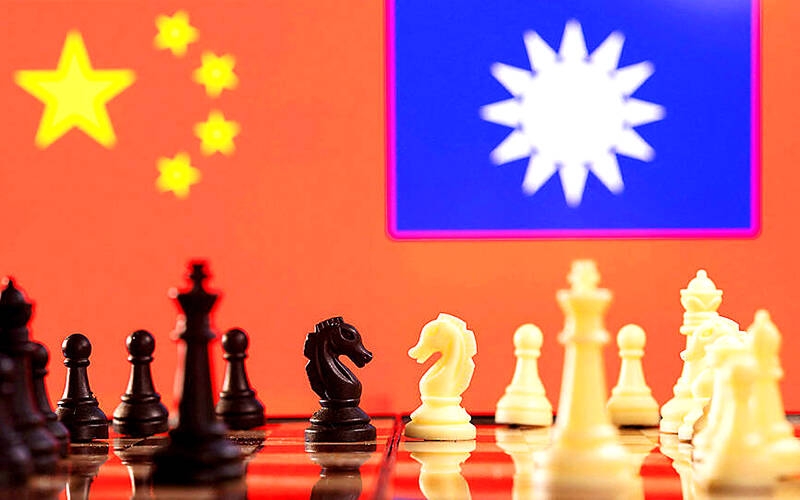
Chess pieces are pictured in front of People’s Republic of China and Republic of China flags in an undated photograph.
Photo: Reuters
Over the past 30 years, Taiwan has held eight direct presidential elections and experienced three changes of ruling party, consolidating its democratic system while becoming a key partner in the global artificial intelligence and semiconductor supply chains, he said.
Shen stressed that the fundamental difference between Taiwan and China lies in their political systems: democracy versus authoritarianism.
Beijing has long sought to impose its “one country, two systems” framework on Taiwan and uses “united front” tactics to infiltrate the nation and spread political propaganda, with the goal of eliminating the Republic of China (ROC) and annexing Taiwan, he said.
However, Taiwan’s mainstream public opinion has firmly rejected “one country, two systems,” Shen said. Nearly 80 percent of the public supports maintaining the cross-strait “status quo” in which the ROC and the People’s Republic of China are not subordinate to each other, a reality that must be acknowledged in any discussion of cross-strait relations, he said.
The challenges facing democracies today extend beyond conventional military threats to include authoritarian powers such as China and Russia using “gray zone” tactics, information manipulation and infiltration to divide democratic societies and undermine public trust and unity, he said.
With local elections to be held this year, Beijing might continue to interfere in Taiwan’s democratic processes to influence voters’ independent judgement, he said.
In response, Taiwan must continue to bolster its democratic safeguards and societal resilience to ensure that its democratic system remains free from external interference and that people can exercise their democratic rights in a free and secure environment, Shen said.
KioskNews shows a cleaned-up reading view extracted from the publisher’s page — the original always lives on their site, not ours.