CDC announces the first local typhoid case of 2026
By Lee I-chia / Staff reporter


The Centers for Disease Control (CDC) yesterday announced this year’s first locally acquired case of typhoid fever, adding that although cases of flu-like illnesses, including COVID-19, declined slightly last week, the case numbers and deaths were still high.
CDC physician Lin Yung-ching (林詠青) said the typhoid fever case is a woman in her 30s who resides in central Taiwan.
The woman developed symptoms, including fever, vomiting and diarrhea, in late August, Lin said.
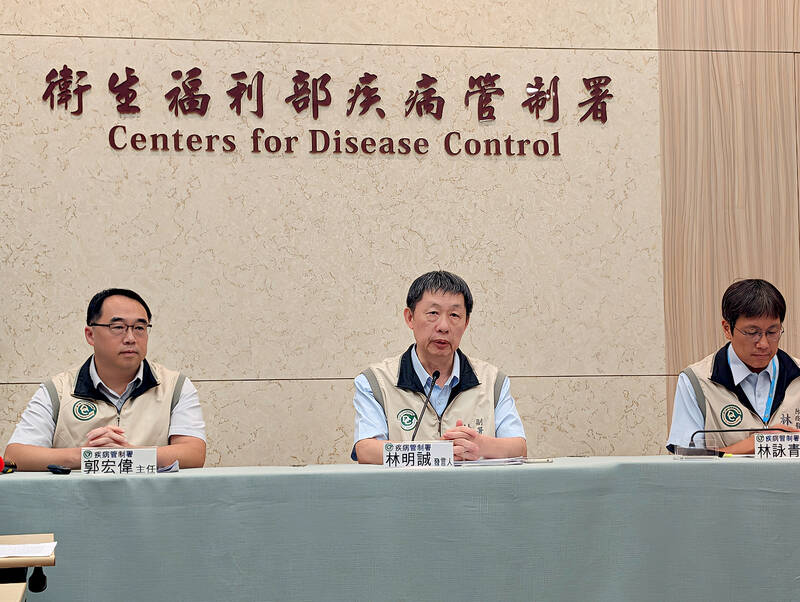
From left, Centers for Disease Control (CDC) Epidemic Intelligence Center Director Guo Hung-wei, CDC Deputy Director-General Lin Min-cheng and CDC physician Lin Yung-ching attend a news conference in Taipei yesterday.
Photo: CNA
She sought treatment and took medicine to relieve her symptoms, but the fever, as well as headaches and general soreness developed early last month, Lin said.
The woman sought treatment again and was hospitalized, he said, adding that a blood culture test confirmed that she had contracted typhoid fever.
The woman recovered after about a week in hospital, he said, adding that she reported having eaten raw seafood — including sashimi and raw oysters — during the incubation period.
There are typically only about two or three locally acquired typhoid fever cases each year, Lin said.
The disease is an intestinal infection caused by the Salmonella typhi bacteria. It has an incubation period of about eight to 14 days.
Typhoid fever spreads through contaminated food and water, so sashimi, and raw oysters and clams are high-risk foods, Lin said, adding that people should practice good hand and food hygiene, such as only drinking boiled or bottled water when traveling in areas with poor public health and sanitation.
Common symptoms include persistent fever, headache, fatigue, loss of appetite, abdominal pain, diarrhea, relative bradycardia, and lower chest and abdomen rashes in some cases, he said.
As early symptoms of the disease are highly non-specific, it can often be misdiagnosed as gastroenteritis or other diseases, he added.
Meanwhile, CDC Epidemic Intelligence Center Director Guo Hung-wei (郭宏偉) said there were 139,060 medical visits for flu-like illnesses and 7,836 medical visits for COVID-19 last week, both slightly lower than a week earlier.
However, both are still in the epidemic period, Guo said.
There were 219 severe flu cases and 44 flu-related deaths, as well as 37 serious COVID-19 cases and 16 deaths confirmed last week, he said.
One of the COVID-19 deaths was a man in his 60s who had cirrhosis and received his last COVID-19 vaccine in 2022, Lin said.
The man developed a fever, coughing and general weakness in the middle of last month, and took medicine without consulting a doctor, Lin said.
He was hospitalized when his symptoms worsened, including difficulty breathing, and he died 10 days later, Lin said.
Contact tracing found people who lived with him had similar symptoms last month, but they had not been tested for COVID-19 and recovered, he added.
The CDC urged people with higher risk of developing severe illness or death from flu or COVID-19 to get vaccinated and to seek medical attention when they develop suspected symptoms.
Shortness of breath, difficulty breathing, cyanosis — a bluish or purplish discoloration of the skin, lips or mucous membranes — bloody sputum, chest pain, altered consciousness and low blood pressure can be signs of severe complications, it said.
CDC Deputy Director-General Lin Min-cheng (林明誠) said flu activity is expected to slightly fluctuate throughout this month, with the epidemic period possibly ending next month.
People should still practice good hand hygiene and cough etiquette to prevent infection and spreading the virus, he said.
KioskNews shows a cleaned-up reading view extracted from the publisher’s page — the original always lives on their site, not ours.