Cooking with Tom Kerridge, the Michelin ‘meatfluencer’
Tom Kerridge is the king of meat: first as a chef, transforming pub classics like pork belly into Michelin-starred fare at The Hand and Flowers in Marlow 20 years ago, and later opening The Butcher’s Tap and Grill in the same village; then as a cookery writer: his Outdoor Cooking – The Ultimate Modern Barbecue Bible of 2021 is well named, being both as comprehensive and as worshipful as a holy book; and recently as a “meat-fluencer”, making gorgeous skills videos on Instagram and YouTube.
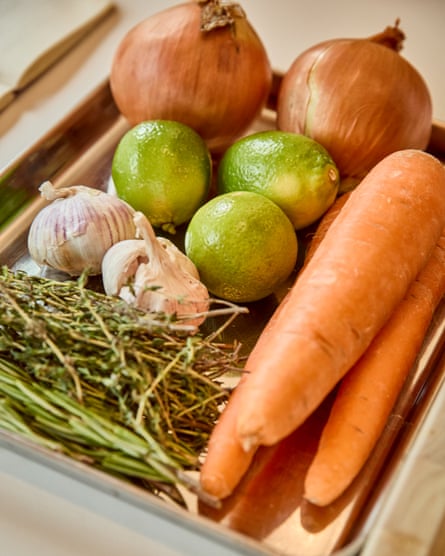
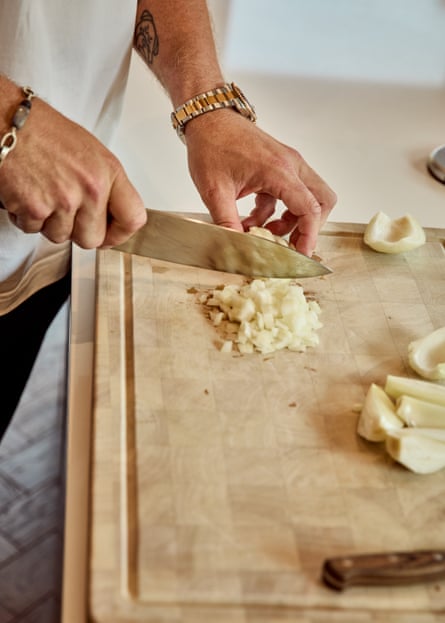
That was just destiny, he says (more or less). “When you’re cooking in a classic brigade system, the sections are like a larder: you’ve got starters, you’ve got garnish, you’ve got meat and fish, you’ve got pastry. The meat is the lead section, where the most experienced chef is, because that’s where you land when you’ve learned to treat vegetables with love and respect. If you fuck up cabbage, it doesn’t cost a lot.” It’s true, it doesn’t, but if you saw the care Kerridge puts into dicing an onion – peeling its layers apart like he’s making a mosaic, assiduous even about half an inch of waste – of an onion – you’d know that love and respect aren’t really about money.
Kerridge is in his hideaway, also in Marlow, making a venison chilli, which flies off his menu for reasons I am shortly to discover. Even though it is September, he is passionate that people should stop thinking of venison as an autumn-only meat – it’s available all year round. You could definitely become a connoisseur by knowing the difference in flavour profile between a red deer and a muntjac, but not by consigning it to some perfect season. You have to “drive flavour into it,” he says: “it sits there with beef but it’s much leaner, so it’s harder in some ways, because there’s no fat content.” The flipside is that it takes on spice really well, and by the time this dish is done – slow-roasted loin, a ragu made separately, everything cooked for hours, combined at the end with some fat chunks of salami – there’s a lot going on, and it is practically orchestral.
Part of that experimentation and complexity is driven by necessity. When Kerridge started in his first kitchen, it was at the Calcot Manor in Tetbury, a classic posh hotel restaurant – one Michelin star, many layers of tablecloth, a food sensibility that was all about fine dining and being somewhat French: “the best ingredients, all racks of lamb and fillets of beef.” That was 1991, and he was 18 – it became quite a racy and experimental decade, in food as well as everything else, and tastes changed to incorporate the rest of the animal. In 2001, Kerridge became head chef of Bellamy’s in London, but that wasn’t as formative as Adlards: “amazing restaurant, small space, really busy, right in the middle of Norwich. That was the first time that I thought: ‘Maybe I could do this’.”
At The Hand and Flowers, Kerridge could stamp the place with his ambition: Michelin-starred food for people who didn’t want to dress like they were going to the opera. It’s hard even to remember the atmosphere of the hushed formality Kerridge ushered away. It’s no accident that his was the first ever pub to get its second Michelin star; he loves pubs. “Wintertime walks across the Lake District, ending up in a pub with an open fire, that smell of crackling wood, beer and steamed puddings; summertime beer gardens; city-centre pubs; London pubs, where loads of city workers are all stood outside, packed together like fish: all of them are amazing, and the one thing they all have in common is a sense that it doesn’t matter where you come from – irrespective of your educational background, financial background, they’re warm. Everybody understands how a pub works, and everyone’s welcome.”
The financial crash took a bit of weathering for Kerridge, and he didn’t start expanding his slate of restaurants until 2015. But by that time, after two series of Great British Menu, the BBC had started to hang whole concepts off his name – Proper Pub Food, Spring Kitchen, Best Ever Dishes – and he had name recognition, but never as a panto personality; he always came across on screen exactly as he does off it: a decent, practical-minded, funny bloke who would follow a flavour to the ends of the earth but never make a soliloquy about it. By 2020, he had three restaurants in Marlow, two in London including at the Corinthia Hotel, and one in Manchester. “Then, when Covid came, it was terrifying. We lost an awful lot of money: an event company we had closed, and the restaurant in Manchester ended up closing too – but everybody was in the same boat.”
The financial pressures facing the industry at the moment are of a different order of magnitude, Kerridge says. “Six or seven years ago, a good restaurant might make 10% profit – not big numbers but you could make that work. Now, a lot of great places are making a fraction of that, and some aren’t breaking even.” Food and energy costs have gone up massively, business rates are high, and the minimum wage and national insurance changes hit this industry particularly hard because it’s quite staff-intensive. “The cost of employing a young person over the last four years has gone up by a third. There’s no way you can put those costs on to the punter – they just won’t go out, or they’ll go to other places that aren’t putting them on. Then it becomes a race to the bottom; a competition to see who can lose the least money.”
Kerridge is very active in the campaign to cut VAT on the sector from 20 to 10%, which seemed to be falling on deaf ears, but then the prime minister changed and the mood changed, and before long a business rate cut was announced, but just for pubs. Restaurants may yet see a slice of government largesse, but at the moment it feels to Kerridge like “there’s no help, there’s no cavalry coming over the hill”, and this is corroding creativity everywhere, because chefs don’t have the headroom to take risks and mess about: 21 hospitality venues are closing every week in the UK.
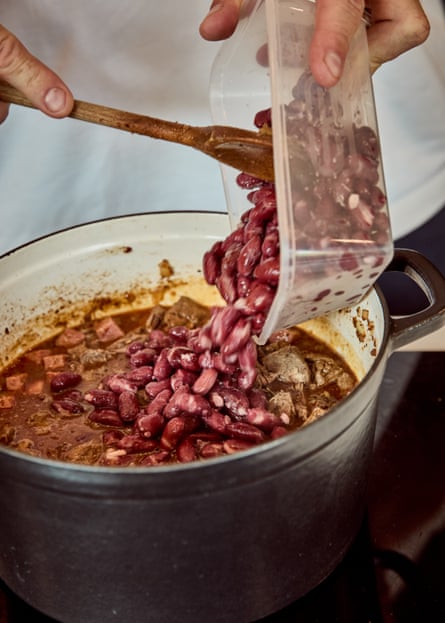
But back to that chilli. The venison haunch, which has been braising for three hours already, has gone into the ragu and the whole thing is a rich and sheeny mahogany, which is the daunting bit for the home cook – how to avoid a grey mess without the cheap win of a can of tomatoes? And Kerridge is anti chucking-in-a-can of tomatoes.
There are cheffy touches at the end. Coriander oil actually couldn’t be simpler – you just whizz coriander with olive oil – but it looks so chic against a splodge of sour cream it’s unreal. A bit of grated chocolate, a bit of lime; I guess we would once have called this fusion – French and Mexican – but now it feels like the satisfyingly inevitable result of anyone blessed with a deer. “I was a kid who grew up in the 1980s,” Kerridge says. “It was crispy pancakes and potato waffles, in a single-parent family on an estate in Gloucester. We weren’t cooking tea every night. But my mum would do Sunday lunch, and she’d do it for everyone we brought back from the rugby club. She didn’t have any money – we never really had a joint; she just used to roast sausage meat and then do all the vegetables. There was always enough, and it was always delicious.” It’s not the obvious origin story for Kerridge, but in a way, it is.
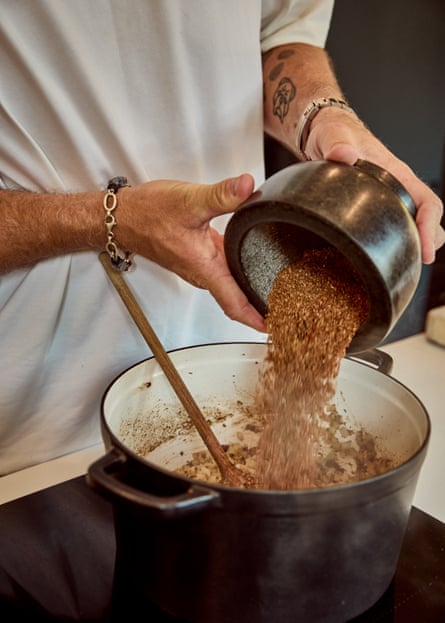
A tip that will change your cooking
When making chilli or bolognese, roast the hell out of the mince before you do anything else. Do this on the hob: put the meat in a pan with a bit of oil, high heat, and roast it for much longer than you would ever have dreamt. Take it way past the point of just having a bit of colour. When it starts to leave its charred remnants on the bottom of the pan, don’t worry – the onions going in afterwards will deglaze all that with their natural juices. When it starts to look very dark – pretty nubbly and dry – again, don’t fret; it will rehydrate later when you add the stock. Don’t trouble yourself over whether it’s lean mince or not: you can sieve off the rendered fat after this first stage, then you get all the benefits of fattier meat with none of the grease. “When you think of the flavour profile you get from a barbecue, or the outside bits of roast beef – that’s the bit everyone likes. And that’s what you’ll get from this ragu.” I tried this myself when I got home, and it was hands down the best bolognese I’ve ever made.
Tom’s favourite utensil: the cast-iron pan
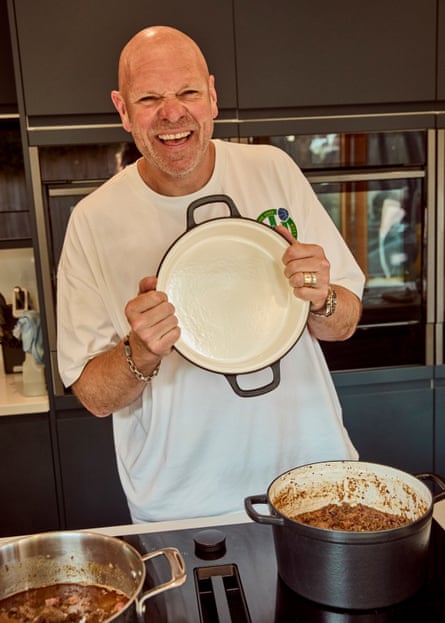
The famous lacquered versions – Le Creuset and whatnot – are the ones that look good in the interiors magazines, but matte black and unvarnished as the day it was born is Tom’s preference (Kerridge has developed a range for M&S, which I wouldn’t normally mention except it’s very good value). “This is absolutely chef-proof,” he says, “indestructible.” If you think of all pans as quite hard to destroy, that’s because you only use yours once or twice a week. A pan that can survive life in a restaurant, 10 uses a service, with outrageous heat (both direct and indirect), rambunctious cheffy fireworks, and still last a lifetime is a higher-order pan.
Venison chilli
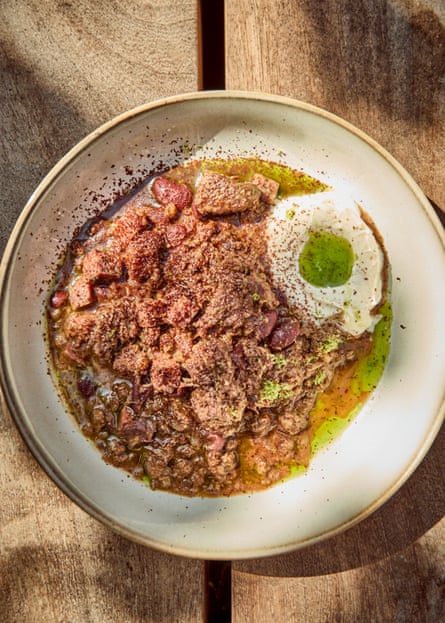
I love a regular beef chilli, but this venison version is something else! Using a combination of diced haunch and venison mince gives the dish a real depth of flavour and a great texture. Although it takes a bit more time, it’s pretty straightforward, and the result is well worth it. Finishing the rich dish with dark chocolate, red wine and a zing of lime perks it up beautifully.
Serves 6-8
For the venison haunch
Vegetable oil, for cooking
1kg venison haunch, diced
2 carrots, halved
4 celery sticks, trimmed and cut in half
1 onion, peeled and quartered
1 bouquet garni (sprig each of thyme and rosemary and a bay leaf, tied together with kitchen string)
2 garlic cloves, peeled and sliced
1 litre dark rich beef or venison stock
For the chilli
2 tbsp cumin seeds
2 tbsp coriander seeds
2 tsp chilli powder
2 tsp cracked black pepper
400g minced venison
Vegetable oil, for cooking
2 onions, peeled and diced
4 garlic cloves, peeled and finely grated
150g Milano salami or chorizo, diced
400g tin kidney beans, drained and rinsed
150ml red wine
Finely grated zest of 1 unwaxed lime
75g dark chocolate (70% cocoa solids), grated, plus extra to serve
Salt and freshly ground black pepper
Creme fraiche, to serve
Heat the oven to 140C (120C fan)/275F/gas 1. Heat a glug of oil in a large, heavy-based, flameproof casserole over a high heat. Sear the diced venison, in batches to avoid overcrowding the pan, for a few minutes until well coloured on all sides. Remove with a slotted spoon and set aside in a bowl.
Lower the heat, add the carrots to the pan and saute until they have taken on plenty of colour. Now add the celery, onion and bouquet garni and fry for a few minutes, then add the garlic and cook for another minute or two.
Return the meat to the pan, pour in the stock and bring to a boil. Put the lid on and transfer to the oven to braise for three hours, until the meat is succulent and deliciously tender.
Remove the meat from the oven and cool slightly. Put a colander over a bowl, and tip the venison braise into the colander to strain off the stock. Reserve the stock and separate the meat from the vegetables. Transfer the meat to a bowl and set aside; discard the vegetables and bouquet garni.
For the chilli, put a small frying pan over a medium heat and add the cumin and coriander seeds. Toast for two to three minutes, rattling the pan, until fragrant. Let it all cool slightly, then grind to a powder using an electric spice grinder or pestle and mortar. Tip into a bowl and mix in the chilli powder and black pepper.
Heat a large, nonstick frying pan over a medium heat. Add the minced venison and dry-fry, stirring frequently, for 20–25 minutes, until it is nicely browned and has a tasty, nutty flavour. It should be very crisp. Drain the mince in a colander to remove any excess fat and set aside.
While the mince is cooking, heat a dash of oil in a large, deep, nonstick saute pan over a medium heat and fry the onions and garlic for eight to 10 minutes, until softened. Stir in the ground spices and cook for two to three minutes to release their flavour.
Stir in the cooked mince and salami or chorizo, cook for two to three minutes, then pour in the reserved stock from the braised haunch. Add the kidney beans, give it a stir and bring to a boil. Lower the heat to a simmer and reduce the sauce until it’s thick and stew-like – about 20 minutes.
Stir in the venison haunch and heat through for five minutes. Pour in the red wine, bring to a boil and add the lime zest, then lower the heat, season to taste and warm for a few minutes.
Remove from the heat and stir in the chocolate. Serve the venison chilli on warmed plates, with a dollop of creme fraiche and a little more chocolate grated over the top.
-
This is an edited extract from Tom’s Table, published by Bloomsbury at £25. To order a copy, visit guardianbookshop.com
KioskNews shows a cleaned-up reading view extracted from the publisher’s page — the original always lives on their site, not ours.