India uses corals, seagrass to shield against rising seas
Under a blazing sun, workers crouch on a shrinking island off India’s southern coast, threading bright green seagrass shoots onto wooden frames before anchoring them onto the ocean floor.
Restoration work on Kariyachalli island hopes to rebuild its natural defenses with artificial reefs, transplanted corals and seagrass meadows, in a bid to slow erosion and protect the mainland from surging seas.
“If you are not able to provide that resilience, you are absolutely at the mercy of vulnerabilities of storm surges, cyclonic storms or sea-level rise and also erosion,” senior state official Supriya Sahu said.
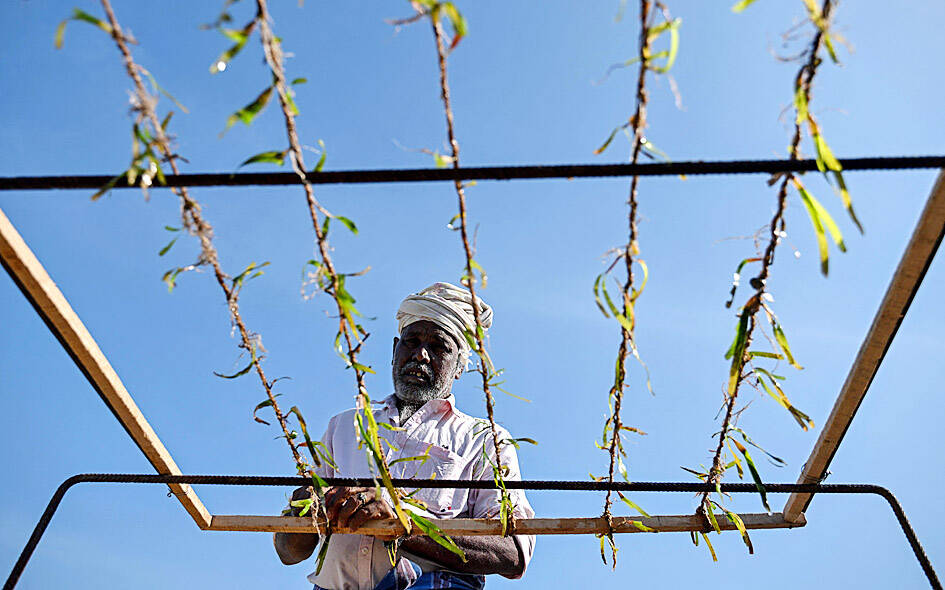
A photograph taken on Sept. 9 shows a fishing community member tying seagrass shoots to the casuarina frame for restoration work protecting Kariyachalli Island, off the coast of Thoothukudi in India’s Tamil Nadu state.
Photo: AFP
Agence France-Presse reporters traveled by boat to the protected island after being granted exclusive access by the Indian foreign ministry.
Kariyachalli, which is part of a chain of 21 islands in southern Tamil Nadu state, has lost more than 80 percent of its landmass over the past half century and could disappear entirely by 2036 if erosion is left unchecked.
Government estimates show Kariyachalli shrank from 20.85 hectares in 1969 to just 3.14 hectares last year.
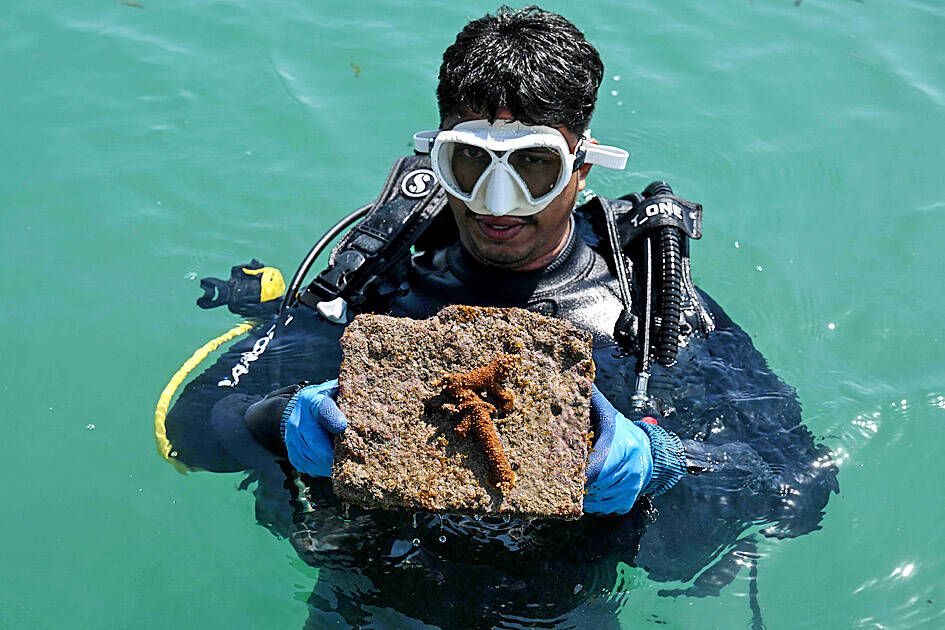
A scientific diver holds a transplanted coral from the restoration site underwater near Kariyachalli Island, off the coast of Thoothukudi in India’s Tamil Nadu state, on Sept. 9.
Photo: AFP
The coral reefs in the Gulf of Mannar, where Kariyachalli and other islands are located, also play a vital role in softening the impact of natural disasters, such as the 2004 Indian Ocean tsunami.
More than 8,000 people were killed in Tamil Nadu during the tsunami, but marine scientists say these ecosystems acted as a crucial natural barrier and prevented a much larger disaster from happening.
“This was because these tiny islands, seagrass and coral beds absorb the impact,” said K. Diraviya Raj, an associate professor at the Suganthi Devadason Marine Research Institute.
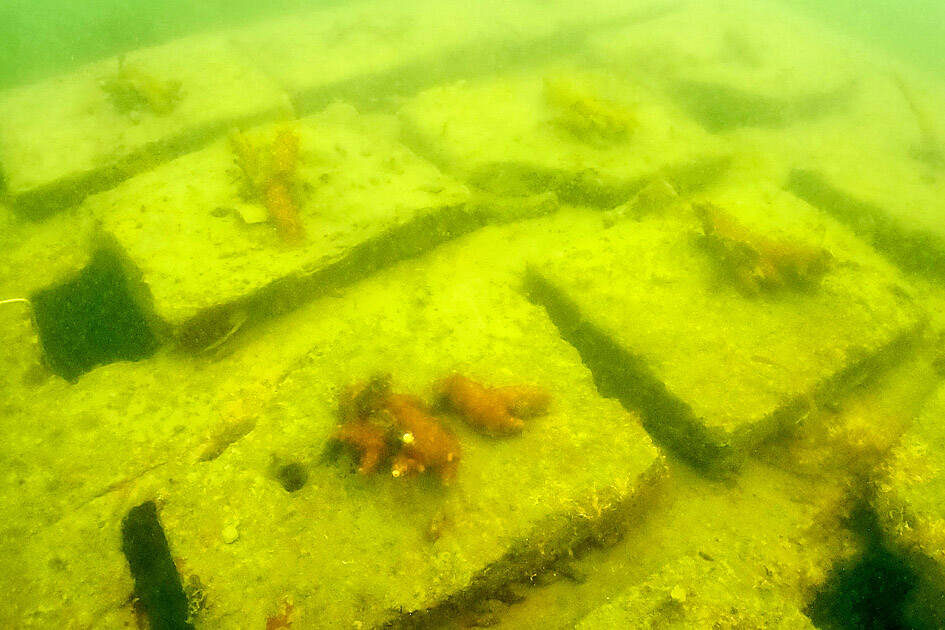
A photograph taken on Sept. 9 shows an underwater view of a coral restoration site near Kariyachalli Island, off the coast of Thoothukudi in India’s Tamil Nadu state.
Photo: AFP
The Gulf of Mannar is among Asia’s richest marine environments, home to coral reefs, endangered dugongs and hundreds of fish species, but decades of human activity and climate change have steadily weakened the ecosystem.
Coral mining in the 1960s and 1970s severely damaged reefs around the islands. Pollution, overfishing and coral bleaching caused by warming seas have also added pressure.
Around Kariyachalli, reef cover fell from roughly 500 hectares in 2005 to 197 hectares in 2021.
The restoration, part of a US$4.79 million state conservation program, includes the deployment of about 8,500 artificial reef modules around the island.
The bulky structures, each weighing several tonnes, are being lowered into carefully selected locations around Kariyachalli. Designed using data on seabed conditions, currents and wave patterns, they are intended to break the force of incoming waves while creating new surfaces for corals to colonise.
Experts are also transplanting corals and restoring seagrass meadows that help stabilise sediments and provide nursery grounds for marine life.
The deployment phase is expected to finish by the end of this month, after which the site would be monitored for at least four years.
For local residents, the project offers a chance to earn some extra money.
Among them is saltpan worker Devkani, 47, who travels 25 minutes by boat from the mainland to prepare seagrass frames.
“We had to borrow loans earlier at high interest rates to make ends meet during lean months at saltpans,” she said. “But this year because of this sea-based work, we didn’t have to.”
Though there have been some strides, scientists acknowledge that warming oceans have created significant challenges to reef restoration.
A severe bleaching incident hit the region in 2024, killing large numbers of corals and raising questions about whether restoration efforts can keep pace with climate change.
Researcher Raj said that the worsening outlook makes intervention even more necessary.
“What we are doing is restoring corals to keep the biomass intact,” he said.
“So, in a way corals will adapt themselves for this deteriorating scenario of changing climatic conditions and will survive to form the future reef,” he said.
Scientists are also searching for naturally heat-resistant coral species that might better withstand future marine heatwaves.
There are already signs of encouragement elsewhere in the Gulf of Mannar.
On nearby Vaan Island, restoration involving about 10,000 artificial reef modules helped recover part of the lost landmass. On Shingle Island, transplanted corals endured a 2024 bleaching event better than older colonies.
“Vaan island restoration results were very promising,” wildlife warden Akhil Thampi said. “That’s why we went towards Kariyachalli island restoration.”
However, for seagrass worker Martina, the reason to support the project is personal.
“Growing seagrass increases the reproduction of fish and saves the ecosystem,” said Martina, 29, who goes by one name.
“This is useful to us and improves our livelihood,” she said.
KioskNews shows a cleaned-up reading view extracted from the publisher’s page — the original always lives on their site, not ours.