21 Years Later, Guy Ritchie's 'Memento' Meets 'Snatch' Thriller Is Officially Streaming

Erik Hawkins is an award-winning writer and editor who's been obsessed with cinema since he was old enough to hold Roger Ebert's Video Home Companion in his hands. He lives in NYC, where he rabidly watches everything from the newest releases to the more odd and obscure, and regularly shares his thoughts on Letterboxd. From ghost-writing fiction and webisodes in South America to local news, trial coverage, and politics in NYC, he's rarely put down his laptop over the past 15 years.
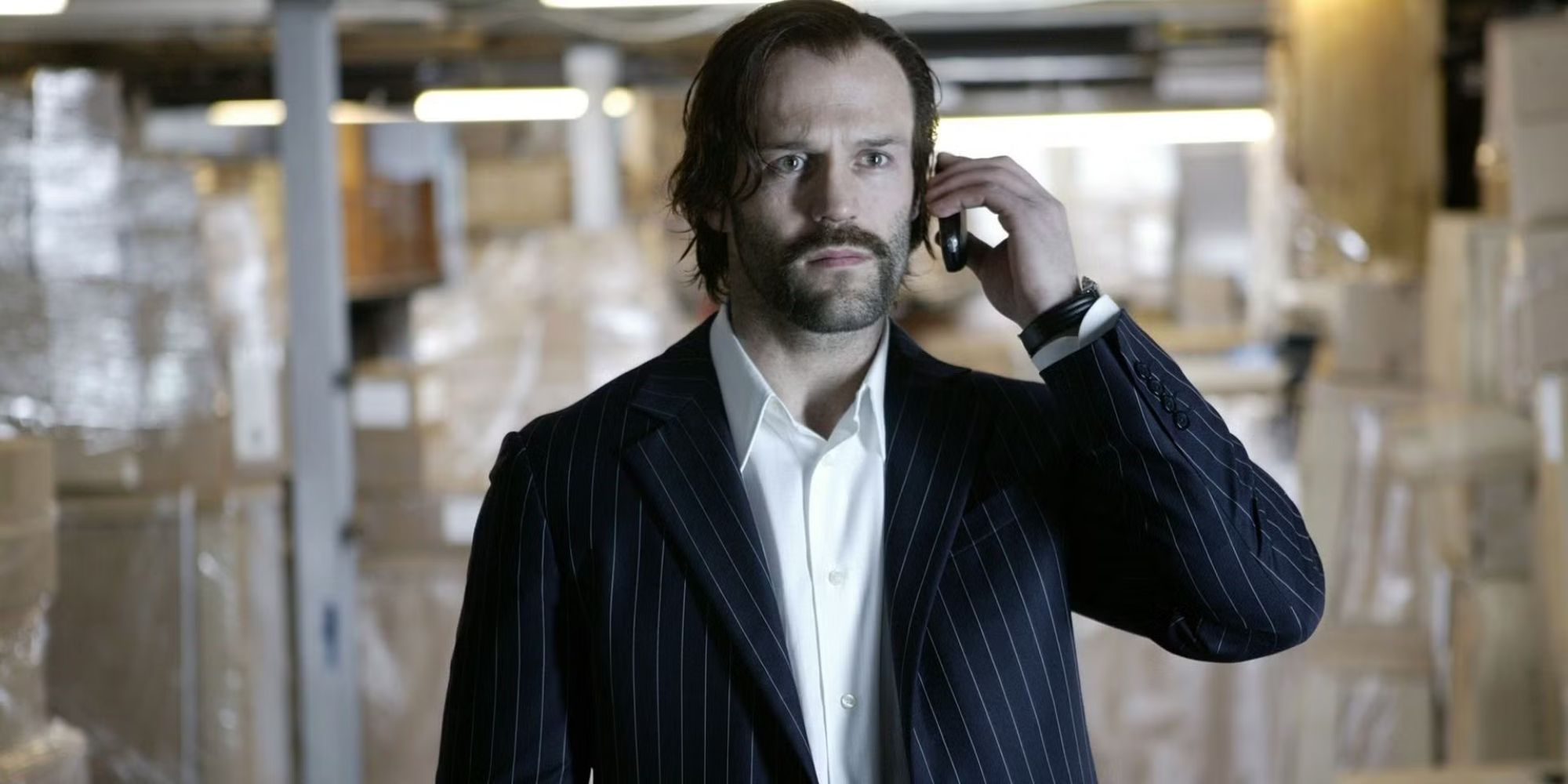
No matter what genre he's working in, Guy Ritchie typically has an instantly recognizable style. It comes through in the action sequences in Wrath of Man and even Disney's Aladdin, and was honed in his earlier one-two punch of Lock, Stock, and Two Smoking Barrels and Snatch. There's one film, though, that even many of Ritchie's most devoted fans tend to avoid like the plague, despite the fact that it's a brutal gangster film featuring his longtime Cockney collaborator Jason Statham: Revolver.
Easily the most critically divisive film of Ritchie's career, Revolver starts out feeling a lot like another entry in Snatch world, with Statham's instantly familiar tough guy being released from prison, but it quickly devolves into a wild stew of abstract symbology, identity confusion, Kabbalah, and Carl Jung, ending as if Ritchie's typical cast of toughs have wandered into a mix of Memento, Donnie Darko, and Terrence Malick's Knight of Cups. It features Outkast's André 3000 as a manifestation of the psyche and a scene in which Vincent Pastore (Big Pussy in The Sopranos) is rendered as a hulking anime character. It's a one-of-a-kind film that deserves another look despite the critical drubbing it took upon release.
What Did Critics Think of 'Revolver'?

Not only did Revolver fail to land with general audiences — taking in just $7.2 million at the worldwide box office on a $27 million budget, per Box Office Mojo — but nary a critic was to be found who'd defend it. Ritchie's experimental crime film, astonishingly, opens on not one but four separate quotes and uses genre as a vehicle for the director's exploration of Jungian and Freudian psychology, as well as Kabbalah; it was universally received like a flaming bag of dog shit.
Roger Ebert awarded the film a half-star out of four, calling it "frothing mad" and urging other filmmakers, if Ritchie was indeed influenced by Kabbalah, to stay away from the belief system. "It is a 'thriller' without thrills, constructed in a meaningless jumble of flashbacks and flash-forwards and subtitles and mottos and messages ... I wanted to signal the projectionist to put a gun to it," Ebert fumed.
Other critics blasted Ritchie's experiment as "incoherent," "impenetrable," and "batshit crazy," with a mere 13 percent giving it even a slightly positive review, per Rotten Tomatoes. On Letterboxd, it sits slightly better with film fans, although it's still wildly divisive: 23 percent of those who rated it gave it three out of five stars. And honestly, that rating feels about right after experiencing Revolver; it's the kind of bizarre big swing that's far from successful, but absolutely worth the curious audience's time.
What Makes 'Revolver' Worth Watching


There's an argument to be made that almost nothing that takes place in Revolver takes place in the real world; rather, it all occurs within the psyche of Statham's Jake Green. That doesn't mean the performances have nothing to offer, though. In fact, Statham and Ray Liotta both deliver career highlights here, working in the kind of surrealist register that lets them go places they don't often go. Tough guy Statham gets to play baffled, terrified, confused, and enraged (sometimes in the same scene, as he's literally talking to himself), and Liotta gives a remarkably pathetic performance as a flailing crime lord trying desperately to hold onto control as his empire spirals; his tearful final scene, delivered in a bathrobe, is a highlight.
We are also treated to iconic performers André 3000 and Vincent Pastore as a bizarre pair of con artists who later prove to be far more important to the film's psychological themes than first revealed. The interplay between Pastore's oafish, cigar-chomping gangster routine and 3000's silky eloquence is a delight to watch. Then, of course, there's that anime sequence, with Pastore's character in a gas mask barreling down a hotel hallway with a shotgun like a demon out of hell ...
Ritchie clearly cares about the story he's telling here — he even includes video clips of real-life psychoanalysts and philosophers waxing about the id and ego over the end credits. The film is layered with so much style it's almost smothering, making for a heady, psychedelic trip of a crime picture that's maniacal fun for those willing to enjoy it for what it is. Curious viewers can watch it on Howdy or for free on Tubi.

- Release Date
- September 11, 2005
- Runtime
- 111 minutes
- Director
- Guy Ritchie
KioskNews shows a cleaned-up reading view extracted from the publisher’s page — the original always lives on their site, not ours.