Saudi Intercepts More Houthi Missiles As Conflict Shows No Signs Of Easing

Saudi Arabia intercepted more ballistic missiles launched by Yemen's Houthis, a sign the confrontation with the Iran-backed militant group is far from subsiding.
The Houthis targeted Riyadh and Khamis Mushait, near the Yemeni border, late Monday, according to a spokesperson for the Saudi-led coalition fighting the group.
Saudi authorities issued a warning to residents of the two areas when the attacks were detected, following days of repeated strikes on the country's main international airport in Riyadh. Those attacks left at least 18 people dead and over 300 wounded, marking the deadliest incidents in the kingdom since the US-Israeli war against Iran began in February.
The fighting poses a serious challenge to Saudi Crown Prince Mohammed bin Salman's efforts to transform the kingdom's oil-rich economy into a center for everything from tourism to finance. Recent Houthi strikes have resulted in the suspension of operations at Riyadh's main airport and forced the capital's main financial district to switch to remote work.
Riyadh has been in conflict with Houthi militants ever since they took control of the Yemeni capital, Sanaa, in 2014 and forced the internationally recognized government backed by Saudi Arabia to resign the following year.
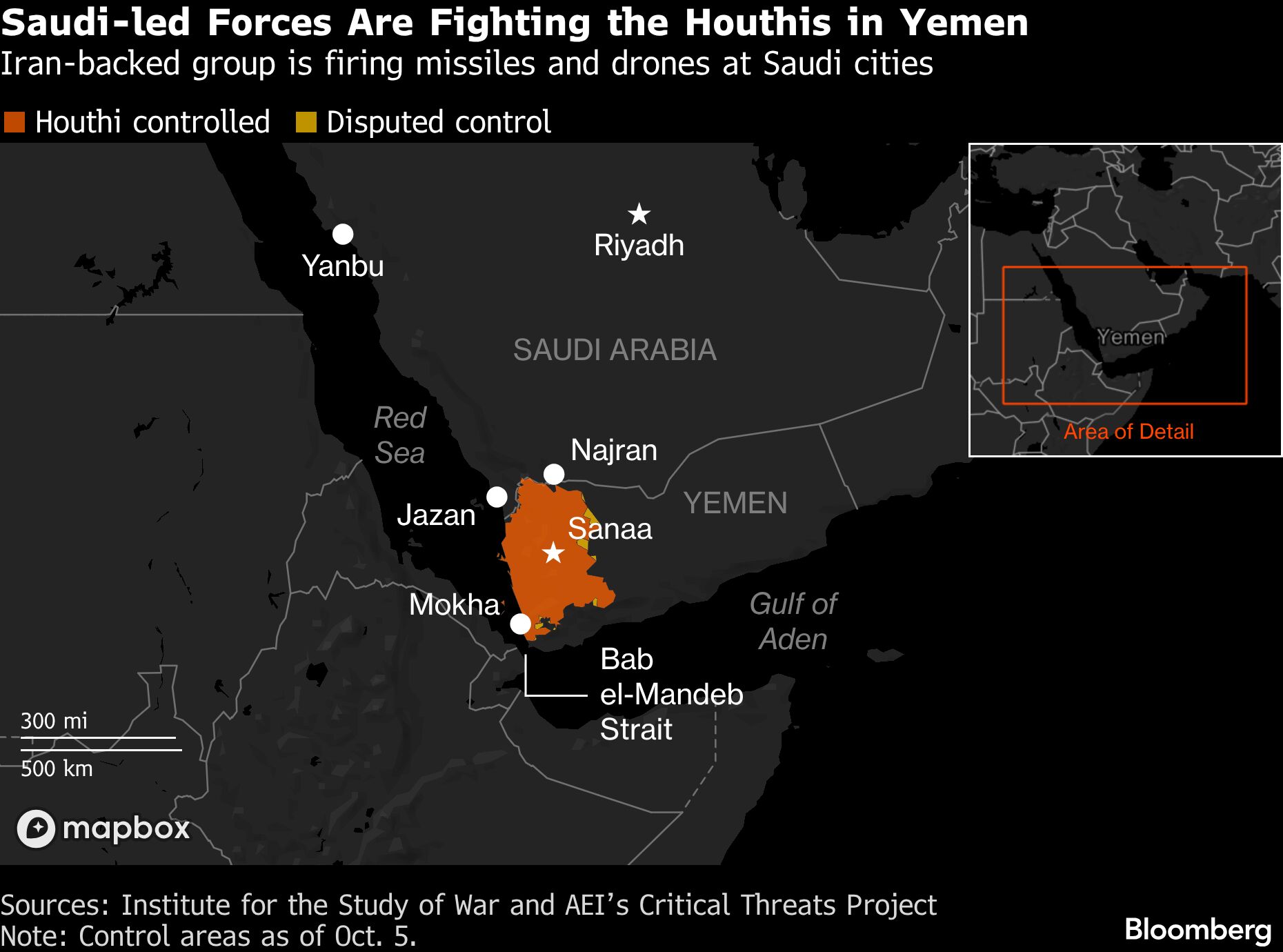
Photo Credit: Bloomberg
The latest flare up began in July, when Saudi jets struck the runway of the airport in Sanaa to prevent a Houthi delegation returning from Iran from landing. Hostilities intensified over the last week as Saudi-led forces in Yemen launched a new campaign to take back control of Houthi-held areas.
US aviation authorities cautioned against flying to or over parts of Saudi Arabia, while the American embassy said US government employees must get special authorization to use any of the airports in the country.
US President Donald Trump said on Monday he spoke to the Saudi crown prince following the weekend attacks. He earlier said he was considering joining in the fight against the Iran-backed militant group.
The US is already assisting Riyadh with intelligence, targeting and aerial refueling. But even direct involvement would likely fail to deter Houthi attacks on the kingdom, according to Aaron David Miller, a senior fellow at the Carnegie Endowment for International Peace, who earlier worked at the State Department advising US administrations on Middle East policy.
"Saudis are incredibly vulnerable. Houthis are determined to demonstrate their proximity as an advantage to them," Miller told Bloomberg TV on Monday. "I don't think frankly, given that the Houthis now believe they have the advantage, that you're going to get the Houthis to back off."
Saudi Media Minister Salman Al-Dosary called for national solidarity to protect the kingdom from the Houthi attacks, according to state-run Saudi Press Agency.
The Houthi strikes come at a particularly sensitive time for the kingdom, as it prepares to host high profile international events. Some business executives have declined to attend the World Petroleum Congress taking place in the capital this week. Misk Global Forum, which was scheduled for next month, was canceled by the organizers.
Riyadh is also due to host the Future Investment Initiative, the kingdom's flagship investor gathering, later this month.
That event usually draws Wall Street titans from BlackRock's Larry Fink to Citigroup Inc.'s Jane Fraser and is used by the kingdom as a platform to pitch itself as one of the region's best investment opportunities.
(Except for the headline, this story has not been edited by NDTV staff and is published from a syndicated feed.)
KioskNews shows a cleaned-up reading view extracted from the publisher’s page — the original always lives on their site, not ours.