Nikhil Kamath's Big AI Bet: Why India Should Look Beyond Silicon Valley
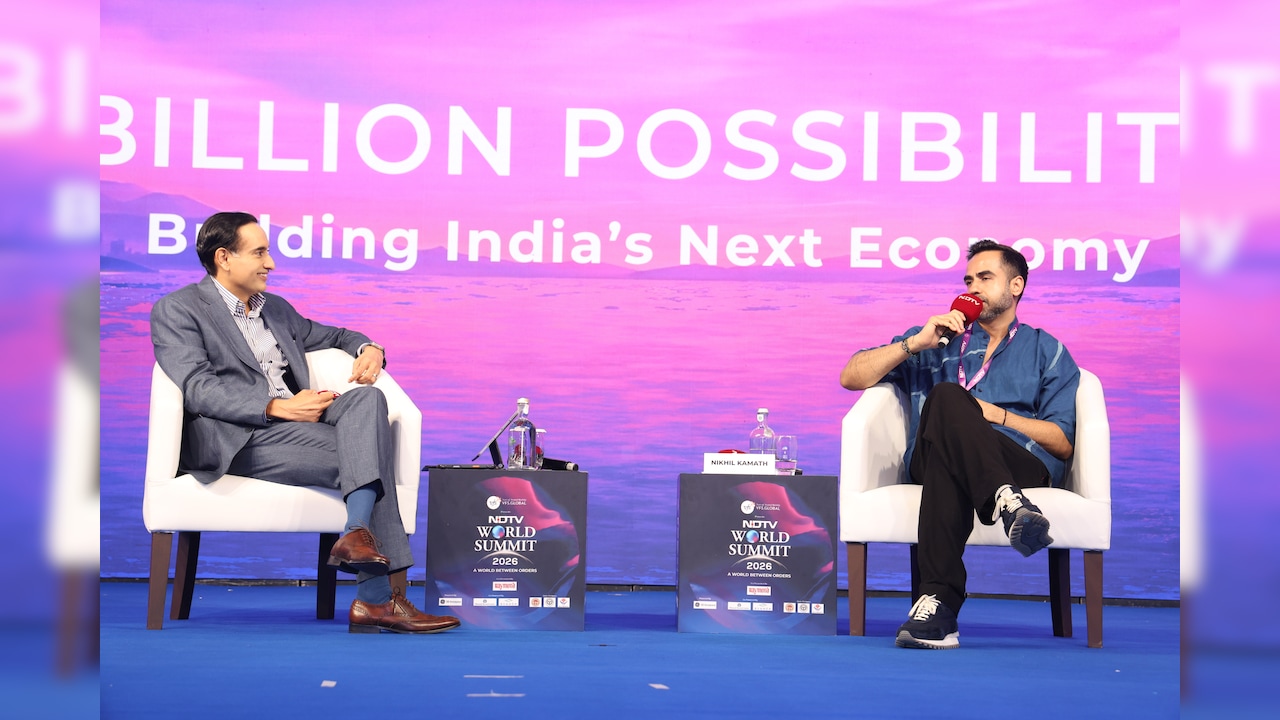
Nikhil Kamath, co-founder of Zerodha and billionaire entrepreneur, believes India may have a better chance of building successful artificial intelligence (AI) businesses by focusing on applications and services rather than trying to compete with the US and China in developing advanced AI models.
Speaking to NDTV CEO and Editor-in-Chief Rahul Kanwal at the NDTV World Summit 2026, Kamath discussed India's AI ambitions, the lessons it could learn from China, the future of entrepreneurship, stock market speculation and the need to change how taxes affect retail investors.
Kamath said Indian entrepreneurs should look for opportunities to build businesses on top of emerging technologies. He also pointed to India's relatively low power and infrastructure costs as potential advantages in the AI race.
Why Nikhil Kamath Thinks India Should Focus On AI Applications
Asked what he would do if he were 17 today, with ideas but no money, connections or network, Kamath said access to education had become far more democratic. "Today if I want to learn about something, I could use AI, I could use the internet and almost anything I want to learn about, if I so choose to, is available freely," he said.
Rather than building foundational large language models (LLMs), Kamath said he would explore opportunities in applications and services built on top of new technology platforms. He acknowledged that competing with global AI leaders would be difficult because of the enormous amount of risk capital available to companies in the US and China.
"I don't see how an Indian company, or for that matter, any company outside of those two or three countries where there is that much risk capital, having a fair shot at competing in that layer," he said.
However, he sees potential for Indian companies to build AI inference businesses using open-source models and computing infrastructure. Such businesses could help companies process information more efficiently while keeping their data and context private.
Kamath also highlighted India's cost advantage. He said the cost of setting up a megawatt of power capacity could be 30-40 per cent lower than in Western markets. Cheaper electricity and labour could help Indian companies build competitive data centre and AI infrastructure businesses.
What India Can Learn From China
Kamath said India could learn from China's approach to encouraging competition among regions.
He argued that Indian states should compete more aggressively to attract businesses and promote economic growth, much like competing companies. "Maybe the chief minister of a state could operate like the CEO of the state," he said.
For this to work, states would need to retain more of the benefits generated by their economic initiatives, Kamath added. He suggested that India examine whether changes to its existing structure could encourage greater competition among states. He also believes India should look beyond software exports when thinking about its next phase of economic growth.
Through his venture-building initiative, Foundry, Kamath said he wants to build consumer brands that can sell in international markets, particularly the US. These could include everyday products such as shampoo and toothpaste.
He argued that Indian companies should not restrict their ambitions to software when the country has cost advantages in manufacturing and consumer businesses.
Kamath also spoke about the possibility of India developing its own social media platforms as the world becomes increasingly fragmented. "I wouldn't be surprised if more of the world goes in that direction," he said, referring to countries developing their own versions of digital platforms and services.
Nikhil Kamath On Entrepreneurship And The Fear Of Failure
Kamath said India's startup ecosystem could benefit from a culture that is more accepting of entrepreneurial failure. He pointed to China as an example of a country that has encouraged entrepreneurs to try again after unsuccessful ventures.
"I think culturally and both from a policy standpoint, we need to inculcate that in some way," he said. According to Kamath, entrepreneurs who attempt ambitious projects but fail should have a clearer path to starting again rather than facing prolonged social or financial consequences.
He also said one of the most important lessons he had learnt from interacting with successful entrepreneurs was that there were no perfect role models. "The one realisation I've had is there are no super humans," he said.
Kamath believes curiosity, persistence and the willingness to change one's mind often distinguish successful people from others. "If I had to bring it down to one trait, I would say the ability to change your mind and change your mind fast is probably one thing that sets these people apart," he said.
He added that he values people who challenge his ideas rather than simply agree with him.
Why Nikhil Kamath Wants Changes In Stock Market Taxes
The conversation also turned to India's growing retail investor base and the debate around losses in futures and options (F&O) trading.
Asked about the ethical implications of speculative trading and the large number of retail investors who lose money, Kamath argued that speculators play an important role in the functioning of stock markets.
"Price discovery would become so inefficient and net net, I think the impact to the market would be more detrimental, it would put us back 10 years," he said, describing a market without speculators.
Kamath also argued that the costs associated with trading account for a significant share of retail investors' losses. These include securities transaction tax, transaction charges, regulatory fees and the impact of execution costs.
He called for changes that would make trading more favourable for retail investors rather than increasing their tax burden.
Kamath also questioned whether high-frequency traders and institutional investors should enjoy execution advantages unavailable to ordinary investors. He argued that retail participants should have a level playing field, including in the way algorithmic orders are executed.
On taxation, he said the system should place greater emphasis on income rather than the cost of carrying out transactions. "Taxation should be tweaked in a manner where taxes apply more on income alone and not on the cost of doing a transaction," he said.
According to Kamath, such changes could help create a larger and more robust Indian equity market, capable of providing the risk capital needed to fund ambitious businesses.
KioskNews shows a cleaned-up reading view extracted from the publisher’s page — the original always lives on their site, not ours.