Palestinian tells of ‘devastating’ struggle after being made redundant by EU in Gaza

A Palestinian man who worked for the EU in Gaza has told of a “devastating” struggle to survive after he was made redundant by bosses in Brussels.
He was let go last year after being evacuated to Egypt but his redundancy payment was made to an account to which he has no access. “My family’s situation has become increasingly desperate,” said Mohammad Baraka, a former staffer at the EU border assistance mission (EUBam).
“Both of my daughters have suffered severe psychological distress as a result of the war, displacement and the prolonged uncertainty surrounding our future.”

The 220,000 Israeli shekels (£52,000) payment for almost 20 years’ service was made on 5 August last year to the Bank of Palestine but access to the money has been blocked, a risk he was aware of given the relatively large sum being transferred.
He said he wrote on several occasions to the European Commission, asking it not to make the payment into that bank because of a known risk that a large sum of money could be misconstrued as war funds. “I am now in the devastating position of having money in my name that I cannot access, while my family is experiencing severe financial hardship,” said Baraka.
Instead he had asked for the payment to go to a new account in an Abu Dhabi bank, but that never materialised.
Baraka was evacuated in 2023 after his house in Gaza was bombed and family members killed. The EU tried to relocate him to alternative offices in the West Bank but travel for Palestinians in Gaza was severely restricted. After a hasty three-day concession agreed with the Egyptian government, Baraka was able to leave for Cairo.
As the conflict continued, Baraka was initially able to work remotely from Cairo as an EU employee and had the comfort of a salary, private healthcare and access to schools for his two children. But when Brussels decided to close its EUBam office in Rafah, he was let go, leading to what he says have been traumatic consequences for himself and his wife and two daughters.
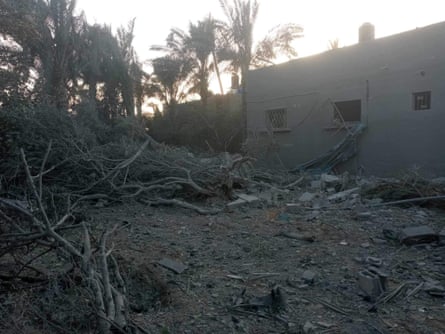
He says the evacuation to Egypt with no plan for onward travel to an EU nation or a diplomatically secured place in another country has rendered him stateless, with no residency rights and no right to healthcare or schooling for his seriously ill wife and two daughters, both of whom he says are suffering from the trauma of war.
One of his daughters has an acute mental health condition and Baraka says he cannot pay for her treatment. “I am not asking for charity or special treatment. I am asking for access to my own money, and for accountability over a decision that could have been avoided,” said Baraka.
“I had specifically asked the [EU] mission to transfer my money to my new bank account in Egypt to avoid precisely this situation,” he said.
“If the EU argues that it fulfilled its obligations simply because it transferred the settlement, I believe the legitimate question is whether an employer can consider its responsibility discharged when it knowingly disregards an employee’s repeated warnings about the destination of such a substantial payment.”
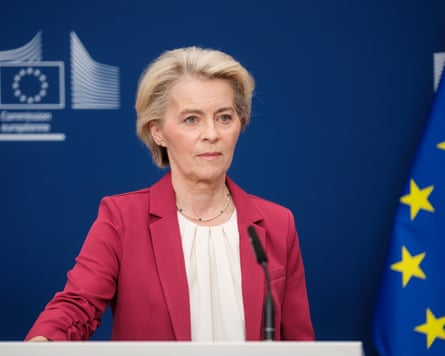
Last year he wrote to the European Commission president, Ursula von der Leyen, pleading with her to reverse what he called his “unjust dismissal” and asked her to restore his employment, even temporarily, “until a dignified and legal solution is arranged”.
He also wrote to the European ombudsman to ask them to open an investigation but they replied last week to say they had no scope for an inquiry. “We fully appreciate that you and your family are in an immensely difficult position. The hardship you are experiencing as a result of the war and your displacement are clear from your complaint,” wrote Tina Nilsson, the head of inquiries.
“I realise that this conclusion will be disappointing. I nevertheless hope you can understand why, based on the information available, there are insufficient grounds for the ombudsman to intervene further.”
He is now suing the commission for alleged breach of Belgian employment law but the case could take years to be heard.
Without the “laissez-passer” document that allowed him to be evacuated from Gaza, he cannot leave Egypt, he says, putting him in an impossible position.
A spokesperson for the commission said: “Due to the ongoing related court case, we cannot comment on this further.”
Year-end fundraiser
$0 of $2,000,000 goal
A moment full of possibility – and risk
We hope you appreciated this article. Before you close this tab, can we ask you to support the Guardian at this crucial time for democracy in the US? With Black Friday approaching, our most impactful monthly support option is just $7.50 a month for six months.
In the last two years alone, Donald Trump has eroded many of the pillars of US democracy – slashing funds for universities, undermining science, shutting down arts institutions, and attacking the free press as an “enemy of the American people” and “a threat to our national security”. While he and his allies have enriched themselves and spread lies, federal forces have harassed and imprisoned innocent people and violated the constitutional rights of many Americans.
Now, in a sweeping change election, the American people have spoken: Donald Trump, Pete Hegseth, RFK Jr, Elon Musk and the tech oligarchs may finally be held to account. A majority of American voters have demanded an end to the costly and immoral wars, the flagrant profiteering, and the corrosive attacks on communities and democratic institutions.
It’s a moment full of possibility, with more stories than we can possibly cover. New leaders are emerging from Texas and Michigan to Iowa and South Carolina – and heading to Washington to fight for affordability, against wealth inequality, and for human survival in the face of AI and the climate crisis.
These new leaders will be facing a cornered Trump and his hardline chief of staff, Stephen Miller, who have nothing left to lose. The next few years are critical for the future of the country. Journalism that covers the epic clash between these forces has a vital role to play right now.
Investigative journalism provides a fact-based paper trail for an emboldened Congress to follow. Members of Congress – and the American public – often rely on our in-depth reporting to inform the tough questions, to connect the dots and to pursue accountability for wrongdoing.
At the Guardian, our newsroom is devoted to uncovering the truth and conveying it to as many people as possible. We’re not alone in this mission, but this kind of journalism faces unprecedented hurdles: big tech threatening our financial stability and stealing our work for AI, billionaire owners telling journalists what to publish, and a hostile executive branch intent on suppressing our reporting.
The Guardian is free to dig deep without fear because we’re funded by our readers. Our readers hold us to account, and we hold the powerful to account.
However, this only works when enough of our readers contribute. Against the advice of most industry analysts, we’ve refused to put up a paywall – we believe good journalism should be freely available to all people, regardless of ability to pay. If you’re counting on our reporting, and you can’t afford to pay, please stop reading this message and go back to our articles.
If you can afford to contribute, please know that your support is not only helping yourself – from voters in Kansas to immigrants in Minnesota and families in Gaza, your generosity is bringing factual news to people around the globe.
Today is among our most important fundraising days of the year. To sustain our unique financial model, our goal is to raise $2,000,000 before the new Congress is seated on 3 January. More than 19,000 people have contributed already. All gifts are gratefully received, but for the next several days only, our most impactful monthly support option is $7.50 a month for the first six months. If you can afford 37 seconds, please join our ranks – and show your support for the rekindling of democracy in the US and around the world.
KioskNews shows a cleaned-up reading view extracted from the publisher’s page — the original always lives on their site, not ours.