AI valuation fears derail Firmus IPO
Firmus Grid Ltd abandoned its attempt at one of Australia’s biggest-ever initial public offerings, after the Nvidia Corp-backed data center company failed to lure global investors who have grown increasingly skittish over frothy AI valuations.
It was a dramatic about-face for a company that just days ago was signaling healthy demand for a deal that would have valued it at US$30 billion, up from US$10.5 billion less than three months ago. The canceled deal is a stark example of investor pushback against AI financing terms that some worry have become too generous as global borrowing costs climb and the long-term payoff from the technology remains uncertain.
Firmus, whose business model hinges on a steady influx of fresh capital, will withdraw its application to list on the Australian Securities Exchange and consider other funding options, according to a statement yesterday.
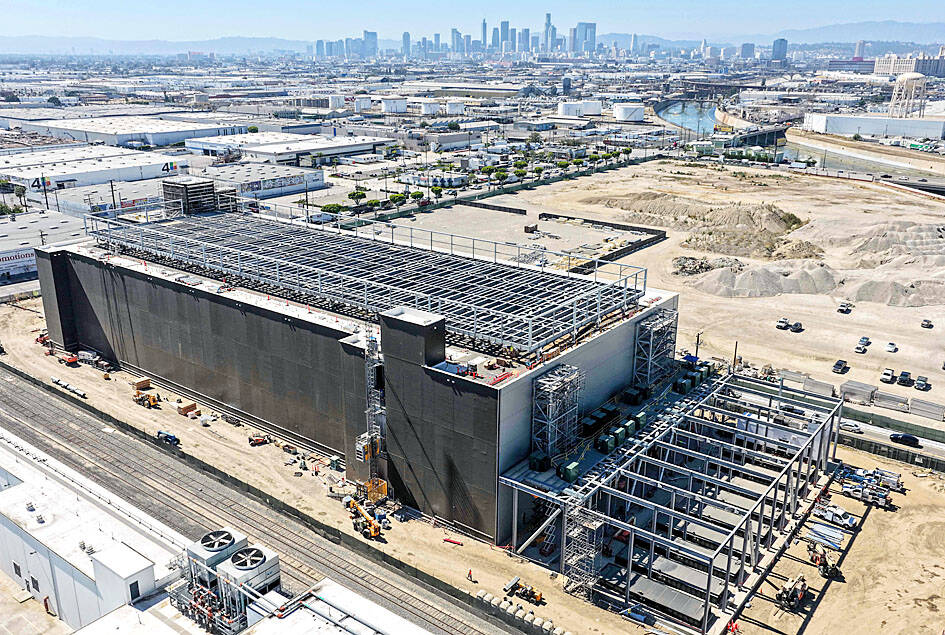
An aerial view shows a 49.5 megawatt, three-level data center under construction in Vernon, California, on July 8. A surge in demand for artificial intelligence infrastructure is fueling a boom in data centers.
Photo: AFP
“Having considered recent market volatility and prevailing market conditions, the board determined that the terms on which the offer could proceed would not appropriately reflect the strength of the company’s business and long-term growth outlook,” it said.
The IPO showed signs of stress soon after books opened for institutional investors this week. The struggles underscored investors’ polarized views on the deal. Some saw the business as well placed to benefit from the artificial intelligence boom, while others are worried about the valuation and existing shareholders potentially flooding the market soon after the debut. Part of the difficulty was convincing potential investors of the steep increase in market value for a company without a proven track record that had revenue of US$51 million in the 2026 financial year.
AI FACTORIES
Firmus, which was looking to raise as much as US$5.5 billion including a greenshoe option, must now find other ways to raise funds to keep its ambitious expansion plans on track. The company aims to build data centers it calls AI factories using hardware from backer Nvidia. It has a pipeline of 912 megawatts, of which only 46MW has been built, according to investor documents seen by Bloomberg.
“Investors just weren’t prepared to pay a sky-high price up front for capacity that’s still largely on the drawing board,” eToro lead analyst for APAC and Middle East Josh Gilbert said. “The timing hasn’t helped either, with higher yields lifting borrowing costs and shrinking what investors will pay today for earnings that sit years down the track.”
Firmus will also explore a potential listing in the US in the longer term, people familiar with the matter have said.
DATA CENTER PIPELINE
The failed deal underscores growing concern over how much capital AI infrastructure companies are demanding from public markets at a time when borrowing costs are rising. Much of Firmus’ valuation was based on the company successfully building a pipeline of data centers across Asia serving customers such as Meta Platforms Inc and OpenAI.
The strain is spreading across credit markets in the US, where a record wave of AI-related borrowing is forcing investors to reassess the risks around some of the biggest technology companies. Nearly US$500 billion of new debt has been priced this year to fund AI infrastructure, while rising financing needs and interest rates have driven up credit-insurance costs and weakened tech debt performance.
“There’s no question investors feel more anxiety recently, as the tech sector rallies despite mounting risk on every other front,” Rayliant Global Advisors head of portfolio management Phillip Wool wrote in a LinkedIn post. “Everything at this point hinges on the virtuous cycle of AI infrastructure spending boosting hardware and hyperscalers’ AI investment exciting shareholders about their own future earnings growth.”
KioskNews shows a cleaned-up reading view extracted from the publisher’s page — the original always lives on their site, not ours.