Magnus Carlsen's Budapest Blues: A Negative Spiral, Family First And A Format He Believes Has Potential
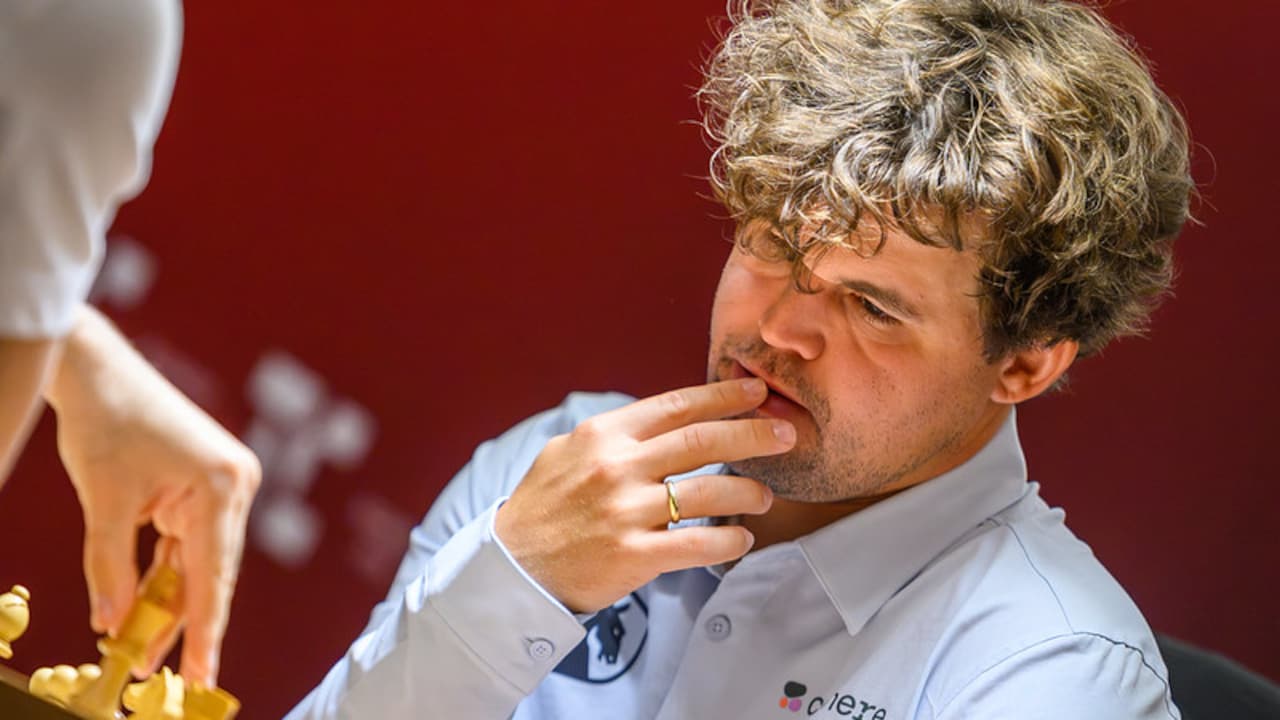
Magnus Carlsen may have spent much of his career making chess look effortless. In Budapest, however, the world No. 1 was confronting a battle that had little to do with the 64 squares. The Norwegian was struggling to find the motivation to compete, admitting that he would much rather have been at home with his family than spending two weeks away for the Total Chess World Championship Tour Pilot. Carlsen finished 17th in the 24-player field, missing out on the championship bracket after a difficult group stage in which he failed to win a single one of his 10 Fast Classic games. Nine ended in draws, while the only defeat came against Armenia's Haik Martirosyan.
It was an unusually candid assessment from a player who has dominated the sport for more than a decade.
Speaking to TV2 during the tournament, Carlsen was visibly frustrated by what he felt was a persistent tendency in the chess world to read more into his words than he intended.
"What annoys me the absolute most in the chess world is that people do not believe me on what I say. I always speak exactly what I think and exactly how I intend it. But still people try to add intentions to what I'm saying, and a lot of wrong things are being written," he said.
Carlsen admitted that his decision to participate in Budapest had come at a difficult point in his life and career. The prospect of being away from his family for an extended period had weighed heavily on him. There was also the question of what motivates him to keep competing.
"When it's about this tournament, I'll say that my entry was unfortunate. I was not in the state of playing chess right now, because it's a long time to be away from my family. And it's a point in my career where I necessarily don't want to play tournaments where there's not a lot of stakes, where it's either very important or very lucrative," he explained.
For a player who has won virtually everything chess has to offer, the challenge of finding the right motivation is perhaps understandable. Carlsen was not questioning his ability to compete. He was only questioning whether every tournament demanded the sacrifices that came with it.
"Here this was more stressful than fun. And of course that's a bad entry to have to a tournament, and then everything gets very amplified when I was not very motivated to begin with."
There were, however, moments when the familiar, playful Carlsen surfaced. In his opening games, he chose to play the Budapest opening in Budapest. He also attempted the Fried Liver Attack, a tribute to his wife Ella, who had once told him it was the only chess opening she knew when they first met.
"My wife Ella has asked me to do the Fried Liver Attack because that was the only opening she knew when we met each other. So I tried that and that's what I did. And she also asked for a shout out. So here's the shout out for my wife," he said.
It was a small but revealing glimpse of where Carlsen's priorities now lie.
Despite his unhappiness with the tournament experience, he was careful not to dismiss the Total Chess concept.
"I feel that the format here has tons of potential," he said, while acknowledging that the organisers had perhaps tried to introduce too many complications in the inaugural edition.
He even offered suggestions for making the competition more engaging. Carlsen proposed a Champions League-style draw, with players seeded into groups, and argued that all three formats - Fast Classic, Rapid and Blitz - should feature every day rather than being reserved for particular stages of the competition.
"I want to play every format every day, not just in the playoffs," he said.
Total Chess, developed by Norway Chess and approved by FIDE, wants to bring together the world's leading players in a unified championship combining Fast Classic, Rapid and Blitz. The ambition is to create a more dynamic product for fans while retaining the competitive depth that defines elite chess.
On the board, Budapest belonged to Alireza Firouzja. The French grandmaster won the inaugural Total Chess pilot after defeating Anish Giri in the final. Giri had taken the opening day 11-9, but Firouzja responded with a 12-8 victory on Friday to force an Armageddon decider. The final game ended in a draw after 35 moves, but playing Black gave Firouzja the draw odds he needed to claim the title.
Giri had to settle for second place, while Fabiano Caruana finished third after beating Maxime Vachier-Lagrave in both daily encounters. Caruana's second victory, 10.5-9.5, secured third place without the need for an Armageddon tiebreak.
For Carlsen, Budapest was a tournament to forget on the competitive front. He eventually beat Vladislav Artemiev in an Armageddon game to finish 17th, but the more significant takeaway was his honesty about where he stands.
KioskNews shows a cleaned-up reading view extracted from the publisher’s page — the original always lives on their site, not ours.