Disasters like Nepal-Tibet floods could become more frequent with climate change: Experts
SINGAPORE - Deadly landslides and floods caused by melting glaciers could become more frequent with the warming climate, underscoring the importance of implementing early warning systems to save lives, researchers say.
On Aug 26, a collapsing glacier in the Himalayan region caused torrents of ice, rock, mud, and debris to race down rivers, slamming into bridges, villages, towns, power projects, and vehicles on both sides of the mountainous border between Nepal and Tibet,
killing more than 500 people.
Among the 1,500 missing are nine Singaporeans as at Aug 27.
Glaciers across the region are melting at an accelerating rate, with ice loss rates doubling since 2000, according to reports released in March by the International Centre for Integrated Mountain Development.
The intergovernmental knowledge and learning centre based in the Nepalese capital of Kathmandu works on behalf of the people of the mountainous Hindu Kush Himalaya region, which spans eight countries, including Nepal.
The ongoing warming of the atmosphere and its impact on glaciers and permafrost are likely to contribute to increased slope instability in the region, Lai Voon Hui, a seismologist at NTU’s Asian School of the Environment and Earth Observatory of Singapore, told The Straits Times.
Benjamin Horton, dean of the School of Energy and Environment at City University of Hong Kong, said the Himalayas is already naturally predisposed to cascading hazards. He noted how the broader river corridor involved in the recent floods had experienced a damaging transboundary flood in July 2025 associated with drainage from a glacial lake in Tibet.
Retreating glaciers
can
remove support from steep valley walls, thawing permafrost
can
weaken fractured rock, and meltwater can enter cracks or the glacier bed, he added.
These weakening mountain slopes make large rock-ice collapses, and the cascading floods and debris flows they trigger, much more probable.
With climate change loading the dice, the principal concern is a cascade of natural disasters, Horton said. A slope failure can strike a glacier or lake, block a river, impound water, and suddenly breach to transform into a fast-moving debris flow.
“These compound events can travel far downstream and produce impacts much greater than the initial collapse,” he said. In narrow valleys, more people and infrastructure are exposed, increasing the severe consequences of such events.
In view of the greater likelihood of compound events wrought by climate change, Horton said monitoring and early-warning system
s should also factor in unstable rock-ice
slopes
or scenarios where rivers get dammed up by debris.
Neera Shrestha Pradhan, Water and
Disaster Risk Reduction
Lead at the International Centre for Integrated Mountain Development, said a cross-border early warning system could serve as a strong example of cooperation between the t
wo countries affected by the floods.
“Our experience shows that providing information alone is not enough,” said the disaster risk expert. “Communities also need to be aware about how to translate this information and prepare themselves to act on it without panicking.”
Horton noted that the precise sequence of events that led to the Nepal-Tibet disaster remains unresolved.
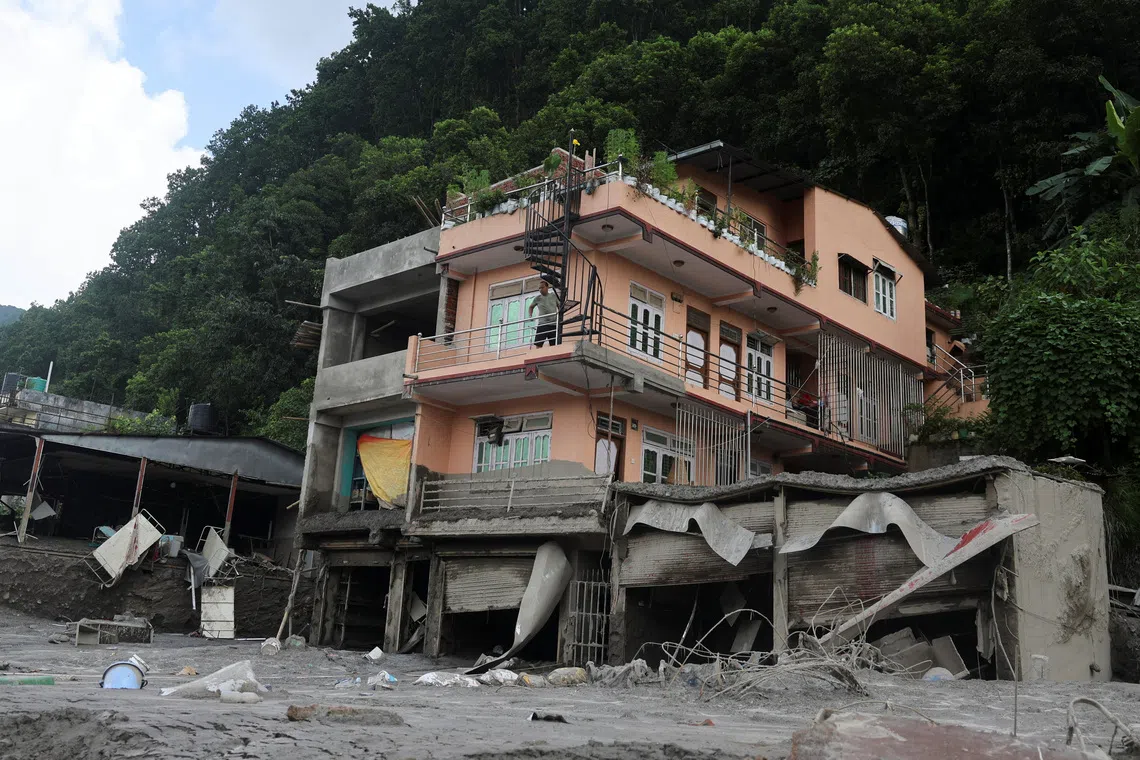
A house that was damaged during flash floods and a mudslide at Trishuli Bazaar, Nuwakot, Nepal, on Aug 28.
PHOTO: REUTERS
He said: “We still need further evidence to identify the immediate trigger of this particular collapse, but it occurred in a mountain system being rapidly destabilised by human-induced warming.”
On Aug 26, the impact of the glacier hitting the valley floor was so massive that it was initially classified by the United States Geological Survey as a magnitude 4.4 earthquake. It was later revised as a magnitude 5.2 seismic event caused by a glacial collapse and debris flow.
Horton said
preliminary satellite analysis indicate
d
that a large section of glacier
broke off
at an elevation of about 5,200m and fell roughly 1,200m.
“The Himalayas have experienced comparable rock-ice avalanches, but an event with this combination of scale, mobility, and downstream consequences is exceptional,” he noted.
The mass movement of rockfalls, rock-ice avalanches, or landslides can generate a ground force that mimics signals from a slipping fault, which is what causes earthquakes, NTU’s Lai added.
As the rock-ice mixture flows downstream, accumulating more loose sediment and water from different rivers, it turns into a flash flood and debris flow, impacting downstream communities, she said.
She added: “Mountainous regions like the Himalayas, with steep slopes, high topographic relief, intense rainfall, retreating glaciers, and degrading permafrost, are prone to flood outbursts and a range of mass movements.”
The speed of the cascade, as well as the remote origin of the event, likely overwhelmed Nepal’s warning system, which is designed to detect slower-rising water levels,
d
isaster response expe
rts told The New York Times.
They said these factors made it nearly impossible to alert residents in time. This was compounded by the absence of rain, which is usually a sign that flooding is imminent.
About 60 large rock-ice avalanches have been recorded in the Himalayas since the 1900s, including the 2021 Chamoli disaster in India’s Uttarakhand state,
according to Lai.
During that event, a large section of ice dislodged from India's second-highest peak, unleashing a flash flood that killed more than 200 people and destroyed villages and two hydroelectric projects.
KioskNews shows a cleaned-up reading view extracted from the publisher’s page — the original always lives on their site, not ours.