Fix it up or knock it down? How a hidden velodrome is holding back John Cain Arena
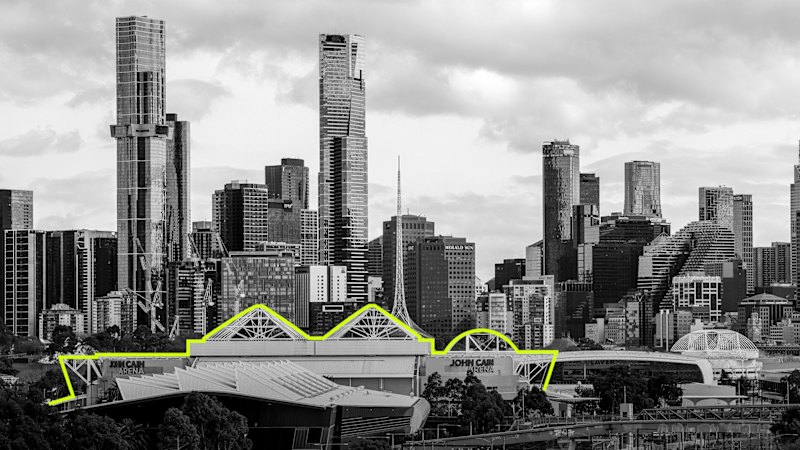
A velodrome lying dormant beneath the retractable seats of John Cain Arena is causing headaches at Melbourne Park, with secret plans drawn up to remove it and industry leaders contemplating knocking down the stadium and rebuilding it.
The arena, which holds up to 11,000 fans, opened in 2000 with a built-in 250-metre cycling track, which was included in the $65 million project with a view to securing the 2006 Commonwealth Games.
“The velodrome will enhance our reputation as the sporting capital of Australia and one of the great sporting capitals of the world,” Liberal MP Martin Dixon told parliament at the time.
The venue has since gone through numerous upgrades and name changes, and in recent years has hosted everything from bull riding to Cirque du Soleil, on top of its regular tennis, basketball and netball roster.
Notably absent from its eclectic roster, however, is one of the main sports the arena was purpose-built to host – track cycling. The timber velodrome remains mostly hidden beneath drop-down seating, unused since 2019.
Former Victorian sports minister Martin Pakula said he had no doubt if Melbourne Park authorities had their time again they would not build the velodrome, which he said was rarely used and took up thousands of seats of space.
He said at some point the arena would probably have to be rebuilt, ideally with the help of private investment and with greater capacity, though in his view, redeveloping the MCG remained the priority.
The space the arena sits on is limited by surrounding infrastructure, so if it were to be demolished and rebuilt, it would be unlikely to be able to expand significantly outward, though some extra capacity for fans could theoretically be built in.
A source not permitted to speak publicly told The Age that Development Victoria put together a plan a few years ago to phase out and remove the velodrome, and to upgrade the Joe Ciavola Velodrome at Darebin International Sports Centre. It is unclear where this plan ended up.
Several Melbourne Park stakeholders who spoke to The Age, also on the condition of anonymity, said it would be either impossible or extremely expensive to remove the velodrome as it was built into the original structure. Development Victoria has been contacted for comment.
Melbourne’s status as Australia’s sporting capital – and what the city needs to do to retain it – is central to Melbourne Assembly, a civic forum hosted by The Age next week, bringing together industry leaders, key decision-makers and the community to help shape the city’s future.
AusCycling said it was firmly against any moves to scrap the velodrome. The national cycling body currently hosts most of its major events in Victoria not at John Cain Arena, but at the Darebin facility, the construction of which was part-funded by the Melbourne and Olympic Park Trust.
When what is now known as John Cain Arena was being built, the Trust was required to make a capital contribution towards building a competition-grade velodrome in Darebin for training purposes as part of funding arrangements with the government.
AusCycling says Melbourne is the only city in the world with two premier indoor velodromes.
But as Joe Ciavola Velodrome can only seat up to 1000 people, if a bigger international meet came to town, it would need to be held at John Cain, which can seat about 4500 for track cycling events. Those, however, are few and far between. While Melbourne Park hosted the UCI Track Cycling World Championship in 2004 and 2012, Brisbane has secured it for 2030 at its Anna Meares Velodrome.
AusCycling told The Age it had been seeking a return for several years to the John Cain track – which it described as “one of the best velodromes in the world” – but had been unable to get confirmation of availability from venue managers.
Even when Victoria secured the ill-fated 2026 Commonwealth Games, the track cycling event was set to take place at Bendigo Showgrounds, where the government planned to construct a temporary velodrome. Commonwealth Games Australia chief executive Craig Phillips told a parliamentary inquiry he had questioned why the event was not taking place at John Cain, and suggested moving it there to save money, but the government was adamant it be held in regional Victoria.
AusCycling said the expansion of the basketball calendar had limited the venue’s availability. Despite its current lack of use, but it was hopeful it might be explored as a potential training venue for the 2032 Olympic Games.
But with John Cain Arena reaching the phase of its life where its infrastructure begins to be labelled “ageing”, there is a major question mark over whether it is worth the prime land it sits on.
“John Cain’s just not as good as Rod Laver Arena and Margaret Court,” Melbourne Park chief executive John Harnden said at an event about future-proofing the city’s event industry this month.
Elaborating on this, Harnden – a Melbourne Assembly panellist – later told The Age the seats and acoustics at John Cain were not up to scratch compared with the precinct’s other arenas, but refused to criticise the divisive velodrome.
In fact, he said if it had not been built, Melbourne Park would not have been forced to create such an adaptive seating arrangement for the arena, which he described as the most versatile in Australia.
“With the velodrome, different aspects of the seating were made removable, and different aspects of the seating was like put on almost a giant hinge, where they can just be rotated up into the ceiling, which has actually enabled to have it that enormous versatility and to be able to make those changes overnight,” he said.
“If it wasn’t there, you might be able to fit a few extra people in, but not materially … There’s probably the corner areas when you’re in basketball mode … But again, you need to weigh that up against the versatility that having the cycling track there has provided in how you’d move the seats because you probably wouldn’t have designed it the way it is designed without the cycling track. So it’s been a great win-win.”
However, an AusCycling spokesperson said switching the venue back to cycling mode took significant time and effort, which they felt was part of the reason they had struggled to gain access.
According to Harnden, though, this was more to do with the fact the velodrome itself requires maintenance.
“We opened it all up and had a look at it in [20]24 when we were doing some other maintenance in the venue, and saw that if we’re going to do some more cycling events ... we’d probably need to do some maintenance, which you’d expect not having used [it] for a couple of years,” he said.
“We’d be more than happy to host cycling again in the future if there was the right event and the right window to do it.”
While the cycling lobby held some sway with the state government back in the day, today it is small-fry compared with the likes of Tennis Australia. Undoubtedly the most important stakeholder at the precinct, the body has long pushed for greater control over Melbourne Park, including more permanent tennis infrastructure.
Speaking at his first Australian Open launch as the new head of Tennis Australia earlier this month, Andrew Abdo said he would consider any ideas to fit more fans into Melbourne Park come January.
“Clearly for us, space is a constraint we don’t want to have,” he said. “We want to continue working with the government to create more space in this precinct so that we don’t have to cap crowds … [and] looking for innovative ways in which we can keep creating more space, more shade and more seats.”
Music promoter Live Nation has also not been shy in putting forward its desires for the precinct. Australia and New Zealand president Alex Klos said a 20,000-capacity venue was at the top of his wish list to prevent Melbourne losing artists interstate.
With so many events keen to make use of the precinct, Harnden said versatility would continue to be the guiding star for development. He said his team was exploring a range of possibilities to achieve “the right and the appropriate mix and permutations for the precinct in the longer term”.
Melbourne Assembly will be held from October 19 to October 21. More information is available on the Melbourne Assembly website.
KioskNews shows a cleaned-up reading view extracted from the publisher’s page — the original always lives on their site, not ours.