‘In our deepest hearts we are voyeurs’: the paedophile-hunting show that inspired Robert Pattinson’s new film

A man from Long Beach, California, is here to have sex with someone he believes is a 13-year-old girl. When the journalist Chris Hansen walks in, the man’s stomach drops. He is caught, and it is the end of his life as he knew it. Hansen asks what his fate should be. “The electric chair?” he asks. No, replies Hansen. “Dateline NBC.”
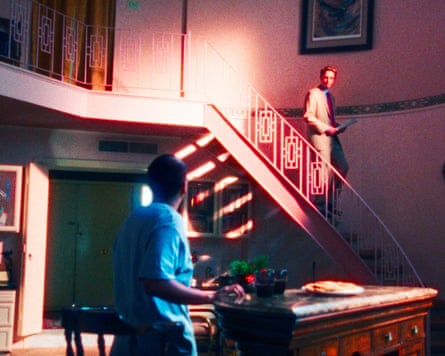
This is the opening scene of Primetime, a film directed by Lance Oppenheim, released in the US this week (a UK release follows on 30 October). It explores how a network news show turned sting operations into must-see television, raising a host of ethical questions about justice, voyeurism and society’s willingness to dehumanise certain offenders for profit and entertainment.
The swaggering Hansen is played by Robert Pattinson, whose recent movies include The Batman, The Drama and The Odyssey. He delivers a line that captures the film’s argument about a societal turning point: “There used to be a pillory in every village. Now, there’s a television in every living room.” But the real Hansen, 67, has branded the movie an “insult” and “identity theft” without having seen it.
Going head-to-head with ABC’s Lost in primetime, Dateline NBC’s To Catch a Predator was one of the defining TV hits of the US ratings wars of the mid-2000s, an era before streaming. The programme targeted men suspected of soliciting sex with minors in online chat rooms. Volunteers from the citizen watchdog group Perverted Justice posed as underage children, engaging adults in conversations and then arranging meetings at fake homes.
There, decoy actors playing the supposed teenagers would be waiting. The men would be confronted on camera by Hansen while police officers stood outside, ready to make arrests. The formula proved hugely successful. By the 2006-07 season, To Catch a Predator was averaging about 7 million viewers an episode, turning Hansen into a star with his own catchphrase: “Have a seat.”
David Osit, director of Predators, an acclaimed 2025 documentary about the show, says: “The show was sordid and creepy and amusing and you could find many different ways to relate to what was happening. You could identify with the parents, you could identify with Chris Hansen, you could identify with the schadenfreude of watching these men have the worst day of their lives.
“You can see that even in the marketing for Primetime: a lot of it’s reposting old clips of To Catch a Predator. It’s quite clear that this still has an effect on people because it is at this nexus of discomfort and basic human instinct. In our deepest hearts we are voyeurs and we enjoy discomfort from a safe vantage point and that’s what the show was able to offer people.”
But in 2006 the operation took a fatal turn. Bill Conradt, an assistant district attorney in Rockwall county, Texas, allegedly contacted a decoy posing as a 13-year-old boy but changed his mind. The team went ahead with the police operation at his home after he failed to appear at the sting house. Conradt killed himself as a local Swat team entered, with the television crew outside.
The episode prompted a lawsuit that was eventually settled out of court, as well as a series of journalistic investigations including reports by ABC’s 20/20 and Esquire journalist Luke Dittrich, whose 2007 article, Tonight on Dateline This Man Will Die, would later become a key source for Ajon Singh’s screenplay for Primetime. By 2008 To Catch a Predator had been cancelled.
But years earlier, local law enforcement agencies across the US had already been quietly wrestling with the dawn of internet solicitation. In Kentucky, then attorney general Greg Stumbo oversaw a series of state-led sting operations aimed at snaring men suspected of soliciting sex with minors.
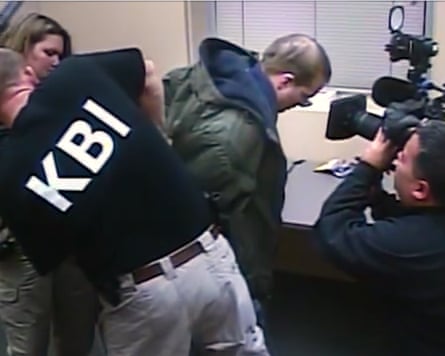
Working alongside local officials – including Jerry “Peanuts” Gaines, the sheriff of Bowling Green – Kentucky’s bureau of investigation used a young-looking female agent to pose online as an underage teenager. The state partnered with Perverted Justice to engage men in online chat rooms and lure them to monitored locations. The stings resulted in more than 20 arrests in Kentucky.
Stumbo recalls: “None of them had a criminal record. They were a firefighter, they were a university teacher – people that you just walk around and see every day on the street. It’s scary when you think about how many people like that there are out there who are predators for our children.”
Only after Kentucky authorities concluded their stings did Hansen and his Dateline NBC crew arrive in Bowling Green to carry out interviews. Stumbo notes that state prosecutors kept tight control over their files, refusing to hand over criminal evidence tapes to network producers while trials were pending. But the message sent to potential offenders, Stumbo says, was immediate: “The talk was, ‘Don’t go to Kentucky. They’ll catch you if you go to Kentucky.’ That’s what we wanted the talk to be, obviously.”

Asked whether the sting setup – and the subsequent television spectacle – crossed an ethical boundary into entrapment, Stumbo is adamant. “Nobody ever came to me and said that and it wouldn’t do any good if they did. We didn’t do it for that purpose. We did it because we wanted that word that was spread through that community of people who look at those types of situations: don’t come to Kentucky.”
And for the men caught on camera whose lives evaporated in an instant, Stumbo offers no quarter. “I’m a prosecutor. I probably am a little bit hard about stuff like that. I don’t find any excuse in that. Yeah, you feel sorry for anybody that stoops that low in life, but to intentionally want to go and do that type of activity with a minor, I have no sympathy for them.”
Perverted Justice, founded by Xavier Von Erck, was also the engine behind Dateline NBC’s To Catch a Predator. Von Erck’s relationship with national media began in early 2004, following a series of stings with local television stations. In a single week CBS’s 60 Minutes II, ABC’s Primetime Live and NBC’s Dateline NBC asked him to replicate his model on a national network scale.
Von Erck immediately knew which he would not choose. He says via email: “We had caught a national news producer for ABC News at our first sting in Milwaukee. He showed up to that very first sting house we ever did, and ABC News did not fire him despite our pressure campaign … So obviously I wasn’t going to work with Primetime Live.”
Von Erck managed volunteers remotely, screening chat logs and enforcing boundaries, while operatives Frag and Del Harvey worked inside the sting houses with Dateline NBC producers. He recalls one particularly disturbing suggestion from a producer: that a target be encouraged to get into a hot tub with one of the female decoys. “We said no.”
Von Erck fiercely defends Perverted Justice’s record, claiming more than 600 convictions, a 99.1% conviction rate and statutory changes in all 50 states. He dismisses accusations of entrapment, arguing that his operatives never made first contact and that convictions based on their evidence survived appeals.

He writes: “In fact, out of the dozens of cases in which convicted individuals desperately appealed to a higher court, convictions due to the evidence we supplied were *never* overturned. It is quite a silly notion to believe that someone can be ‘induced’ to want to sexually assault a 10-15 year old. It requires a specific predilection.”
He says he spoke to Hansen only twice and regards To Catch a Predator as fundamentally dependent on his group work. “Without my organization, there was no To Catch a Predator possible at that time,” he says. “It would have been a tall reporter standing inside of a house interviewing no one.”
That history is one reason Von Erck is so hostile to Oppenheim’s film. He accuses the filmmakers of inventing scenes, opinions and locations involving him. “I don’t regard ‘Primetime’ as being a movie made about the story of To Catch a Predator because from what I know from watching the trailer and reading reviews of the movie, it seems like most of the details of the movie are absurdly inaccurate when it comes to my organization in particular.
“It feels like an oddly and purposely malicious portrayal, especially of myself, given that every review I’ve seen that mentions the way they have portrayed me is literally something I did not do, things I never said, and places I never was ever even physically at. Frankly, I find it bewildering that they are using my legal name and semi-likeness while completely inventing every opinion, statement, act and physical location that they portray me as in the movie.”
The Guardian made repeated attempts to contact Oppenheim and Dittrich but without success. Hansen did not respond to requests for an interview. But he has used other platforms to condemn Primetime as an “insult” and complain that the actor Denis Leary would have been better casting than Pattinson.
In an interview with USA Today newspaper on Wednesday, Hansen said: “They wanted to exploit the brand that I’ve built over the last 45 years. You can decide whether that’s ethical or legal or identity theft or however you look at it. But it seems a little exploitive, as Hollywood often is.”
Intriguingly, he has also bought advertising for his true crime streaming network TruBlu to play before screenings of Primetime. The move strikes Osit, the director of Predators, as characteristically shrewd. “It does fit with the Chris Hansen I know,” he says. “That’s a savvy and intelligent thing to do for what Chris Hansen is interested in doing, which is to get people to see his investigations.”
Osit argues that when commercial news networks commodified vigilante justice, they established a precedent that has only accelerated in the age of social media and streaming. In modern iterations of the format, networks and digital streamers no longer feel compelled to blur the faces of suspects or provide traditional journalistic safeguards. He argues that ethical qualms have increasingly been swept aside.
“We’ve societally accepted that these men are not human beings. They’re not deserving of the same rights or protections that someone who committed a different kind of crime and has their face blown up on the internet might be. We’ve societally accepted it’s quite acceptable to shame these men and that is their punishment for this crime.”
Osit found Hansen to be a charismatic combination of both journalist and entertainer and does not think To Catch a Predator’s intentions were cruel. He admires Hansen’s ability to interact with people but does not agree with some of the ways that he conducts himself professionally.
“If Chris was interested in ending child predation, the investigations wouldn’t still be going on,” Osit comments. “That’s not what we’re doing here. However, Chris has been told by many, many people over the years that they’re grateful for his investigations and those people exist. There are also many people who think that those investigations are problematic and then there’s a lot of people in between.”
Ultimately, Osit contends, fixating on Hansen’s personal motives misses the more uncomfortable truths that To Catch a Predator exposed about its audience.
“The more interesting question than who is Chris is who are we? Why do we enjoy this show? What do we get out of the show? What is this show reflecting about the society we live in where we sexualise teenage girls so much and yet create circumstances where we will ask people to show up to a house because they think it’s safe and people are playing these games on the internet where they’re pretending to be different ages?”
Osit adds: “This is a world that we helped create as a society and those are more challenging questions to ask about who we are as human beings because it involves maybe interrogating how culpable we are in the culture that decides to treat young people as attractive objects for men who can’t get mental help to avoid being sucked into these issues. Those are questions that a movie is not going to deal with.”
-
Primetime is out in the US now, in Australia on 29 October and in the UK on 30 October
KioskNews shows a cleaned-up reading view extracted from the publisher’s page — the original always lives on their site, not ours.