Austria ‘ghetto’ language classes leave children behind
For two years after he first arrived in Austria, Iraqi pupil Abdlrahman Aljanabi did not follow maths, science and other subjects like the rest of his peers.
Instead, he was pulled out of his class every day for several hours to learn German under a flagship program meant to bring newcomers like him up to par with the national language.
However, an assessment has shown the program — long decried by critics as “ghetto” classes — leaves a number of pupils to repeat at least one school year, contributing to a relatively high number of over-age pupils in the Alpine EU member.

Abdlrahman Aljanabi, a 19-year-old student from Iraq, speaks during an interview in Vienna on Sept. 9.
Photo: AFP
“I was a bit lost, a bit upset ... because I didn’t understand why I was the only one who had to leave to go to another class,” said the 19-year-old refugee, who has yet to take his end-of-school exam.
The language classes differ from many other European countries where newly arrived pupils are fully immersed in the regular school system right away.
Introduced eight years ago under a conservative-far-right government, it was mandatory for schools to provide the program.
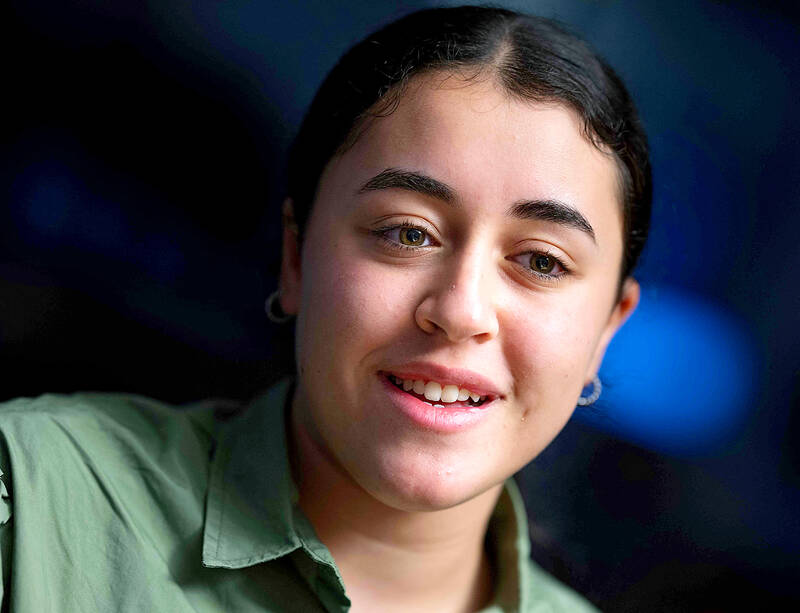
Judy Amer, a 16-year-old student from Egypt, speaks during an interview in Vienna on Sept. 9.
Photo: AFP
However, given the assessment that one-quarter of students who took the classes lose at least one year, the government has relaxed the rule from this school year onwards.
Schools can now decide for themselves how they want to support non-native German speakers, leading to half of them to abolish the separate classes.
However, their legacy is bound to stay for some years to come.
Austria has a comparatively large number of over-age pupils — those who are at least two years older than the intended age for their grade level — according to Organisation for Economic Co-operation and Development (OECD): figures.
From 2015 to 2023, the proportion of such pupils rose from 4.1 percent to 5.8 percent in primary schools and from 6.5 percent to 9.1 percent in secondary school, the OECD said.
In the last school year, there were almost 60,000 so-called “non-regular students” who had to take the special classes. In Vienna, this was one-fifth of children in elementary school.
Among them, 35 percent are from Syria and 27 percent from Ukraine, Austrian Integration Fund figures showed.
“When you arrive at a school, you just want to blend in,” said a 16-year-old Ukrainian student, who only gave his first name Makarii and who fled Kyiv in 2022 at the start of Russia’s invasion.
“You spend time in a group that is then dissolved, you lose your friends, and you don’t know the teachers in the regular class,” he said.
A recent assessment by the Austrian Ministry of Education found that 22 percent of 22,800 students deemed “non-regular” in the school year 2022-2023 had to repeat the year once and 3 percent twice.
Austrian Minister of Education Christoph Wiederkehr told the Austria Press Agency this was a “far too high” number.
The program leads to an “automatic repetition” of pupils who stay in it for a long time, because they are not graded in core subjects such as maths, and so cannot move up to the next level, University of Vienna expert Susanne Schwab said.
“As a consequence, it becomes apparent that students who attend German support classes are highly likely to suffer a significant learning delay, and repeating a grade is a real part of their educational trajectory,” said Schwab, who has studied the program’s effects.
The program, adopted against the “scientific consensus,” does not “create solutions, but generates additional problems,” she added.
A 2022 report by experts evoked “racist mechanisms” and “institutional discrimination... under the guise of language support.”
The country of 9 million inhabitants has long drawn people from poorer nearby nations, as well as asylum seekers, although numbers have slumped due to anti-migration policies.
The anti-immigration far-right Freedom Party (FPO) has already slammed the change of relaxing the rules for schools.
The FPOe won the last parliamentary elections, in 2024, for the first time, but it failed to find partners to govern.
KioskNews shows a cleaned-up reading view extracted from the publisher’s page — the original always lives on their site, not ours.