Legarda camp wants plunder complaint reconsidered
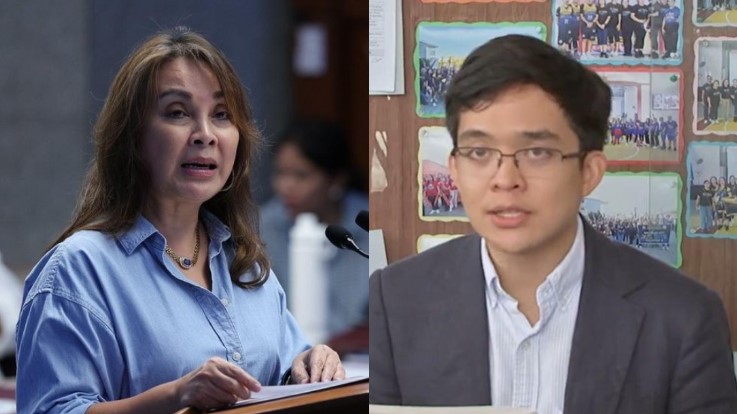
Senator Loren Legarda’s spokesperson, Atty. Tony La Viña, called on the Office of the Ombudsman to reconsider the plunder and graft complaints filed against the senator and her son, Congressman Leandro Leviste, saying there is "insufficient evidence" against them.
“We would like the government… especially the Ombudsman to reconsider at wag na nilang ituloy ito (not pursue this anymore),” La Viña said at a news forum on Friday.
According to La Viña, filing a case against Legarda and Leviste would fail to meet the Department of Justice’s (DOJ) new policy standard, which requires prima facie evidence with a reasonable certainty of conviction before a case can be filed.
“Yan din naman ang ano ni Ombudsman Remulla sa DOJ, ‘yung kanyang binago na standard—you do not file a case unless may reasonable certainty ka na maco-convict mo,” La Vina said.
(That’s also Ombudsman Remulla’s standard—or rather, the standard he changed at the DOJ: you do not file a case unless you have a reasonable certainty of winning a conviction.)
“Ito talagang walang certainty, walang reasonable certainty, walang possibility na ma-convict,” he added.
(In this situation, there is simply no certainty, no reasonable certainty, and no possibility of a conviction.)
'Benefit of the doubt'
La Viña previously described the Ombudsman’s probe into Legarda and Leviste as “lawfare,” or the weaponization of the law against government critics or opposition figures.
He noted that the timing of the complaint against Leviste is not dismissible, as it seems connected to, or triggered by, his earlier exposé on government corruption.
“Kung magpatuloy sila, I have to say, clearly political ito, di ba? This is lawfare, this is weaponization of the law… This is actually to stop Leandro Leviste speaking about corruption. And parang nag-succeed sila, ‘di ba? Kasi napatahimik nila right now, “ La Vina said.
(If they proceed, I have to say this is clearly political, right? This is lawfare; this is the weaponization of the law… This is actually intended to stop Leandro Leviste from speaking out about corruption. And it seems they succeeded, right? Because they managed to silence him for now.)
He added that they are currently giving the government the benefit of the doubt, assuming it merely made an error regarding the issue.
“So, lahat ito, sa tingin namin, benefit of the doubt, nagkamali lang sila. Please reconsider. Please look at your invoices, please look at your bills, please look at the documents. ‘Yun ang una naming hinihingi,” the spokesperson said.
(So, considering all this, we are giving them the benefit of the doubt that they just made a mistake. Please reconsider. Please look at your invoices, please look at your bills, please look at the documents. That is what we are asking for first.)
Legarda and Leviste are facing plunder and graft complaints in connection with the latter’s solar energy projects valued at P10.44 billion. They have both denied the allegations and filed a counter-affidavit answering the complaint.
Legarda has been on medical leave since August 3 to undergo treatment for a lung illness.
She requested to extend her leave until October 9 as she continues her treatment in France, where she is currently being cared for by Leviste.
‘No criminal act'
La Viña also denounced allegations that Leviste should be held accountable for the non-implementation of the Solar para sa Bayan project, explaining that he never received the required implementing rules and regulations from the Department of Energy (DOE), which subsequently led to the revocation of his solar project’s franchise.
“Totoo ba na hindi na-implement yung Solar ng Bayan? Totoo, kasi ‘di naglabas ‘yung DOE ng rules and regulations and ng places ng mga lugar kung saan ito i-implement,” La Viña said.
(Is it true that Solar para sa Bayan was not implemented? Yes, that’s true, because the DOE failed to issue the rules, regulations, and specified locations where it should be implemented.)
“Because the law provided na once na in 2 years kung ‘di mo siya maimplement… automatically revoked ang franchise mo. Na-revoke siya. Uulitin ko, hindi kasalanan ni Leandro Leviste [at]... hindi kasama si Loren Legarda sa pag-approve, in fact, nag-inhibit siya,” he added.
(Because the law specifies that if you fail to implement the project within two years… your franchise is automatically revoked. So it was revoked. I repeat: this is not Leandro Leviste’s fault, [and] Loren Legarda had no part in approving it—in fact, she inhibited herself.
La Viña also denied claims that Leandro owes P10 billion or P24 billion in debt, adding that he does not hold a monopoly on renewable energy contracts, as his projects account for only about 10% of the market.
He reiterated his previous stance that the lawmaker is an out-of-the-box innovator whose sole intention is to accelerate the country's solar energy industry.
“I want to make it clear: walang kasalanan, walang criminal act na kinommit ‘yung bata, innovator lang siya out-of-the-box lang siya, minsan hindi naiintindihan yung mga moves niya kasi panibagong mga moves, pero importante yung motivation niya to accelerate the solar transition or the just energy transition in the Philippines,” La Vina said.
(I want to make it clear: the young man committed no crime, no criminal act. He is simply an out-of-the-box innovator. Sometimes his actions aren't immediately understood because they are novel approaches, but what matters is his motivation to accelerate the solar transition or a just energy transition in the Philippines.)
Regarding Legarda, he emphasized that the senator should not be implicated simply because she is Leviste’s mother.
“Having said that, the only accusation against Loren Legarda is nanay ka ng bata,” La Vina said.
(Having said that, the only accusation against Loren Legarda is that she happens to be the young man's mother.)
Investors
The spokesperson also stressed that this issue is crucial for renewable energy investors looking to invest in the country, warning that these cases could discourage investors who might fear prosecution if a project does not push through—a common outcome if a project proves unviable after assessment.
“These cases, if they are filed, will be a signal to all the renewable energy investors, ‘Wag na kayong pupunta sa Pilipinas, kasi mapa-plunder kayo ‘pag ‘di kayo magpatuloy sa project ninyo,’” La Vina said.
(If these cases are filed, it will send a signal to all renewable energy investors: ‘Do not go to the Philippines, because you will be charged with plunder if you fail to complete your project.’)
“And natural ’yon na consequence… regular ‘yon na sitwasyon na ‘di magpapatuloy beyond predevelopment kasi hindi siya viable— walang lupa, walang araw, walang hangin, may katutubo, may magsasaka hindi maka-connect sa grid, maraming dahilan bakit hindi tumutuloy,” he added.
(And that is a natural consequence… it is a normal occurrence for a project not to move past the pre-development stage if it turns out not to be viable—whether due to lack of land, lack of sunlight or wind, issues with indigenous communities, farmers, or grid connectivity challenges. There are many reasons why projects do not proceed.) —VAL, GMA News
KioskNews shows a cleaned-up reading view extracted from the publisher’s page — the original always lives on their site, not ours.