‘Nobody else is going to save us’: the direct action group taking on the UK’s banks, bailiffs and water firms

Yasmin didn’t expect to find herself sitting across a negotiating table from executives at one of Britain’s biggest water companies. But her growing frustration with her water bills had led her to launch a national campaign.
The 34-year-old single mother from Manchester had endured unexplained charges and a nine-month wait for a water meter. She went to the community union Acorn to propose a campaign that would in time force four major water companies into negotiations. United Utilities eventually apologised for its handling of her case and credited £250 to her account.
It is the latest in a series of direct actions by Acorn targeting the cost-of-living crisis, from challenging councils over bailiffs to confronting banks over housing policies. Rather than wait for government intervention, members say they are taking matters into their own hands and forcing powerful institutions to negotiate directly with them.
“Joining the union has given me so much confidence,” Yasmin said. “Because nobody else is going to save us. We can only save ourselves, right? And save each other.”
Founded in Bristol in 2014, Acorn began by organising renters against rogue landlords and evictions, before expanding into wider cost-of-living campaigns. Its members propose, debate and vote on campaigns at branch level, with issues of wider significance referred to regional or national committees made up of elected members. National campaigns can also be proposed at conferences and put to a membership vote.
On 20 August, Acorn staged nine protests as part of its national Dignity Not Debt campaign, forcing Yorkshire Water, Severn Trent, United Utilities and Welsh Water into negotiations and securing concessions.
Yorkshire Water agreed to stop sending bailiffs after vulnerable customers, while Welsh Water pledged not to use artificial intelligence to make debt-collection decisions or contact vulnerable people.
United Utilities committed to avoiding AI in customer dealings and establishing a direct route for Acorn members to resolve complaints. Severn Trent agreed to explore writing off debts accumulated since September 2021 and widening access to discounted bills for low-income households.
Andy Burnham’s government has offered a £100 payment to help 20 million households with soaring energy bills, but the prime minister has since said his first budget did not go far enough.
Acorn members are testing whether collective action can achieve what politicians say they cannot.
In Bristol, members have spent two years campaigning against the council’s use of bailiffs to recover unpaid council tax and other debts.
After negotiations produced what they considered an inadequate offer, they voted to escalate their campaign, disrupting a full council meeting and prompting its cancellation.
Sam Kidel, Acorn’s south-west area organiser, said the council had previously promised to protect people who received council tax reductions from bailiff action, but campaigners wanted those protections extended to other low-income and vulnerable residents.
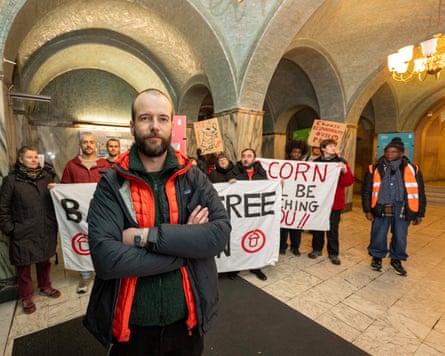
“There’s people getting a £30 parking fine and then it’ll get sent to the wrong address, or the person doesn’t open the letters because they’ve got mental health issues,” he said. “And then they end up getting bailiffs sent and the bailiffs add hundreds of pounds of fees on top.”
Sam said the organisation’s experience showed why members were unwilling to rely solely on politicians to tackle rising living costs.
“We don’t feel like our democracy is working. If it was working, we wouldn’t be constantly being pushed into debt by energy bills, by rising council tax, by rising rents,” he said. “So we’re not going to wait around for politicians to sort that out.”
He pointed to a previous national campaign against TSB, in which Acorn targeted 32 bank branches over mortgage conditions restricting the length of tenancies landlords could offer. Within days, he said, the bank entered negotiations and agreed to change the policy.
In Leeds, Usman Akhtar, 26, the chair of Acorn’s local branch, helped organise a blockade of a Yorkshire Water facility near Bradford.
Growing up in a cold, mouldy flat with his brother and single mother had drawn him into housing activism. But conversations with residents revealed how often housing insecurity was compounded by utility debts.
“Acorn being a direct action group, a community union, means when you talk about something, you actually take action to get it,” he said. “We do have the power in our own hands to create the sort of change we want in our own communities.”
Yorkshire Water, Severn Trent, United Utilities, Welsh Water, Bristol city council and TSB have all been contacted for comment.
KioskNews shows a cleaned-up reading view extracted from the publisher’s page — the original always lives on their site, not ours.