ENERGY DISPUTES : SA’s nuclear push at COP31 draws activist opposition and legal threats
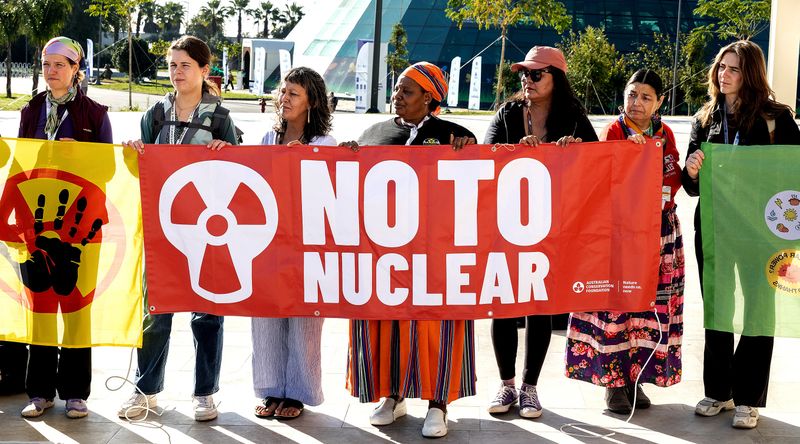
Nuclear energy is a contentious topic, both in South Africa and internationally. At the 31st Conference of the Parties (COP31), now under way in Antalya, Turkey, battle lines have been drawn over ambitions to increase electricity generation from nuclear power stations, with several nation-states on one side and activists on the other.
So when SA’s Electricity and Energy Minister Kgosientsho Ramokgopa announced the country’s ambition to build 5.2 GW of new nuclear capacity, it naturally caused a stir among South African activists at the global climate talks.

On 10 November, Ramakgopa announced that Eskom had submitted a feasibility programme for the new nuclear energy programme. This aligns with South Africa’s Integrated Resource Plan (IRP) 2025, which targets 5.2 GW of new nuclear capacity by 2039, with construction set to begin around 2028.
“The department is preparing a proposed determination for public participation. We will put the case for additional capacity before the public and consider submissions on their merits. It should not be an in-principle objection, an obsession with one energy technology over the other. It must be on the basis of merits, and merit is anchored on science and evidence,” Ramokgopa said,
While the department has not yet decided what technology it will use to meet its 5.2 GW ambitions, it will consider both small modular reactors and traditional reactors in its nuclear plan.
In addition to the new nuclear plants, the Department of Electricity and Energy is developing a case to expand the nuclear program to 10 GW.
Civil society rejects nuclear energy
Nuclear energy is a bit of a grey zone through a climate and environmental lens, though the exact shade of grey depends on which environmental metric you prioritise.
From the climate perspective, near-zero carbon emissions make it a desirable transitional energy source for many countries. Nuclear emits roughly the same amount of greenhouse gases (GHGs) per kilowatt-hour as wind power. This is around 12 grams of CO2 compared with 490g for gas and 820g for coal.
However, nuclear becomes a lot greyer from an environmental perspective. Traditional environmentalists argue that creating multimillennial toxic waste and risking land contamination violates core sustainability principles, especially when renewables are now cheaper and faster to deploy.
Speaking at a side event at the COP31 negotiations, EarthLife Africa executive director Makoma Lekalakala said that nuclear energy was a “false solution” to the climate crisis.
Lekalakala, alongside eco-justice lead for the Southern African Faith Communities’ Environment Institute Liz McDaid, took the South African government to court in 2015, resulting in the Western Cape Division of the High Court in Cape Town ruling the R1-trillion ($76-billion) secret nuclear deal with Russia unlawful and unconstitutional, and effectively nullifying it two years later, in 2017.
Speaking on an international panel examining the push to triple global nuclear capacity, Lekalakala warned that new nuclear proposals threatened environmental integrity and public accountability, particularly in a country grappling with severe energy poverty.
“Where waste is stored in Namaqualand, we have seen the destruction of the environment, and we have seen the impact on the health of the people that live around that area. Radioactive waste takes hundreds of thousands of years to deactivate,” Lekalakala said.
Court action
She said civil society was gearing up to take the Department of Electricity and Energy to court and would use South Africa’s Climate Change Act to challenge the expansion of nuclear energy. Comparing the timeline to South Africa’s delayed coal mega-projects such as Kusile, she questioned whether new reactors would deliver power in time to help current generations.
“Are they not aware of the commitments that South Africa has made? Are they not aware of the legislative and regulatory framework that does not allow them to continue building another mega-infrastructure project that is time-intensive, dangerous, and will take more than two to three decades? We may not even access electricity from that in our lifetime, if ever it is completed,” she said.
While the Climate Change Act mandates the South African government to coordinate a low-carbon, climate-resilient transition, it does not prescribe a specific technology mix for electricity generation.
The Act legally compels the government to align all energy planning, policy, and infrastructure decisions with a binding national greenhouse gas (GHG) emissions trajectory and a long-term just transition to a low-carbon economy.
Cost of nuclear
Beyond the arguments about the potential environmental cost of disposing of nuclear waste, the real issue is the cost of getting a nuclear power station online.
While nuclear is cheap to operate, it is expensive to build. Just Transition adviser to Power Shift Africa Kuda Manjonjo says that is a prime example of why generating electricity from nuclear is not the best option for South Africa.
“I do know that this is the third or fourth iteration of this nuclear plant. And the answer is simple: if they say they don’t have money, where will you get the money for nuclear and who will pay for it? And the numbers are quite clear on the continent. So it’s not even a technology argument; it’s a simple financial argument,” Manjonjo said.
Referring to South Africa’s vast solar and wind potential, Manjonjo said governments should abandon costly mega-projects in favour of bottom-up, locally controlled renewable energy systems.
“Solar is by far the cheapest. Wind is by far the cheapest, especially in South Africa and southern Africa — in the Western Cape, Namibia, we get some of the best sun; if anything, it’s too hot. So why would we do nuclear when we have this option that’s way more expensive?” he added.
Case for nuclear
As the debate over the role of nuclear in South Africa’s just energy transition continues, Dr Jonathan Cobb, senior programme lead for climate at the World Nuclear Association, argues that governments must plan across multi-decade horizons rather than relying solely on short-term renewable deployments.
Cobb said that rising global electricity demand required a balanced mix of all low-carbon technologies, including nuclear energy.
Responding to Daily Maverick’s questions about negative public perceptions of nuclear power in South Africa, Cobb noted that global sentiment had shifted markedly over the past five years as nations confronted energy security challenges and unpredictable fossil fuel prices.
“The overall positive sentiment in comparison to negative sentiment on nuclear energy has actually been moving in a more positive direction, certainly over the last five years, when the benefits of nuclear energy for providing secure electricity and also having much more stable pricing than fossil fuels are something that countries around the world have experienced. People who are having to pay more for their electricity are also growing in their understanding and appreciation for nuclear energy,” he said.
With electricity consumption projected to climb steadily over the next 10, 20, and 30 years, Cobb said that meeting 2050 climate and reliability goals required deploying renewables rapidly where feasible, while building out nuclear capacity for the long haul.
“What countries should be doing is analysing what is going to happen to their energy systems over those kinds of time frames and putting together energy policies that are going to deliver the best energy mix for those countries, most cost-effectively, with the most reliability, and also the best environmental performance they are going to want to meet by 2050,” he said. DM
KioskNews shows a cleaned-up reading view extracted from the publisher’s page — the original always lives on their site, not ours.