Foreign workers for hotel industry arrive
LANGUAGE SKILLS: One worker said he chose Taiwan to improve his Mandarin, which could make him more competitive in the labor market in Indonesia and abroad
The first group of foreign skilled workers recruited for Taiwan’s hospitality sector arrived yesterday from Indonesia, as part of a government program aimed at easing labor shortages in the hotel industry.
The 35 Indonesians recruited by Regent Taipei arrived at Taiwan Taoyuan International Airport under the Cross-border Workforce Enhancement Program, which Taiwan launched in January to allow hospitality businesses to recruit foreign skilled workers.
At a welcoming ceremony at the airport, Cross-Border Workforce Recruitment Center Deputy Director Huang Wei-cheng (黃偉誠) said that the new category of foreign skilled workers is “different from general migrant workers.”
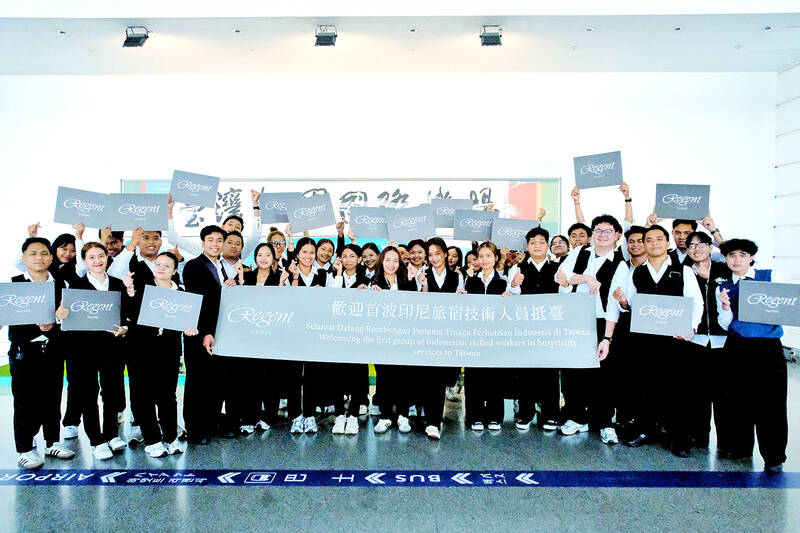
Indonesians who are to work at the Regent Taipei pose for a photograph upon their arrival at Taiwan Taoyuan International Airport yesterday.
Photo: CNA
Their jobs “require a certain level of technical skill,” while they must also meet requirements for education, skills and language ability, he said.
The 35 Indonesians — mostly in their 20s — had previously spent at least a year interning in Taiwan and are required to obtain at least A2-level Mandarin speaking or listening proficiency within three years of starting work in Taiwan, he added.
Citing figures from the Tourism Administration, Huang said Taiwan’s hospitality sector faces an annual labor shortage of about 6,000 workers.
Regent Taipei human resources group director Jason Feng (馮昌俊) said the workers had returned to Indonesia after completing their internships, during which they had all “performed well.”
Regent remained in contact with them and approached them individually after the new program became available, he said, adding that the workers would mainly return to the departments where they previously worked as interns, including food and beverage and housekeeping.
“Previously, they were interns. Now they are becoming full-time employees,” Feng said, expressing hope that they could develop their careers at Regent.
Regent had previously been approved to hire 37 Indonesians.
Indonesian Economic and Trade Office to Taipei (IETO) Representative Arif Sulistiyo said that two workers did not pass the required medical examinations and are expected to arrive with a later group.
He called it “remarkable” that Indonesian workers were the first to benefit from Taiwan’s decision to open its hospitality sector to foreign skilled workers, saying Indonesia was ready to supply more experienced workers.
The program is “zero cost” for the Indonesian workers, with recruitment-related expenses borne by employers, Arif said.
The IETO had already received “several job orders” from other hotels in Taiwan and was in the process of verifying them, he added.
Among the workers is 19-year-old Martin Lawrence, who said one of the biggest differences he noticed between working in Taiwan and Bali was workplace discipline, which he found stricter in Taiwan.
He also identified Mandarin as his biggest challenge.
“We have to keep upgrading our language [skills] continuously,” particularly when communicating with hotel guests who use words he does not yet understand, he said.
Another worker, I Nyoman Miyoga, 23, said improving his Mandarin was one reason he chose Taiwan, as the language could make him more competitive in Indonesia and abroad.
“If possible, three years. If I am comfortable, then maybe I will continue,” he said when asked how long he planned to stay.
Under the program, hotels that raise the wages of their lowest-paid full-time Taiwanese rank-and-file workers by at least NT$2,000 can receive a quota for one foreign skilled worker for each eligible Taiwanese employee given the pay raise.
As of the end of last month, more than 60 hospitality businesses had applied to conduct domestic recruitment, with recruitment certificates issued for staffing shortfalls totaling more than 600 workers following the required domestic recruitment process, Huang said.
The figure does not represent the number of foreign skilled workers to be hired, as employers must still obtain eligibility certification, with quotas tied to pay raises for local workers and capped at 10 percent of their workforce, he said.
KioskNews shows a cleaned-up reading view extracted from the publisher’s page — the original always lives on their site, not ours.