LeBron James is everything Philadelphia wants. And everything it can’t stand | Bryan Armen Graham
Philadelphia has always had an instinctive affinity with athletes who embrace the grind over the glamour. In a place where sports mean a little too much, commitment has traditionally counted for more than celebrity. What it demands above all, sometimes unreasonably, is the sense that they have bought in, that the city and its fortunes matter to them as much as they do to the people who devote their lives to backing its teams.
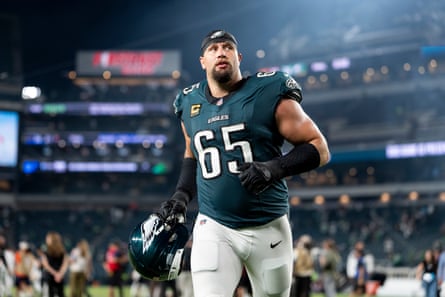
Few embodied that ethic more completely than Lane Johnson, the Eagles’ revered right tackle and best player for more than a decade, who abruptly announced his retirement Tuesday after 14 seasons, two Super Bowl titles and a career spent neutralizing some of the most freakish physical specimens to walk the earth. Johnson’s quotidian greatness on the offensive line was almost perversely workmanlike. According to Pro Football Focus, he allowed just 10 sacks across close to 7,000 pass-blocking snaps in the last 13 years, going entire seasons without letting his man bring down the quarterback. The Eagles won nearly two-thirds of their games when he played and lost nearly two-thirds when he didn’t.
Surely a first-ballot Hall of Famer when he’s eligible in 2031, he earned a place in the first rank of Philadelphia sporting legends alongside Mike Schmidt, Julius Erving and Bobby Clarke, despite playing a position where success is largely measured by how little anyone notices you. But perhaps the most revealing thing Johnson did was decide when to stop. At 36, he walked away from millions in future earnings to prioritize his mental wellbeing and focus on his parents’ health. For a man who made his living holding the line, there was something fitting about knowing when to let go.
Johnson’s departure comes at a particularly anxious moment on the local sports scene. The ageing Phillies’ desultory wildcard exit against the Atlanta Braves last week marked a fifth consecutive playoff appearance with diminishing returns. The Flyers have opened their season with five straight losses, splashing cold water on the mounting optimism that had surrounded them. The Union have US soccer’s most exciting prospect in generational talent Cavan Sullivan, but they remain a decidedly niche concern in a town dominated by its four traditional major-league teams. And the Eagles, almost comically beset by injury and suddenly without one of their franchise cornerstones as they travel to London this week, appear consigned to a rebuild. Across the city, the sensation is less of a championship window closing than of several slamming shut at once.
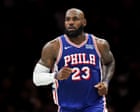
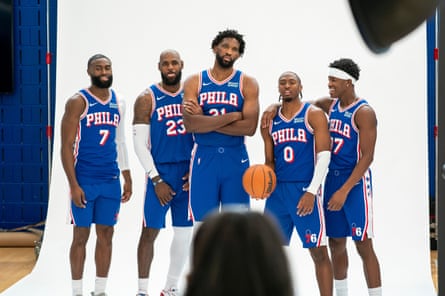
All of which has left the new-look 76ers, who debuted their tricked-out starting five on Thursday night in Brooklyn, carrying an almost inordinate share of the city’s sporting hopes. The timing makes for an uncomfortable juxtaposition. Philadelphia is losing an athlete who spent 14 years making the city his own, just as it welcomes the greatest basketball player to ever live, who has given precious little indication that he intends to do the same.
The Philly sporting identity has always been shaped by its uneasy relationship with New York, the northern neighbor that eclipsed it as America’s commercial and cultural capital a long time ago and has spent the intervening centuries reminding it of that fact. That history has bred a peculiar combination of civic pride and insecurity, a conviction that Philadelphia is entitled to better and a gnawing suspicion that deep down it doesn’t even deserve it. The 76ers, third on the NBA’s all-time wins list, haven’t won a championship since 1983, spending more than four decades watching Boston and Los Angeles pile up the sport’s prizes. The city’s athletes are expected to understand that burden, or at least pretend to share it.
James admitted at last month’s media day that Philadelphia had not been his preferred landing spot in free agency. The 41-year-old had dreamed of finishing his career at Madison Square Garden, only to abandon the idea after the Knicks ended their 53-year title drought in June, wary of being perceived as a ring-chaser. For a city that has spent generations bristling at New York’s perceived superiority, the confession carried a particular sting. Nearly a century after WC Fields quipped that he would rather see Paris before he died but Philadelphia would do, the NBA’s most famous star appeared to have reached the same conclusion. Even now, James seems reluctant to commit to the place geographically. Asked where he would live, he answered: “Both. Multiple residences.” That apparently means commuting from New York in a Fanatics-branded helicopter that gets roughly 1.6 miles to the gallon.
Allow Instagram content?
This article includes content provided by Instagram. We ask for your permission before anything is loaded, as they may be using cookies and other technologies. To view this content, click 'Allow and continue'.
The Leonardo AW139, supplied through his sponsorship arrangement with Michael Rubin’s sports merchandising empire, has become James’s preferred mode of transport between the two cities. Publicly available flight-tracking data showed 18 trips between Manhattan and Northeast Philadelphia Airport in the first days of October alone. Never mind that Amtrak’s Acela service connects the cities in about 90 minutes, with comfortable seats, wifi and enough legroom even for a 6ft 9in basketball player.
The environmental optics have raised eyebrows. The AW139, according to a Defector report, is unusually emissions-intensive, even by the standards of private helicopters. But in Philadelphia, the symbolism is as offensive as the carbon footprint. It’s hard to imagine a more exquisitely calibrated insult to the city’s sporting psyche. Philly fans have never cared much where their sporting heroes come from. What matters is whether, somewhere along the way, they come to regard the city as their own. Johnson gave the city 14 years of his body, his loyalty and his labor. James appears determined to give it his working hours.
Which is fine. James isn’t the first gun-for-hire to find himself in an arranged marriage in the winter of his career. Yet the helicopter is merely the latest indignity in James’s increasingly depressing transformation from athlete-activist into walking corporate billboard. Not so long ago, James was helping lead More Than a Vote, the organization he co-founded in 2020 to combat voter suppression, register voters and mobilize Black communities. He leveraged his extraordinary celebrity to encourage civic participation and tell people that their voices mattered. It was a meaningful demonstration of what an athlete with virtually unlimited cultural influence could accomplish. Six years later, he’s hawking online gambling and brown liquor.
His reported $15m-a-year partnership with Polymarket, a prediction-market platform encouraging ordinary marks to wager on everything from basketball to elections to war, is all the more dispiriting. The mainstreaming of prediction markets, and the relentless creep of gambling into news, politics and virtually every corner of society, are one of the bleaker developments in American public life. The same cultural capital that once encouraged people to participate in democracy is now being deployed to encourage them to speculate on it with their disposable income, all so a handful of techno-fascist investors can become obscenely rich. His involvement with Fanatics, with its ever-expanding connections to the gambling industry, makes the whole spectacle even harder to reconcile with his cultivated image as a socially conscious athlete. It’s the kind of corporate exploitation couched in cultural legitimization and the aesthetics of cool that feels ripe for a Spike Lee satire … were the Bamboozled director not appearing in glossy Polymarket ads himself.
Nobody begrudges James the fortune his extraordinary talent and longevity has earned him. Nor should anyone expect professional athletes in his echelon to move like ascetics. His philanthropic work, most notably the I Promise School in Akron, remains meaningful regardless of what and who he chooses to align himself with. But there’s something grotesque about the NBA’s first active billionaire collecting millions more to promote an industry fueling an emerging public-health crisis, while burning extraordinary quantities of fuel to avoid the mild inconvenience of the train.
Johnson spent 14 years protecting Philadelphia’s quarterbacks before deciding there were things more important than football and money. James has accumulated enough wealth to say no to almost anything, yet he keeps finding reasons to say yes. Perhaps that’s the most lamentable part of the spectacle: a man who once seemed determined to change the world now seems more concerned with what it will pay him to fly over it.
KioskNews shows a cleaned-up reading view extracted from the publisher’s page — the original always lives on their site, not ours.