Athens to Washington: What is the ‘Thucydides Trap’ Chinese President Xi keeps invoking
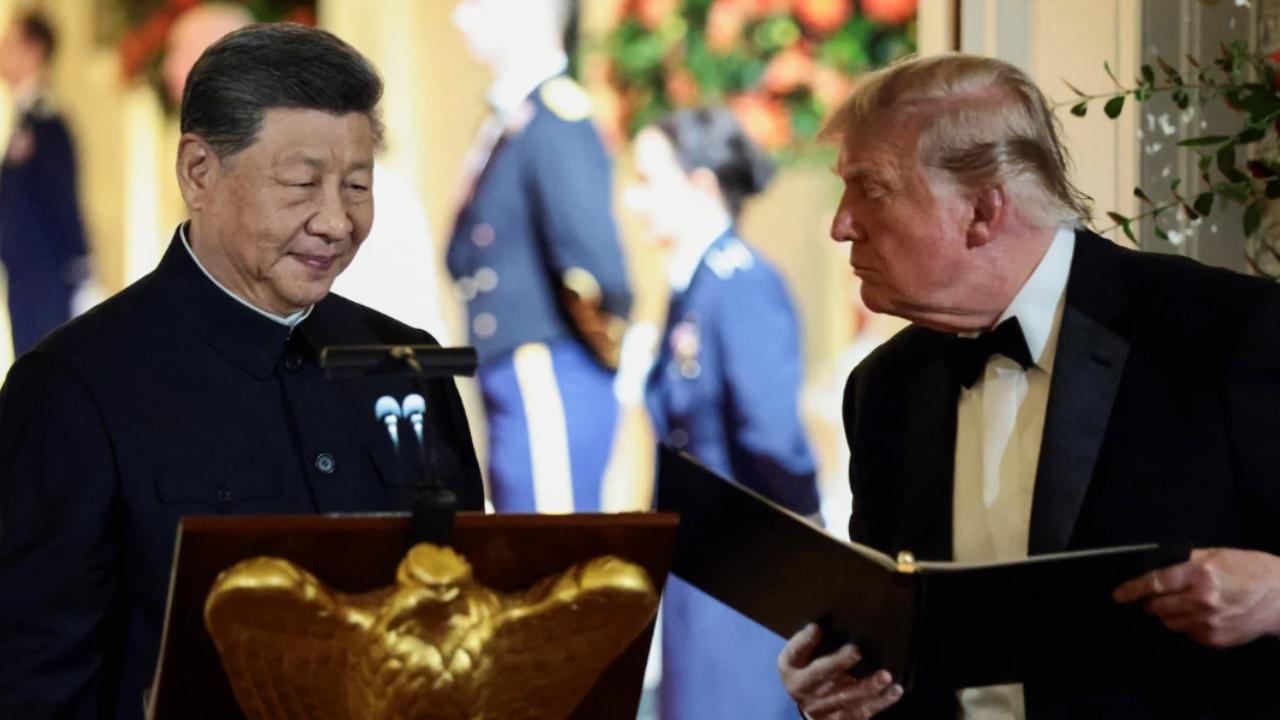
US President Donald Trump hosts state dinner for Chinese President Xi Jinping at the White House
Chinese President Xi Jinping, during his meeting with US President Donald Trump, revived discussion over the “Thucydides Trap,” an idea used to describe the tensions that can arise when a rising power challenges an established one.For Xi, the message is not that conflict between China and the US is inevitable. Rather, he has repeatedly used the concept to argue that the two countries must find a way to co-exist as China’s economic, technological and military power grows.Xi also raised the same idea when Trump visited China in May.
What exactly is the Thucydides Trap?
The term was popularised by Harvard political scientist Graham Allison in the early 2010s. He drew on the work of Greek historian Thucydides, who wrote about the Peloponnesian War.Allison argued that history has repeatedly shown what can happen when a rising power begins to challenge an established one: the resulting tension can lead to conflict.He identified this pattern across history and used it to look at the growing rivalry between China and the US. At its simplest, the idea is about the pressure created when an emerging power starts to challenge a country that has long held the dominant position.
In the case of China and the US, China's growing economic, technological and military strength has challenged America’s long-standing position as a global superpower.The concern is that even if neither country wants a confrontation, competition between the two could create tensions that become increasingly difficult to manage.
From Athens and Sparta to China and the US
The concept takes its name from Thucydides, a Greek historian who lived in the 5th century BC.Thucydides described the Peloponnesian War as an inevitable clash between Athens, which was rising as a power, and Sparta, the established superpower of the time.More than two millennia later, Allison used that account to coin the term “Thucydides Trap”.
Why Xi keeps using the phrase?
Xi’s references to the concept go back to at least 2014, according to Zichen Wang, a Beijing-based analyst who has researched the Chinese leader’s past references to the framework.He also used the term during a meeting with US President Joe Biden in November 2024 on the sidelines of the APEC gathering in Peru.Xi’s message has remained broadly consistent: China does not see conflict as inevitable and says the two sides should find a way to live alongside each other.Beijing has often described that approach in terms of “mutual respect” and “win-win cooperation”.But the phrase also serves a broader purpose in how China presents its relationship with the US. By framing the relationship through the Thucydides Trap, Beijing places tensions over China and the US on a much wider footing than individual disputes over trade or Taiwan.It turns the relationship into a test of how two major powers can deal with each other as their interests and influence increasingly overlap.The language also underlines Beijing’s view of China as a peer of the US rather than a subordinate power. Xi put that idea directly to Trump when he asked whether the two countries could “create a new paradigm of major country relations?”US policymakers have generally been more cautious about the term. In Washington, the focus has instead tended to be on guardrails and managing risks between the two powers.
Has this happened before?
Allison’s research identified 16 cases over the past 500 years in which a rising power threatened to displace a dominant one.
Twelve of those cases ended in war.The period leading up to World War I is one example. Germany was seeking to expand its military strength in Europe and build its own overseas empire, putting increasing pressure on its relationship with Britain, the leading power of the time.Another example is the Thirty Years’ War in the 1600s. It followed growing tensions between emerging Protestant powers, initially a group of German and Dutch states, and the established Catholic power, the Holy Roman Empire.
Allison has argued that China’s growing strength could similarly challenge US influence, creating a rivalry that could eventually lead to armed conflict.
The bottom line
The historical pattern does not mean every such power transition ends in war.There have been cases where major powers have co-existed peacefully. In the last century, the US overtook the UK as the leading military and political power, and the transition was relatively smooth.Germany also regained significant power in Europe after reunifying in 1990, following its division after World War II, without triggering a conflict.The Cold War offers another example. The US and Soviet Union remained locked in a bitter rivalry, but it did not escalate into a full-scale war between the two superpowers, although they did clash through proxies.For the same reason, some analysts are still sceptical of the Thucydides Trap as a way of explaining war, arguing that the concept can oversimplify the causes of conflict and question how useful it is for understanding the relationship between China and the US.
KioskNews shows a cleaned-up reading view extracted from the publisher’s page — the original always lives on their site, not ours.